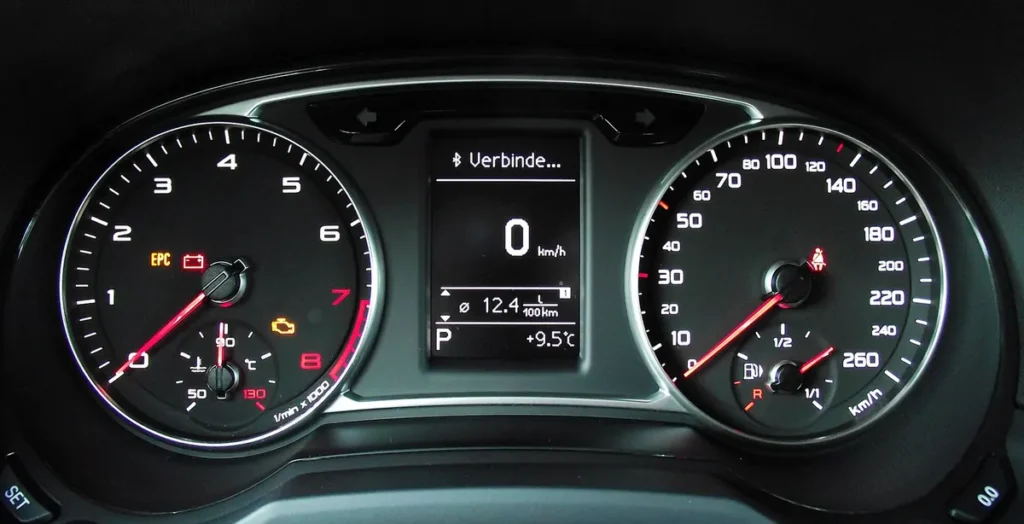
The Audi EPC light is a warning that worries many Audi owners, because it can appear suddenly, sometimes together with the check engine light, and the car may suddenly feel down on power. EPC stands for Electronic Power Control, Audi’s electronic throttle and engine-power management. The lamp itself does not name a failed part. It tells the driver that a control unit has detected a fault serious enough to report.
This guide explains what the EPC light means on an Audi, whether it is safe to keep driving, the most common causes, the fault codes Audi lists in its own technical service bulletins (TSBs), the US recalls whose official reports mention the EPC lamp, realistic repair costs in US dollars and how to reset the warning properly. It covers mainstream Audis as well as S and RS models, and it is part of the AMGRSM Audi RS problems and reliability hub. Every bulletin and recall cited here is an Audi or NHTSA document, linked where it is used.
Short answer: A yellow EPC light means the engine management system, or a module that talks to it, has logged a fault. If the car drives normally, drive gently and have all control modules scanned soon. If the car has lost a lot of power, is shaking, or shows a red warning or “Drive system: malfunction! Safely stop vehicle,” stop safely and arrange a tow. Common causes include throttle and pedal sensor faults, a failing brake light switch, misfires, boost or vacuum leaks and software faults that Audi has addressed through bulletins.
Audi EPC Light at a Glance
The table summarizes the causes with the strongest documentation. Each one is explained below, and the costs are collected in a separate section.
| Cause | Typical clues | Main evidence |
|---|---|---|
| Throttle body or accelerator pedal sensor fault | Low power, poor throttle response, stalling, throttle-related codes | Cartech UK, RAC, Audi bulletin 2018260 |
| Brake light switch | EPC light, P0571, brake lights or cruise control not working | Ross-Tech, Cartech UK, owner reports |
| Misfires (coils, plugs, valvetrain) | Car shaking, rough idle, check engine light with EPC | Audi bulletins 2042071 and 2033561 |
| Boost, intake or crankcase (PCV) leaks | EPC under acceleration, hissing, P050100 on some 2.0 TFSI cars | Audi bulletin 2045223, Cartech UK |
| Blocked electric coolant pump (2.0 TFSI) | EPC light on 2012–2017 four-cylinder models | Recalls 17V-002 and 18V-229 |
| Other modules: ABS wiring, quattro coupling, fuel level sender | EPC plus ABS, AWD or fuel-system warnings | Audi bulletins 2033412, 2043144, 2070211 |
| Software faults | EPC with “Drive system: fault,” no hardware defect found | Audi bulletin 2070571 |
What Does the EPC Light Mean on an Audi?
Audi uses the term Electronic Power Control for drive-by-wire engine control. In its bulletin 2003658, Audi of America describes the “introduction of Electronic Power Control (EPC) (no accelerator cable),” meaning the accelerator pedal sends an electronic signal and the engine control module decides how far to open the throttle. Because the engine computer is constantly comparing the pedal request with what the engine actually does, many different faults can trigger the same lamp.
Audi owner’s manuals describe the EPC warning lamp as the monitor for the engine management system on gasoline engines. It lights up when the ignition is switched on to show that it works, and if it comes on while driving, it indicates a fault in the engine management system that should be checked by a qualified workshop without delay, according to an Audi S5 owner’s manual. The RAC describes the same yellow lamp as an Electronic Power Control fault that can put the car in limp mode and relate to the accelerator pedal, traction control, cruise control or fuel injection.
EPC light vs. check engine light
The check engine light, also called the malfunction indicator lamp (MIL), mainly reports faults that can raise emissions, according to RepairPal. The EPC lamp is specific to Volkswagen Group cars such as Audi, VW, SEAT and Skoda (Cartech UK) and focuses on engine power control. The two often appear together: Audi bulletins describe conditions with “MIL and/or EPC warning lamps” on (bulletin 2072121) and with both the engine warning lamp and the EPC lamp lit (bulletin 2042071). When both lamps are on, a stored engine code is almost certain, and a scan tool will show where to start.
“Drive system” messages on newer Audis
On newer models with a digital cluster, the EPC lamp may come with a text message. Recent Audi manuals, such as the Q8 owner’s manual, explain that “Drive system: malfunction! Please contact Service” means driving power is limited and the car should be driven slowly to a dealer, while “Drive system: malfunction! Safely stop vehicle” means the brake booster and power steering may stop working and the car should be stopped as soon as safely possible. Audi bulletin 2070571 links the message “Drive system: fault” with the EPC light on 2022–2023 2.0-liter models.
Can You Drive With the Audi EPC Light On?
Whether it is safe to drive depends on what the car is doing, not on the lamp alone:
- EPC on, car drives normally: drive gently, avoid full throttle and long highway trips, and have the car scanned within days. Cartech UK advises short distances only and warns that continuing to drive hard with an EPC fault can cause secondary damage, for example to the turbocharger.
- EPC on with reduced power (limp mode): the engine computer is protecting the engine. Drive slowly to a safe place or a workshop, as the Audi manual instructs for “Drive system: malfunction! Please contact Service.”
- EPC with a flashing check engine light, heavy shaking, an oil pressure warning, overheating or a red “Safely stop vehicle” message: stop as soon as it is safe and arrange a tow. A flashing check engine light indicates a misfire that can damage the catalytic converter, according to RepairPal.
The EPC light can also be an early warning of an expensive problem. NHTSA recall report 22V-178, which covers the 2013–2017 A8, S6 sedan, S7 and S8 and the 2014–2017 RS 7, says a blocked turbocharger oil strainer can lead to “warning messages such as the EPC, MIL or oil warning light,” plus long cranking, rough idle or lack of power, before possible turbocharger damage.
Common Causes of the Audi EPC Light
Many Audis set the EPC light for one of the following reasons. Because the same lamp covers so many systems, a full scan of every control module is the only reliable way to find the real cause.
Throttle body and accelerator pedal sensors
The electronic throttle body is the part most directly controlled by Electronic Power Control, so faults in its motor, position sensors or wiring are a classic EPC trigger. Cartech UK lists the throttle body and pedal position sensors first among EPC causes, and the RAC names the accelerator pedal. RepairPal lists stalling, failure to start, warning lights and hesitation or surging as common throttle body symptoms and warns that the accelerator pedal must be ruled out before the throttle body is replaced.
Audi bulletin 2018260, which covers several 2005–2009 A3, A4, A6, TT and Q7 models, shows how often the cause is wiring rather than the part itself. It lists throttle codes P1545, P0121, P0123, P0221 and P0222 and blames “contact resistance in the ECM wiring” to the throttle valve. That bulletin is written around the check engine light, but it shows why a throttle code alone does not prove the throttle body has failed. After the throttle body has been cleaned or removed, or after the battery has been disconnected, the engine computer needs a throttle body alignment (TBA). The Ross-Tech wiki notes that some cars will not run correctly, or at all, without it.
Brake light switch
The brake light switch tells the engine computer when the brakes are applied, and Audi’s software lets the brake override the accelerator. A faulty or misadjusted switch sends an implausible signal, which Audi engines store as P0571 “Brake Light Switch (F): Implausible Signal.” The Ross-Tech wiki, written by the maker of the VCDS diagnostic software, notes that these switches “have the reputation of breaking quite often” and lists faulty wiring, fuses and wrong bulbs as other causes. Cartech UK calls the brake light switch one of the cheapest EPC fixes, and an owner on AudiWorld describes an EPC light with P0571 that was cured by replacing the brake switch. Brake lights that stay on or do not work (RepairPal) and, in owner reports, cruise control that stops working are strong clues.
Misfires and an EPC light with the car shaking
If the EPC light comes on and the car is shaking, a misfire is the first suspect. Failing ignition coils and worn spark plugs can both cause misfires and rough running, according to RepairPal (coils, spark plugs). Audi bulletin 2033561 says some Bosch ignition coils fitted to certain 2010–2011 A3, TT, A4, A5 and Q5 models with 2.0-liter turbocharged engines “may fail prematurely,” with misfire codes P0300–P0304 and the complaint that the “engine shakes.” On the 4.0 TFSI V8, Audi bulletin 2042071 describes the EPC lamp, the engine warning lamp and irregular running linked to a possible delay in the cylinder-on-demand adjusting mechanism (see the RS and S model section below). AudiWorld also names loose electrical connections and faulty crankshaft or camshaft sensors as likely culprits when the EPC and check engine lights appear together.
Boost leaks, intake leaks and the PCV system
Turbocharged TFSI engines compare the boost and airflow they expect with what the sensors measure. Cartech UK lists MAP and MAF sensors, turbo actuators, wastegates and leaks in the intake pipework among frequent EPC causes, which explains why the EPC light often comes on under acceleration. Audi bulletin 2045223 for 2016 and early 2017 A6 models with the 2.0 TFSI describes an EPC light with code P050100 and states that it “can be caused by air leaks in the intake and/or crankcase ventilation system.” Technicians are told to check the oil filler cap and dipstick tube plug before Audi’s software update.
Blocked electric coolant pump on the 2.0 TFSI
Two recalls use the EPC lamp as a warning. NHTSA recall report 17V-002 covers 2.0 TFSI versions of the 2013–2016 A4 sedan and A4 allroad, 2013–2017 A5, A5 Cabriolet and Q5 and 2012–2015 A6. Their electric coolant pump can be blocked by debris and overheat. The remedy software shuts off power to a blocked pump, and “the driver will be notified of the blocked coolant pump through the illumination of the Electronic Power Control lamp (EPC).” Follow-up recall 18V-229 replaces the pumps on the same models. On these cars, an EPC light is a reason to check the recall status first.
ABS wiring, quattro coupling and other modules
Some EPC lights start outside the engine. Audi bulletin 2033412 covers 2009–2014 A4, S4, A5, S5 and Q5 models (2010–2014 for the Cabriolets) where damaged insulation on ABS wheel speed sensor wiring at the left bulkhead grommet leads to an ABS warning “with additional warning lights on (EPB/TPMS/EPC/MIL).” On 2015–2016 A3 and Q3 quattro models, bulletin 2043144 links the EPC lamp and inoperative all-wheel drive to a leaking Haldex coupling pump with code C111204. Cartech UK also lists ABS/ESP communication faults and corroded ground straps as causes.
Software faults and the fuel level sender
Not every EPC light means a broken part. Audi bulletin 2070571 covers 2022–2023 A4, A4 allroad, A5, A5 Cabriolet, A5 Sportback, Q5, Q5 Sportback and Q5 e quattro models with 2.0-liter engines that show the EPC light, “Drive system: fault” and code P060C00. In that October 2023 revision, Audi said the cause was “under analysis,” told technicians to clear the code and expressly said not to replace components. Owners with this fault should ask a dealer whether a newer software solution exists for their VIN.
On larger models, bulletin 2070211 describes an EPC warning together with a fuel system warning, caused by deposits on the fuel tank level senders (codes B10581B or B103E1B). Its July 2024 revision lists, among others, the 2017–2024 Q7, 2019–2024 A6 and Q8, 2021–2024 RS 6 Avant and 2021–2023 RS 7. The fix starts with a software update to the comfort control module, followed by sender replacement if the complaint returns.
EPC Light on Audi RS and S Models
High-performance Audis use the same EPC logic, and several documents name RS and S models directly. These are the ones buyers and owners should know.
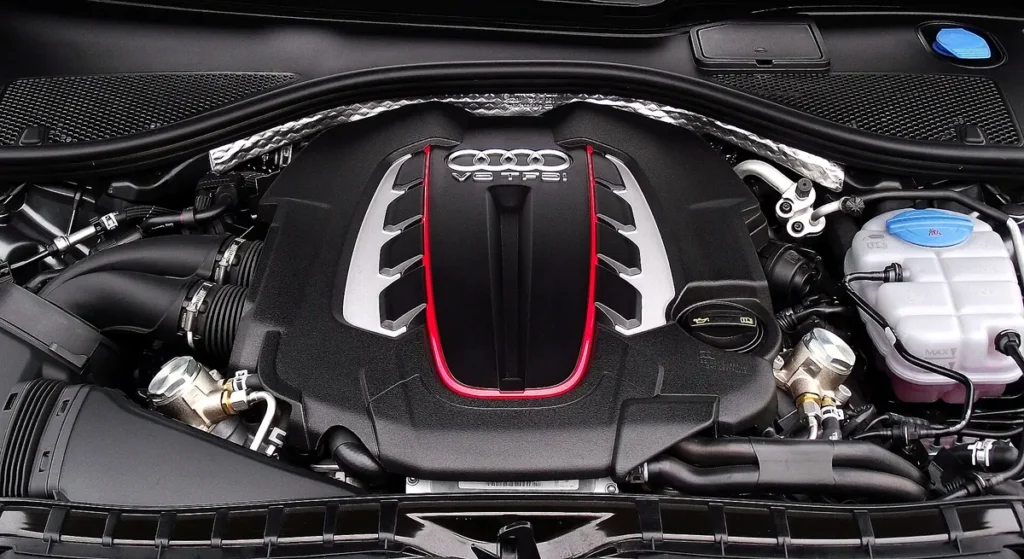
- 4.0 TFSI V8, cylinder on demand: Audi bulletin 2042071 covers 2013–2015 A6, A7 and A8 models with the 4.0 TFSI, and its labor table lists the S6, S7 and RS 7. The condition is an EPC lamp, engine warning lamp and irregular running, with camshaft adjuster codes such as P11A6, P12A9, P11D5 and P12B9. Audi’s technical background is a possible delay in the adjusting mechanism when the engine switches between eight- and four-cylinder mode. The repair is replacement of the affected camshaft adjusters.
- Turbocharger oil strainer recall: recall 22V-178 covers the 2013–2017 A8, S6 sedan, S7 and S8 and the 2014–2017 RS 7. Its report lists the EPC light among the possible warnings. Dealers replace the oil strainer and change the oil free of charge.
- RS 5 catalyst codes: bulletin 2072121 covers 2014–2015 A5, S5 and RS 5 coupes and cabriolets with “MIL and/or EPC warning lamps” and codes P042000 or P043000. The fix is an engine control software update.
- C8 RS 6 Avant and RS 7 fuel level sender: listed in bulletin 2070211 as described above.
For a broader look at these cars, see the AMGRSM guides to Audi RS5 problems, Audi RS3 problems and Audi S tronic problems, which covers the dual-clutch gearbox warnings that can appear alongside engine faults.

Audi EPC Light Fault Codes
The EPC lamp itself has no code. The useful information is in the codes stored in the engine module and other modules. The table lists codes that Audi bulletins, NHTSA documents or Ross-Tech connect with EPC-type faults. The “Warning named” column shows which lamp the source itself mentions.
| Code(s) | Meaning (source wording) | Warning named | Source and models |
|---|---|---|---|
| P0571 | Brake light switch (F): implausible signal | MIL in Ross-Tech; EPC in owner reports | Ross-Tech, AudiWorld owner thread |
| P1545, P0121, P0123, P0221, P0222 | Throttle valve control and throttle angle sensor faults | MIL | Bulletin 2018260; 2005–2009 A3, A4, A6, TT, Q7 |
| P0300–P0304, P130A | Misfire detected (random/multiple, cylinders 1–4); P130A listed by Audi as “Hide Cylinder” | MIL; engine shakes | Bulletin 2033561; 2010–2011 four-cylinder models |
| P11A6, P12A9, P11D5, P12B9 and related | Camshaft adjuster (cylinder on demand) faults | EPC and engine warning lamp | Bulletin 2042071; 2013–2015 4.0 TFSI |
| P050100 | Speed signal 1, implausible signal (air leaks in intake or crankcase ventilation) | EPC | Bulletin 2045223; 2016–2017 A6 2.0 TFSI |
| P060C00 | Internal control module main processor performance | EPC and “Drive system: fault” | Bulletin 2070571; 2022–2023 A4, A5, Q5 2.0L |
| P042000, P043000 | Catalyst system efficiency below threshold, bank 1 or 2 | MIL and/or EPC | Bulletin 2072121; 2014–2015 A5, S5, RS 5 |
| C111204 | Haldex clutch pump faulty | EPC; AWD not working | Bulletin 2043144; 2015–2016 A3, Q3 quattro |
| B10581B, B103E1B | Fuel level sensor 2 or 1 resistance too high | EPC and fuel system warning | Bulletin 2070211; A6, A7, Q7, Q8, RS 6, RS 7 and others |
| U012100, U012200 | No communication with ABS or ESP control module | ABS, EPB, TPMS, EPC, MIL | Bulletin 2033412; 2009–2014 A4, A5, Q5 |
Codes stored in modules other than the engine computer, such as the B-codes for the fuel level sender (comfort control module) or C111204 (all-wheel-drive module), may not show up on a basic engine-only OBD-II reader. That is why Cartech UK insists on scanning every module, not just the engine. A similar logic applies to BMW’s equivalent warning, explained in the AMGRSM guide to the BMW drivetrain malfunction message.
Audi Recalls That Mention the EPC Light
A search of NHTSA Part 573 recall reports for Audi models found three recalls whose official reports mention the EPC lamp. Each row lists only the models named in that report.
| Recall | Models named by NHTSA | Problem | Remedy |
|---|---|---|---|
| 17V-002 (NHTSA data) | 2013–2016 A4 sedan and A4 allroad, 2013–2017 A5, A5 Cabriolet and Q5, 2012–2015 A6, all with 2.0 TFSI | Electric coolant pump can be blocked by debris and overheat, increasing fire risk | Software that cuts power to a blocked pump and warns the driver with the EPC lamp |
| 18V-229 (NHTSA data) | Same 2.0 TFSI models as 17V-002 | Coolant pump blocked by debris or short-circuited by moisture | Coolant pump replacement, in addition to the 17V-002 software |
| 22V-178 (NHTSA data) | 2013–2017 A8, S6 sedan, S7 and S8; 2014–2017 RS 7 | Blocked turbocharger oil supply strainer can damage turbo bearings and stall the engine | New oil strainer and oil change |
NHTSA’s recall summaries state that dealers perform each remedy free of charge. Before paying for any EPC diagnosis, enter the VIN on the NHTSA recall lookup to check for open recalls.
Audi EPC Light Repair Cost
The cost of an EPC repair depends entirely on the cause. The ranges below are RepairPal’s estimates for an Audi A4. They exclude taxes and fees, and other models, especially S, RS and V8 models, can cost more.
| Repair | Estimated cost (US) | Source |
|---|---|---|
| Diagnosis and fault code testing | $159–$233 | RepairPal |
| Brake light switch replacement | $150–$200 | RepairPal |
| Spark plug replacement | $151–$259 | RepairPal |
| PCV valve replacement | $221–$303 | RepairPal |
| Ignition coil replacement | $256–$383 | RepairPal |
| Mass airflow sensor replacement | $388–$502 | RepairPal |
| Throttle body replacement | $914–$1,017 | RepairPal |
| Recall repairs (17V-002, 18V-229, 22V-178) | $0 at an Audi dealer | NHTSA reports 17V-002, 18V-229, 22V-178 |
Software updates described in Audi bulletins can be covered under warranty. For example, bulletins 2072121 and 2045223 list a warranty claim type of up to 48 months/50,000 miles, while bulletin 2070571 is informational only. Outside warranty, these bulletins are informational only, so the owner normally pays for the work.
How to Reset the Audi EPC Light
The EPC light should be reset only after the cause has been found and repaired. The right sequence is:
- Scan every module. Use a dealer tool or an Audi-capable scanner such as VCDS or OBDeleven. Write down every code, including stored and intermittent ones, before clearing anything.
- Check bulletins and recalls. Ask a dealer to run the VIN for open recalls, campaigns and matching TSBs. Several EPC faults above are fixed with software, not parts.
- Repair the cause. Replace parts only after testing. RepairPal recommends never replacing a part based only on the code in its diagnosis guide.
- Clear the codes and perform adaptations. After throttle body work or a battery disconnection, run the throttle body alignment (Ross-Tech). After a Haldex pump repair, Audi bulletin 2043144 calls for all-wheel drive basic settings.
- Test drive and rescan. If the EPC light returns, the fault is still present and needs further diagnosis.
Clearing the code without a repair only hides the evidence. Some EPC faults are intermittent, so a lamp that goes out after a restart still deserves a scan. Disconnecting the battery is not a fix either: the light returns if the cause is still there, and the throttle body may need a new alignment afterwards.
Used Audi Buyer’s Checklist
An EPC history is not a reason to reject a car, but it should be explained. Before buying any Audi, especially an S or RS model:
- Switch the ignition on and confirm that the EPC lamp lights up as a bulb check and goes out once the engine is running. A lamp that does not light up during this check should be investigated.
- Ask for a full scan of all modules, not just the engine, and look for stored throttle, brake switch, misfire, boost or communication codes.
- Check the VIN on the NHTSA recall site, especially for 17V-002 and 18V-229 on 2012–2017 2.0 TFSI models and 22V-178 on the 2013–2017 A8, S6, S7 and S8 and 2014–2017 RS 7.
- Ask the dealer which TSBs and software updates have been performed, for example bulletin 2042071 on 4.0 TFSI cars or 2070571 on 2022–2023 2.0-liter models.
- Test drive from cold: check for smooth idle, full power under hard acceleration, working brake lights and working cruise control.
- On RS and S models, have a specialist check boost, misfire counters and camshaft adjuster codes before purchase.
For model-specific checklists, browse the Common Problems and reliability guides hub, and for background on the cars themselves see the AMGRSM overviews of the Audi RS6 Avant and the Audi RS 7 Sportback.
Frequently Asked Questions
What does the EPC light mean on an Audi?
EPC stands for Electronic Power Control. The yellow EPC lamp monitors the engine management system and the electronic throttle. If it comes on while driving, a control unit has stored a fault, often related to the throttle, pedal sensors, brake light switch, misfires, boost or software, and the car should be scanned without delay.
Can you drive an Audi with the EPC light on?
If the car drives normally, it can usually be driven gently for a short distance to a workshop. If power is severely reduced, the engine is shaking, the check engine light is flashing, an oil or temperature warning appears or the display says “Safely stop vehicle,” stop as soon as it is safe and have the car towed.
Why is the Audi EPC light on and the car shaking?
An EPC light with shaking usually points to a misfire from ignition coils, spark plugs or a valvetrain fault. Audi bulletins describe premature coil failures on some 2010–2011 four-cylinder models and EPC lights with irregular running from camshaft adjuster faults on 2013–2015 4.0 TFSI V8 models.
What causes the EPC and check engine lights to come on together?
Both lamps light when the engine computer stores a fault that affects both emissions and power control, such as misfires, throttle faults, boost problems or catalyst efficiency codes. Audi bulletin 2072121, for example, covers MIL and EPC lamps with codes P042000 or P043000 on 2014–2015 A5, S5 and RS 5 models.
How much does it cost to fix the EPC light on an Audi?
It depends on the cause. RepairPal estimates $159–$233 for diagnosis on an Audi A4, $150–$200 for a brake light switch, $256–$383 for an ignition coil and $914–$1,017 for a throttle body. Recall repairs and some bulletin software updates under warranty cost nothing.
How do you reset the Audi EPC light?
Find and fix the cause first, then clear the codes with a dealer tool or an Audi-capable scanner such as VCDS or OBDeleven and run any required adaptations, such as a throttle body alignment. If the fault is still present, the EPC light will come back.
Is there a recall for the Audi EPC light?
There is no recall for the lamp itself, but NHTSA reports for recalls 17V-002 and 18V-229 (2012–2017 2.0 TFSI models) and 22V-178 (2013–2017 A8, S6 sedan, S7 and S8 and 2014–2017 RS 7) mention the EPC lamp. Check any VIN on the NHTSA recall site.
The Bottom Line on the Audi EPC Light
The Audi EPC light is a symptom, not a diagnosis. Common causes include a throttle or pedal sensor, a brake light switch, misfires, boost or vacuum leaks or a software fault, and several of the most important causes are documented in Audi’s own bulletins and in NHTSA recall reports. Drive gently or stop depending on how the car behaves, scan every module, check the VIN for recalls and bulletins and replace parts only after testing. That approach keeps a warning light from turning into an expensive guess.
Sources and notes: The definition of Electronic Power Control comes from Audi of America bulletin 2003658 and Audi owner’s manual text (S5 manual, Q8 manual). Bulletins are Audi of America technical service bulletins filed with NHTSA and linked where cited; recall details come from the NHTSA Part 573 reports and NHTSA recall data linked in the recall table, searched on November 26, 2026. Independent explanations come from the RAC, Cartech UK, AudiWorld and the Ross-Tech wiki. Repair cost ranges come from RepairPal (estimates last updated September 3, 2026). Costs vary by model, engine, region and shop. This article is for general information; confirm any diagnosis, bulletin or recall status for a specific vehicle with an Audi dealer or a qualified specialist.