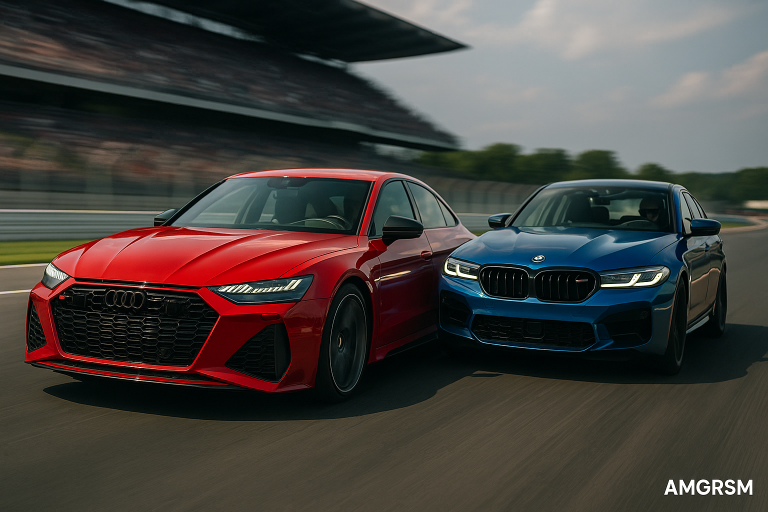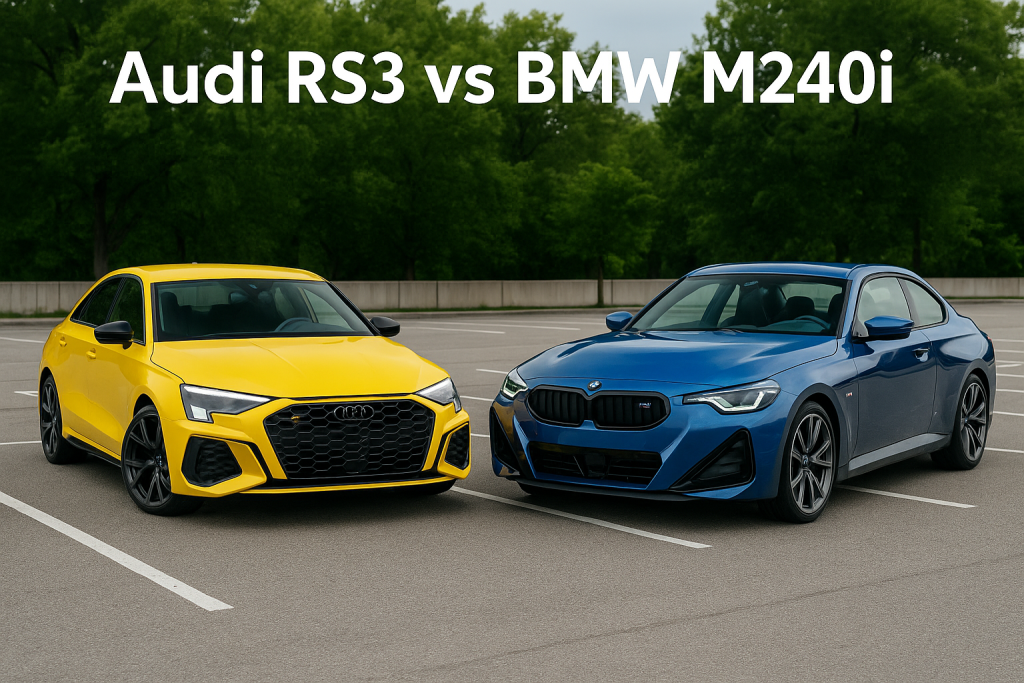
The Audi RS3 vs BMW M240i comparison matches two of the most exciting entry points into German performance. Both are compact, both have around 400 horsepower and both deliver acceleration that would have embarrassed supercars only a few years ago. Yet they approach the job very differently. The Audi RS3 is a compact sedan with a legendary five-cylinder engine and a clever all-wheel-drive system. The BMW M240i is a stylish two-door coupe with a smooth turbocharged inline-six and rear-biased handling.
In this guide we compare performance, engines, handling, interior, technology, practicality, running costs and value to help you choose between the Audi RS3 and the BMW M240i. For a broader look at the brand rivalry, read our Audi RS vs BMW M comparison.
Table of Contents
- Two Different Approaches
- A Quick Look at Their History
- Audi RS3 vs BMW M240i: Specifications
- Performance and Engines
- Audi RS3
- BMW M240i xDrive
- Handling and Driving Experience
- Sound and Character
- Exterior Design
- Interior and Technology
- Practicality
- Running Costs and Reliability
- What About the BMW M2?
- Buying Used
- Price and Value
- Who Should Buy Each Car?
- Choose the Audi RS3 If:
- Choose the BMW M240i If:
- Frequently Asked Questions
- Is the Audi RS3 faster than the BMW M240i?
- Which is more comfortable?
- Which is better in snow?
- Verdict: Audi RS3 vs BMW M240i
Two Different Approaches
The RS3 is a full Audi Sport RS model, built by the same division that creates the RS6 and RS7. It is designed to be the fastest and most focused compact car in the Audi lineup. The M240i, on the other hand, is an M Performance model, which sits between regular BMW models and full M cars like the M2. It offers much of the M experience with more comfort and a lower price. That difference in positioning explains many of the contrasts between the two cars.
A Quick Look at Their History
The first RS3 arrived in Europe in 2011 as a hatchback, and the model only reached the United States as a sedan for the 2017 model year. The current generation, launched for 2022, introduced the torque splitter and became the most powerful RS3 yet. The M240i replaced the earlier M235i and M240i coupes, and the current G42 generation arrived in 2022 with a bolder design and more power.
Audi RS3 vs BMW M240i: Specifications
| Specification | Audi RS3 | BMW M240i xDrive |
|---|---|---|
| Body style | Four-door sedan | Two-door coupe |
| Engine | 2.5L turbo five-cylinder | 3.0L turbo inline-six |
| Horsepower | 401 hp | About 382 hp |
| Torque | 369 lb-ft | 369 lb-ft |
| Transmission | 7-speed S tronic dual-clutch | 8-speed automatic |
| Drivetrain | Quattro AWD with torque splitter | xDrive AWD (rear-biased) |
| 0-60 mph (official) | 3.6 seconds | 4.1 seconds |
| Approximate US starting price | Low $60,000s | Low $50,000s |
Performance and Engines
Audi RS3
The heart of the RS3 is its 2.5-liter turbocharged five-cylinder engine, a design with roots in Audi’s rally cars of the 1980s. It has won the International Engine of the Year award in its class many times. With 401 hp and 369 lb-ft of torque, it propels the RS3 from 0-60 mph in about 3.6 seconds according to Audi, and independent US tests have recorded even quicker times. The engine’s uneven firing order produces a unique, warbling sound that no other modern car can match.
BMW M240i xDrive
The M240i uses BMW’s B58 3.0-liter turbocharged inline-six, one of the most respected engines in the industry for its smoothness, strong torque and durability. It produces around 382 hp and 369 lb-ft of torque, and it reaches 60 mph in about 4.1 seconds according to BMW, with testers often recording faster results. The B58 is also famous among tuners, who can extract much more power with simple software upgrades.
The RS3 is quicker in a straight line and from a standstill, but the M240i is not far behind, and its engine is smoother and more relaxed in everyday driving.
Handling and Driving Experience
The RS3 uses a clever RS torque splitter on the rear axle, which can send up to all available rear torque to the outside rear wheel in a corner. That reduces understeer and makes the car more agile than previous RS3 models. It even has an RS Torque Rear mode that allows controlled drifts on a closed course. The result is a compact sedan that feels stable, grippy and very fast on any road surface.
The M240i offers more natural rear-biased dynamics. Its xDrive system sends most power to the rear wheels unless extra traction is needed, and its longer wheelbase and coupe body give it a balanced, playful feel. The steering is precise, and the car rewards smooth, committed driving. Many enthusiasts find the BMW more engaging on a winding mountain road, while the Audi is faster and more secure in poor conditions. A rear-wheel-drive version of the M240i is also available for drivers who want an even purer experience.
Sound and Character
Sound is one of the biggest differences between these cars. The RS3’s five-cylinder delivers a raspy, off-beat growl that rises into a howl at high revs, and its sport exhaust adds pops and crackles in dynamic mode. Many owners say the sound alone justifies the purchase. The M240i’s inline-six is smoother and more refined, with a deep, linear tone that suits long-distance driving. Enthusiasts who want drama usually prefer the Audi, while those who value refinement prefer the BMW.
Exterior Design
The RS3 looks aggressive, with wide flared fenders, a large honeycomb grille, functional air intakes and oval exhaust tips. Bright colors such as Kyalami Green emphasize its sporty character. The M240i has a more elegant coupe shape with a long hood, short rear deck and muscular rear fenders. Its design is more understated, which appeals to buyers who prefer subtle performance.
Interior and Technology
Inside the RS3, drivers get the Audi virtual cockpit with RS-specific displays, including a shift light and performance data, plus a central touchscreen running the MMI system. RS sport seats, red or green accents and an aggressive design give the cabin a racy feel. Materials are good, though some plastics remind owners that the RS3 is based on a compact car.
The M240i features BMW’s latest curved display, combining a digital instrument cluster and a central touchscreen running iDrive. The layout is clean and driver-focused, with sport seats, a thick M steering wheel and premium materials. Both cars offer wireless smartphone integration, premium audio and modern driver assistance features.
Practicality
As a four-door sedan, the RS3 is the more practical choice for families or anyone who regularly carries passengers. Its rear seats are easier to access, although legroom is limited. The M240i is a two-door coupe, so rear passengers must climb in, and its rear seats are best for short trips. The BMW’s trunk is reasonably useful for a coupe, but the Audi is easier to live with day to day.
Running Costs and Reliability
Both cars require premium fuel and performance tires, and both are more expensive to run than regular compact cars. The B58 engine has an excellent reputation for reliability, and BMW’s standard maintenance coverage on new cars reduces early costs. The RS3’s five-cylinder engine is also robust, but its dual-clutch transmission needs fluid services at the recommended intervals. Insurance costs are usually higher for the RS3 because of its performance and RS badge.
What About the BMW M2?
Many buyers comparing the Audi RS3 vs BMW M240i also consider the BMW M2. As a full M car, the M2 offers more power, rear-wheel drive, a manual transmission option and a much sharper chassis, making it the more direct rival to the RS3 in terms of focus. However, it is also more expensive and less comfortable. For most daily drivers, the M240i offers a better balance, while track-day enthusiasts may find the M2 worth the extra cost.
Buying Used
Both cars are attractive on the used market. When shopping for a used RS3, check the service history of the dual-clutch transmission, look for signs of aggressive launches and inspect the wheels and tires. For a used M240i, check for software tunes, which are common on B58-powered cars, and confirm that maintenance was done on time. A pre-purchase inspection by a specialist is always a good investment.
Price and Value
The RS3 starts in the low $60,000s in the US, while the M240i xDrive starts in the low $50,000s. The RS3 delivers more performance and a unique engine, but the M240i offers nearly the same real-world speed for around $10,000 less. For buyers on a tighter budget, the BMW represents outstanding value.
Who Should Buy Each Car?
Choose the Audi RS3 If:
- You want the quickest acceleration and maximum all-weather grip
- You love the unique sound of a five-cylinder engine
- You need four doors for passengers or family use
- You want a full RS model with aggressive styling
Choose the BMW M240i If:
- You want a smooth, refined inline-six and a comfortable ride
- You prefer the style of a two-door coupe
- You want strong performance at a lower price
- You enjoy tuning potential and rear-biased handling
Frequently Asked Questions
Is the Audi RS3 faster than the BMW M240i?
Yes. The RS3 has slightly more power, a quicker-shifting dual-clutch transmission and a faster official 0-60 mph time.
Which is more comfortable?
The BMW M240i is generally more comfortable and refined, with a smoother engine and a more relaxed ride.
Which is better in snow?
Both offer all-wheel drive, but the RS3’s Quattro system and front-heavy layout make it especially confident on slippery roads. Winter tires matter more than the badge for either car.
Verdict: Audi RS3 vs BMW M240i
Choose the Audi RS3 if you want the most speed, grip and character, and if four doors matter. Choose the BMW M240i if you want the best balance of price, power, comfort and driving purity in a stylish coupe. In the Audi RS3 vs BMW M240i battle, both are excellent choices that deliver a true taste of German performance.