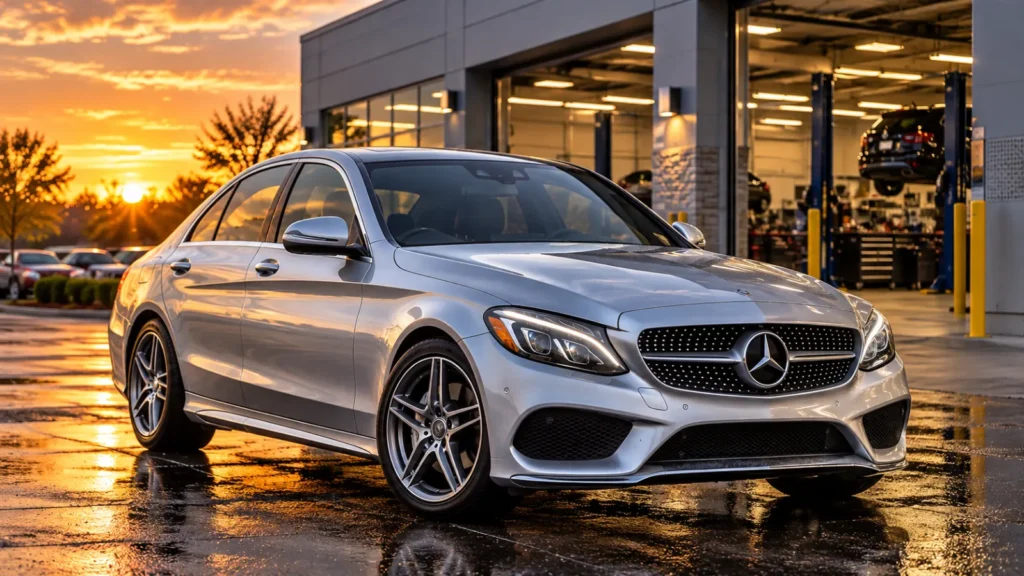
The most common Mercedes C300 problems depend heavily on which generation sits in front of you, because the badge has covered three very different cars in the United States since 2008: a naturally aspirated V6 sedan, a turbocharged four-cylinder that defined the modern C-Class, and today’s mild-hybrid model with S-Class-style screens. Each has its own weak spots, its own recalls and its own sweet-spot model years.
In this guide we break down the C300 year by year, using NHTSA recall filings, Mercedes-Benz technical documents, owner complaint databases and major road tests. The goal is simple: help American buyers understand which Mercedes C300 problems actually matter, what Mercedes-Benz did about it, and which used C300 is the smartest purchase today.
Table of Contents
- Mercedes C300 Generations and Engines Explained
- The Most Common Mercedes C300 Problems
- Electronic Steering Lock Failure (W204, 2008 to 2014)
- M272 V6 Oil Leaks, Intake Manifold and Thermostat (2008 to 2012)
- 7G-Tronic Conductor Plate (W204 and Early W205)
- M274 Piston and Wrist Pin Concerns (2015 to 2016)
- Camshaft Timing Codes on the M274
- Fuel Smell and Fuel Delivery Faults (2015 to 2016)
- Interior Wear and Water Leaks (W205)
- Electrical and Fuel Pump Recalls (W206, 2022 to 2023)
- How Mercedes-Benz Responded: Recalls and Campaigns
- Mercedes C300 Problems by Year: Best and Worst Years
- Repair Costs and Maintenance Tips
- Buyer’s Advice: Who Should Buy a Used C300
- FAQ
- What year C300 should be avoided?
- Is the Mercedes C300 a reliable car?
- How long does a Mercedes C300 engine last?
- What are the most common Mercedes C300 problems on the newest model?
- Conclusion
Mercedes C300 Generations and Engines Explained
The C300 name arrived in the US with the W204 C-Class for the 2008 model year. Early cars used the 3.0-liter M272 V6, and for the 2013 model year the C300 4MATIC switched to a detuned 3.5-liter M276 V6. The W205 generation launched for 2015 with a 2.0-liter turbocharged four-cylinder, and the current W206 arrived for 2022 with a 48-volt integrated starter generator.
| Generation | US model years | Engine | Output | Transmission |
|---|---|---|---|---|
| W204 | 2008 to 2012 | 3.0L V6 (M272) | 228 hp, 221 lb-ft | 7G-Tronic automatic (6-speed manual on early cars) |
| W204 | 2013 to 2014 (C300 4MATIC) | 3.5L V6 (M276) | 248 hp, 251 lb-ft | 7G-Tronic Plus |
| W205 | 2015 to 2018 | 2.0L turbo I4 (M274) | 241 hp, 273 lb-ft | 7G-Tronic Plus, then 9G-Tronic |
| W205 facelift | 2019 to 2021 (sedan) | 2.0L turbo I4 (M264) | 255 hp, 273 lb-ft | 9G-Tronic |
| W206 | 2022 to present | 2.0L turbo I4 (M254) with 48V ISG | 255 hp, 295 lb-ft | 9G-Tronic |
According to Kelley Blue Book’s launch coverage, the 2015 C300 made 241 hp and 273 lb-ft, and Business Fleet reported that the 2019 refresh raised output to 255 hp with the same 273 lb-ft. For the W206, The Drive’s first drive reports 255 hp and 295 lb-ft, with the starter generator adding up to 20 hp for short bursts at lower rpm.
The Most Common Mercedes C300 Problems
Below are the Mercedes C300 problems that appear most often in NHTSA filings, Mercedes-Benz documents and owner communities such as MBWorld and CarComplaints.com. Not every car will suffer them, but each one is worth checking on a used example.
Electronic Steering Lock Failure (W204, 2008 to 2014)
Symptoms: the key turns but the car will not start, the steering column stays locked, or the dash stays dark. Owners on CarComplaints.com describe the car refusing to start while parked, often with no warning.
Cause: the electronic steering lock (ESL) module and related ignition electronics can fail with age. On CarComplaints.com, the 2008 C300 alone has more than 100 steering-related complaints, almost all tied to this module.
Fix: replacement of the steering lock module, sometimes with the ignition switch. Owners report paying roughly $1,000 to $1,900 at dealers, figures that are owner-stated rather than official.
M272 V6 Oil Leaks, Intake Manifold and Thermostat (2008 to 2012)
The 3.0-liter M272 is generally robust in the C300, but it carries well-documented age-related faults. Parts specialist FCP Euro notes that the camshaft adjuster magnets can leak oil through their electrical connectors, letting oil wick up the engine wiring harness. The plastic intake manifold flap lever can break and trigger codes P2004 to P2006, and FCP Euro calls the map-controlled thermostat the single most common failure it sees on this engine.
What about the famous M272 balance shaft gear failure? The class action settlement covered 2005 to 2007 model year vehicles with engines up to a specific serial number, extending coverage to 10 years or 125,000 miles. The W204 C300 began with the 2008 model year, so it falls outside that settlement, although a pre-purchase scan for timing correlation codes is still sensible.
7G-Tronic Conductor Plate (W204 and Early W205)
Independent transmission specialists frequently cite the 722.9 7G-Tronic’s internal conductor plate, which carries the transmission control unit and speed sensors, as a common failure point. Symptoms include harsh shifts, limp mode and transmission warning messages. The repair usually involves replacing or repairing the conductor plate and programming it to the car, which costs far less than a full transmission. Regular fluid service also helps this gearbox.
M274 Piston and Wrist Pin Concerns (2015 to 2016)
This is the most discussed issue among W205 owners. In July 2015 Mercedes-Benz issued technical service bulletin LI03.10-P-060916, which, according to CarComplaints.com, cites an “unfavorable tolerance of piston wrist pin” linked to knocking or rattling noises when the engine is cold.
In 2022 a 2015 C300 owner petitioned NHTSA (DP22-002), arguing that the wrist pins caused his engine to fail with a cracked piston. NHTSA reviewed Mercedes field data and complaints and found “no relationship between wrist-pin conditions cited in the TSB and engine failure or loss of motive power.” The petition was denied, and the file was closed in February 2024, as documented in the NHTSA petition report.
Even so, owner reports of engine failure and cracked pistons cluster around the 2015 and 2016 cars. CarComplaints.com lists engine failure as the top problem for the 2016 C300, with an average reported mileage of about 48,000 miles. Buyers should listen carefully for cold-start rattles on these years.
Camshaft Timing Codes on the M274
Owners on forums such as MBClub UK report camshaft timing faults on the M270 and M274 family, including P0016 and P0017 correlation codes, cold-start chain rattle from a leaking hydraulic tensioner and, in some cases, failed cam adaptation. Diagnoses vary from sensors to timing chain and camshaft parts, so a proper scan is essential. Our guide to the Mercedes P0016 code explains this fault in detail.
Fuel Smell and Fuel Delivery Faults (2015 to 2016)
A strong gasoline smell is the second most reported problem for the 2016 C300 on CarComplaints.com. Early cars were also hit by NHTSA recall 15V-138, which covered 3,039 C300 4MATIC and C400 4MATIC models built between April and July 2014. The fuel delivery module could be improperly secured to the tank, risking a fuel leak, and pinched wires could stop the fuel pump.
Interior Wear and Water Leaks (W205)
MBWorld has documented MBTex vinyl seats developing a shiny, sticky surface, which owners link to temperature swings, and water leaks into the front footwells or door panels after rain or car washes. These are not mechanical risks, but they affect resale value and should be checked on any used W205.
Electrical and Fuel Pump Recalls (W206, 2022 to 2023)
The current C300 has had a busy start. Its problems so far center on early-production parts rather than engine design, with several recalls that can cause loss of drive power. Buyers should confirm every campaign has been completed, as detailed in the next section.
How Mercedes-Benz Responded: Recalls and Campaigns
Mercedes-Benz USA has addressed many C300 faults through official recalls. The most relevant ones are listed below, based on NHTSA filings and published reports.
- Takata airbags (2005 to 2014 C-Class): In February 2016 Daimler recalled about 840,000 US vehicles, including the C-Class, for potentially dangerous Takata inflators, according to The Christian Science Monitor.
- Starter fuse (2015 to 2017 C-Class): In 2017 Mercedes recalled vehicles worldwide because the starter current limiter could overheat after repeated failed start attempts. Nearly 308,000 US units across several model lines were affected, and the fix added an extra fuse.
- eCall location error (2016 to 2021): Recall 21V-058 covered about 1.29 million US vehicles, including the C-Class, whose emergency call system could send an incorrect location after a crash. A software update fixed it.
- Fuel pump shutdown (2021 to 2024 models): Recalls 23V-445 and its expansion 23V-880 cover multiple lines including the C-Class, with dealers replacing the fuel pump.
- Transmission wiring harness (2022 to 2023 C300 4MATIC): Under recall 23V-462, 8,174 C300 sedans could have a harness that chafes on the front drive shaft, causing loss of propulsion, according to the NHTSA recall report.
- Fuse box and pre-fuse wiring (W206): Recalls 24V-115, 24V-446 and 25V-255 address faulty 80-amp fuses, an under-tightened pre-fuse box bolt and incorrect replacement fuse boxes, all with fire or power-loss risk.
There has been no recall for the M274 wrist pin issue, since NHTSA denied the petition. That means owners facing engine damage outside warranty have no recall remedy to fall back on, which makes service records especially important on these cars.
Mercedes C300 Problems by Year: Best and Worst Years
The table below combines complaint volumes from CarComplaints.com (which compiles owner and NHTSA reports), known engineering issues and recall activity. Complaint counts reflect that site’s data and are a guide, not an absolute ranking.
| Model years | Verdict | Key concerns |
|---|---|---|
| 2008 to 2009 | Average | Steering lock failures, M272 oil leaks, Takata airbag recall |
| 2010 to 2011 | Average | Same as above, fewer complaints |
| 2012 to 2014 | Best of the W204 | Very low complaint counts; check steering lock and transmission |
| 2015 | Avoid or inspect closely | Most complaints of any C300 year, wrist pin TSB, fuel module recall |
| 2016 | Worst year | Rated worst by CarComplaints.com; engine failure and fuel smell reports |
| 2017 to 2018 | Good | Far fewer complaints; starter fuse (2017) and eCall recalls |
| 2019 to 2021 | Best overall | Lowest complaint counts of the turbo era, newer M264 engine |
| 2022 to 2023 | Check recalls | Fuel pump, wiring harness and fuse box recalls |
In short, the most frequently cited Mercedes C300 years to avoid are 2015 and 2016, while the 2019 to 2021 facelifted W205 offers the best balance of modern technology and proven Mercedes C300 reliability. On a tight budget, a well-kept 2012 to 2014 W204 is a solid alternative.
Repair Costs and Maintenance Tips
Most Mercedes C300 problems are manageable when caught early, but a few can be expensive. CarComplaints.com lists an average reported repair cost of about $15,600 for engine failure on the 2016 C300, typically a full engine replacement. Steering lock repairs on the W204 run from roughly $1,000 to $1,900 by owner accounts, while a conductor plate repair costs far less than a replacement transmission.
- Follow Service A and Service B intervals using oil that meets Mercedes-Benz specifications, and consider shorter oil change intervals on turbocharged cars driven in short trips.
- Service the automatic transmission with fluid and filter changes at the intervals a Mercedes specialist recommends.
- Replace the M272 thermostat proactively around 60,000 miles, as FCP Euro recommends.
- Investigate cold-start noises immediately on M274 cars, since rattles can point to chain tensioner or piston pin issues.
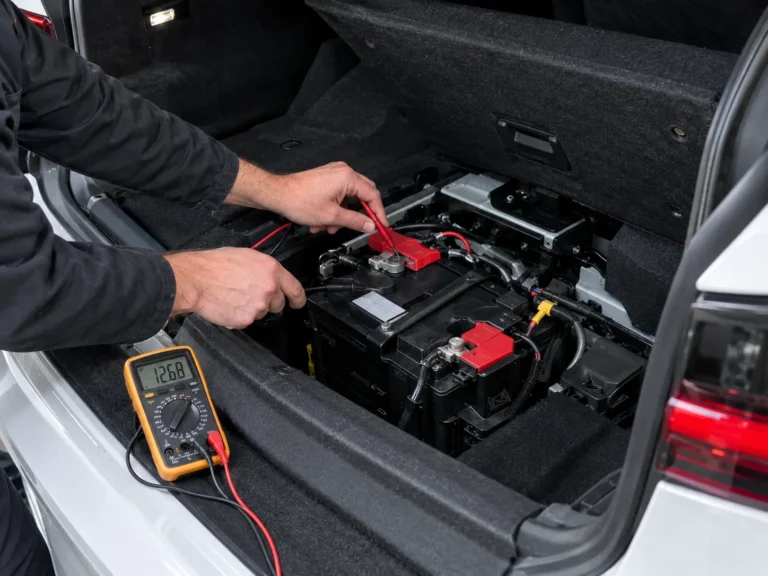
- Keep the 12-volt and 48-volt systems healthy on newer cars, because weak batteries can trigger electrical warnings.
Buyer’s Advice: Who Should Buy a Used C300
The C300 suits buyers who want a comfortable, upscale compact sedan and accept German maintenance costs. Those who need low ownership costs with minimal risk should favor 2019 to 2021 cars with service history or a certified pre-owned example with warranty. Buyers who cannot absorb a large surprise bill should avoid out-of-warranty 2015 to 2016 cars without records.
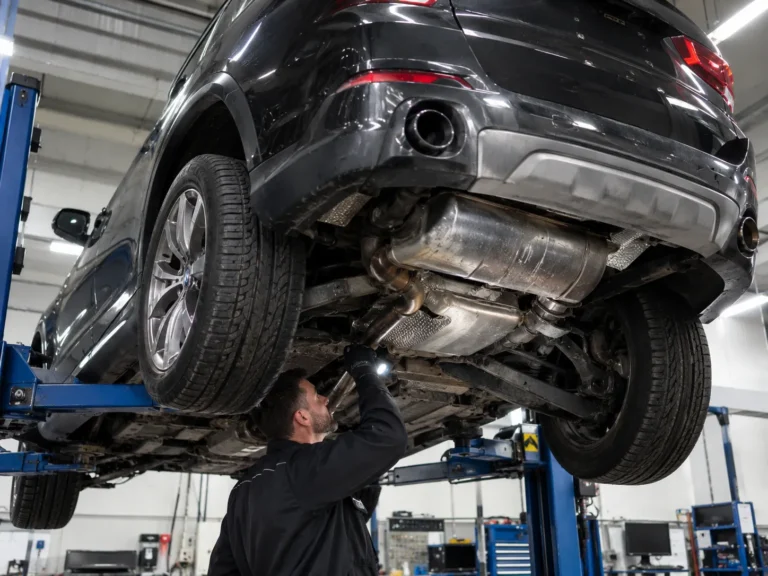
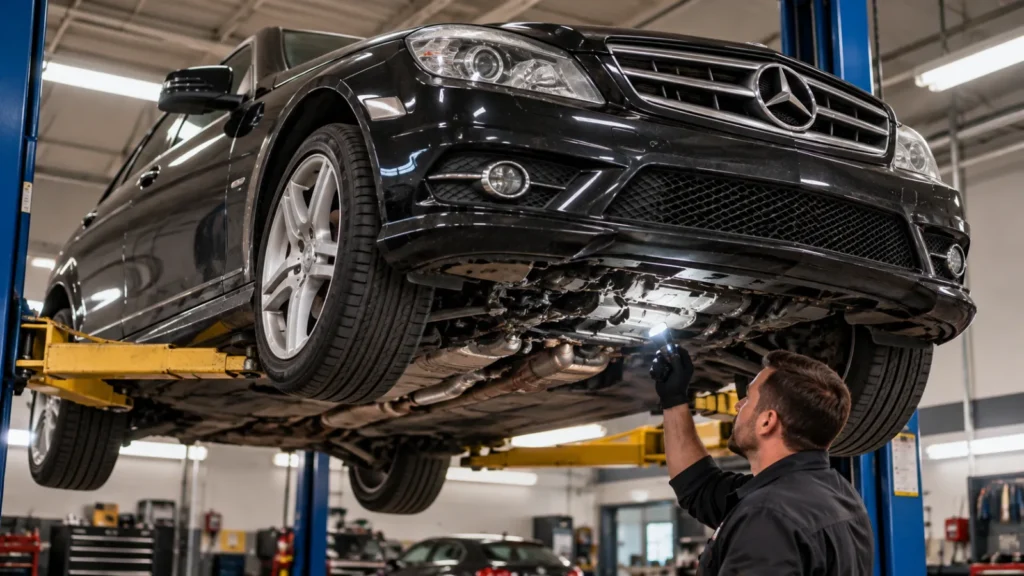
Before buying, a pre-purchase inspection at an independent Mercedes specialist is the best defense against expensive Mercedes C300 problems. Here is what to check:
- Run the VIN through NHTSA’s recall lookup and confirm all campaigns are completed.
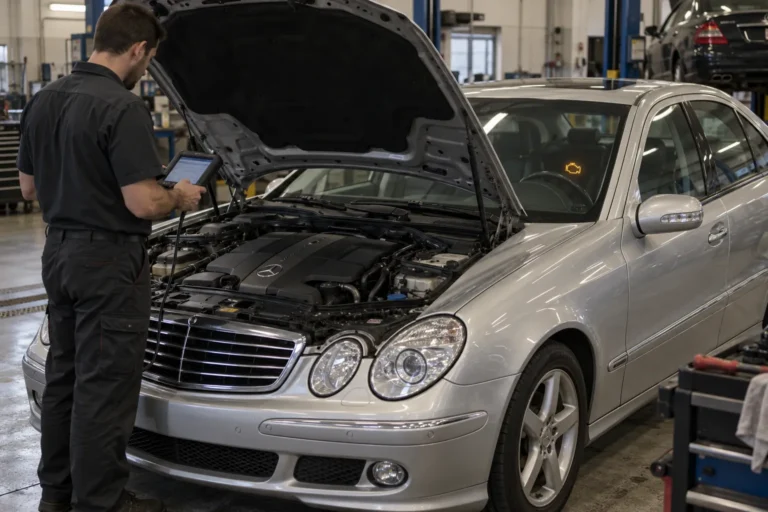
- Scan for stored codes with a Mercedes-capable tool, especially camshaft timing and transmission faults.
- Start the engine cold and listen for rattles or knocking during the first seconds.
- On W204 cars, test the ignition and steering lock several times.
- Look for oil around the camshaft magnets, oil cooler and harness connectors.
- Check for any fuel smell inside the cabin.
- Inspect footwells and door panels for water stains, and the seats for surface damage.
- Request full service records with oil change dates and transmission service.
Shoppers considering a faster C-Class should also read our deep dive into Mercedes C63 AMG reliability, and our comparison of AMG vs Mercedes-Benz models.
FAQ
What year C300 should be avoided?
Based on complaint data, the 2015 and 2016 C300 are the years most often flagged. They received the most complaints on CarComplaints.com, carry the wrist pin service bulletin, and saw early fuel module and starter fuse recalls.
Is the Mercedes C300 a reliable car?
Mercedes C300 reliability is average for a luxury compact when maintained properly. The 2012 to 2014 and 2019 to 2021 model years have the fewest reported issues, while skipped maintenance raises costs quickly on any generation.
How long does a Mercedes C300 engine last?
Mercedes-Benz publishes no official lifespan figure, but many owners report high mileage from the M272, M274 and M264 engines when oil changes, leak repairs and cooling system maintenance are kept up. Neglected oil service is the biggest threat to longevity, and early 2015 to 2016 M274 engines deserve extra scrutiny.
What are the most common Mercedes C300 problems on the newest model?
On the 2022 and later W206, the main issues have been recalls for fuel pumps, transmission wiring harnesses and fuse box components. Most are fixed free of charge by dealers.
Conclusion
Mercedes C300 problems vary sharply by generation. The W204 suffers mainly from aging electronics and V6 oil leaks, the early W205 carries the most serious engine concerns, and the newest W206 has mostly faced fixable recalls. For most American buyers, a 2019 to 2021 C300 with documented service is the safest pick, while a clean 2012 to 2014 W204 is a strong value choice.
Whichever year appeals, verify recall completion, scan for codes and invest in a specialist inspection. Doing so turns the C300 from a gamble into one of the most rewarding entry-level luxury sedans on the used market.