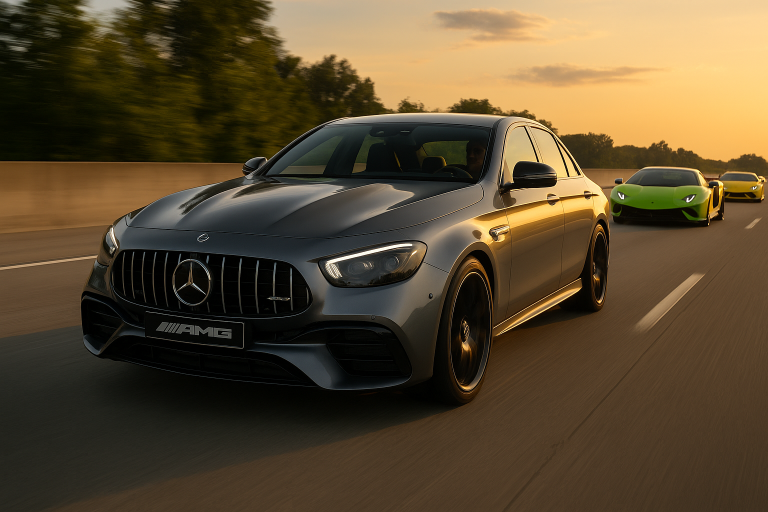
Mercedes C63 AMG reliability is one of the most debated topics among performance car buyers. Few performance sedans divide opinion like the Mercedes-AMG C63. Depending on which forum you read, it is either one of the most rewarding cars ever built or a money pit waiting to empty your bank account. The truth sits somewhere in between, and it depends almost entirely on which generation you are looking at and how the previous owner treated it.
This guide breaks down Mercedes C63 AMG reliability generation by generation: the naturally aspirated W204, the twin-turbo W205 and the hybrid C63 S E Performance. It covers the known weak points of each, what ownership really costs, and exactly what to check before you buy one. If you are still deciding which AMG model fits you best, our Top 10 Mercedes-AMG models guide is a good place to start.
Table of Contents
- Why Mercedes C63 AMG Reliability Has a Mixed Reputation
- Mercedes C63 AMG Reliability by Generation
- W204 (2008–2015): The 6.2-Liter Naturally Aspirated V8
- W205 (2015–2022): The 4.0-Liter Twin-Turbo V8
- C63 S E Performance (2023–Present): The Hybrid Four-Cylinder
- Ownership Costs: What Reliability Really Means for Your Wallet
- Mercedes C63 AMG Reliability Checklist Before You Buy
- Should You Still Buy a Mercedes C63 AMG?
- The Bottom Line on Mercedes C63 AMG Reliability
Why Mercedes C63 AMG Reliability Has a Mixed Reputation
The C63 has always been an emotional car. It packs a large, powerful engine into a compact executive sedan, and many examples are driven exactly the way AMG intended: hard. That combination is why Mercedes C63 AMG reliability varies so much between well-maintained cars and neglected ones. A C63 that received its oil changes on time, was warmed up properly and was serviced by a specialist can be a dependable car. One that was launched at every traffic light and serviced only when a warning light appeared can become very expensive, very quickly.
Mainstream reliability surveys such as those published by J.D. Power tend to rate Mercedes-Benz around the industry average, but high-performance AMG variants are a small slice of those numbers. For a car like the C63, owner communities and specialist workshops are often a better guide to real-world problems, because they see the same failures again and again. The most important point to understand is that much of the online disagreement comes from people comparing completely different generations.
Mercedes C63 AMG Reliability by Generation
Each generation of the C63 uses a fundamentally different powertrain, so each has its own strengths and its own list of known issues. Treat them as three separate cars when you research them.
W204 (2008–2015): The 6.2-Liter Naturally Aspirated V8
The W204 C63 AMG is powered by the hand-built M156 6.2-liter V8, one of the last great naturally aspirated engines from Affalterbach. In standard form it produces 451 hp, with the optional Development Package and the limited 507 Edition pushing output higher. Early cars used the AMG SPEEDSHIFT PLUS 7G-TRONIC automatic, while the facelifted models switched to the AMG SPEEDSHIFT MCT 7-speed with a wet start-off clutch instead of a torque converter.
The M156 has two well-documented weak points. The first is the cylinder head bolts on early production engines. Over time some of these bolts could stretch, which can lead to coolant leaks into the cylinders and, in the worst cases, serious engine damage. Mercedes revised the bolts, and many affected cars have already had them replaced, but a buyer looking at an early W204 should ask for proof that the work was done. Because the repair requires major engine disassembly, it is one of the most expensive jobs on the car.
The second issue is camshaft and lifter wear on early engines, often described by owners as a “cam lobe” problem. Symptoms can include a ticking noise and a misfire code. Later production engines received improved parts. Owner discussions on the MBWorld forum are a useful resource for checking which build dates and engine numbers were most affected.
Beyond those two issues, the W204 is a relatively simple car by modern standards. Engine mounts, rear differential noise and general wear items such as brakes and suspension bushings are the other areas to inspect. A late, well-documented W204 with its known issues addressed is widely considered one of the most characterful AMG models you can buy.
W205 (2015–2022): The 4.0-Liter Twin-Turbo V8

The W205 generation replaced the 6.2-liter engine with the M177 4.0-liter twin-turbo V8, with the turbochargers mounted inside the engine’s “hot vee.” The C63 produces 469 hp and the C63 S produces 503 hp. Pre-facelift cars use the AMG SPEEDSHIFT MCT 7-speed transmission, while the facelifted models from the 2019 model year onward moved to the AMG SPEEDSHIFT MCT 9-speed.
In terms of Mercedes C63 AMG reliability, the M177 has a better reputation than the early M156. Many owners report years of trouble-free driving on cars with a clean service history. The issues that do come up most often in owner communities include oil leaks around the engine’s oil cooler area and related seals, worn engine mounts that cause extra vibration, ignition coil and spark plug problems that show up as misfires, and occasional fuel system faults. Because the turbochargers sit in the hot vee, heat management matters, and regular oil changes with the correct specification are critical.
The transmissions in this generation also divide opinion. Some drivers love the fast, direct shifts of the multi-clutch units, while others complain about jerky behavior at low speed. Many specialists recommend fluid changes at regular intervals rather than relying on long or “lifetime” service claims, so check whether the previous owner did this.
C63 S E Performance (2023–Present): The Hybrid Four-Cylinder
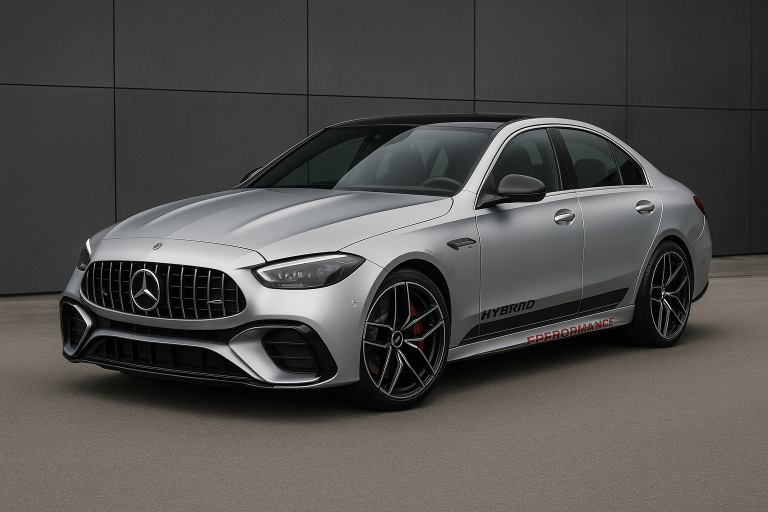
The current C63 S E Performance is the most controversial C63 ever made. Mercedes-AMG replaced the V8 with a turbocharged 2.0-liter four-cylinder engine, the M139l, combined with an electric motor on the rear axle and a high-performance battery. Combined system output is 671 hp, sent through the AMG SPEEDSHIFT MCT 9-speed transmission and 4MATIC+ all-wheel drive.
The engine is related to the unit used in models such as the Mercedes-AMG A45 S and CLA 45 S, which gives it a solid foundation. However, this generation is still relatively new, so there is not enough long-term data to judge its reliability fairly. What is clear is that a high-voltage hybrid system, an electrically assisted turbocharger and a complex battery cooling system add many more components that could need attention as these cars age. Buyers of this generation should place extra value on factory warranty coverage. For more background on AMG’s move to electrification, read our guide to the rise of hybrid AMG performance.
Ownership Costs: What Reliability Really Means for Your Wallet

Mercedes C63 AMG reliability is only half of the ownership story. Even a perfectly healthy C63 is more expensive to run than a regular C-Class, and first-time AMG owners are often surprised by the bills. When you compare it with rivals, as we do in our Mercedes-AMG vs Audi RS comparison, it is clear that all high-performance German sedans demand a serious budget.
The main cost areas to plan for are:
- Insurance: premiums for a C63 are typically much higher than for a standard sedan and vary widely by state, age and driving record. Get quotes before you buy, not after.
- Scheduled maintenance: oil services, spark plugs, brake fluid and transmission fluid are all more expensive on an AMG. An independent Mercedes-AMG specialist is usually more affordable than a dealer.
- Tires and brakes: high-performance tires wear quickly on a car with this much torque, and large AMG brakes are costly to replace.
- Fuel: every C63 requires premium fuel, and the V8 models are thirsty when driven with enthusiasm.
- Repair fund: setting aside money every month for unexpected repairs turns a surprise bill into a planned expense.

A common theme among long-term owners is that the C63 is affordable to buy used but never cheap to own. The owners who are happiest with their cars are the ones who budgeted for that from day one.
Mercedes C63 AMG Reliability Checklist Before You Buy
No matter how clean a car looks, a pre-purchase inspection by an independent Mercedes-AMG specialist is the single most important step when buying a used C63. Enthusiast marketplaces and communities such as AMG Market can help you find specialists and compare prices. Use this checklist during your search:
- Complete service history: look for invoices, not just stamps in a service book. Oil changes should be regular and on time.
- W204 head bolts and camshafts: on early cars, ask for written proof that the head bolts were replaced and the camshafts inspected.
- Oil leaks: check around the oil cooler, valve covers and turbo oil lines on W205 models.
- Engine mounts: excessive vibration at idle or clunks when shifting between drive and reverse can indicate worn mounts.
- Transmission behavior: test drive from cold and in traffic, and ask when the transmission fluid was last changed.
- Signs of hard use: uneven tire wear, worn brakes, curb damage and aftermarket tuning can all point to a hard life.
- Recalls and service campaigns: a Mercedes-Benz dealer can check whether all open campaigns have been completed using the VIN.
- Oil analysis: a lab oil sample can reveal internal wear before it becomes a major failure.
- Hybrid system (C63 S E Performance): confirm the battery and high-voltage system warranty status and check for any hybrid system warnings.
Should You Still Buy a Mercedes C63 AMG?
If you want a fast sedan that you can drive daily with minimal maintenance and the lowest possible running costs, a C63 is probably not the right choice. Cars such as the Lexus IS 500 F Sport Performance or the Genesis G70 offer strong performance with a more relaxed ownership experience.
If, however, you understand the costs, have access to a trusted specialist and are willing to wait for the right car with a documented history, the C63 offers a level of sound, character and performance that few rivals can match for the money. A late W204 appeals to buyers who want the naturally aspirated V8 experience, while a well-maintained W205 C63 S gives the best balance of modern performance and proven mechanicals. If you are also considering BMW, our BMW M5 vs M8 comparison shows how Munich approaches the same formula.
If your budget is tight, a C63 is only one of many fast used options. See our list of fast used cars under $40K for more alternatives.
The Bottom Line on Mercedes C63 AMG Reliability
The Mercedes C63 AMG is neither the disaster some forums describe nor a car you can ignore and expect to stay healthy. When it comes to Mercedes C63 AMG reliability, each generation has known weak points, and most of them can be identified with a proper inspection and a complete service history.
The formula for a good ownership experience is simple: choose the right generation for your needs, buy the best-documented example you can find, have it inspected by a specialist, and build a maintenance fund before you need it. Do that, and the C63 can be one of the most rewarding performance sedans you will ever own. Skip those steps, and it can quickly become one of the most expensive.