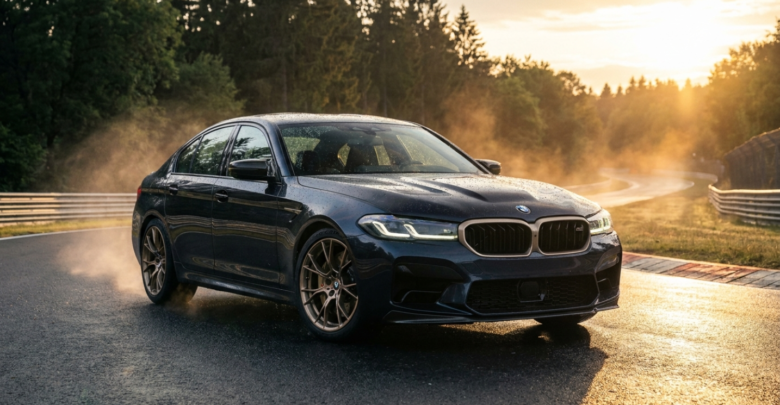
Most cars don’t scare you. The BMW M5 CS does.
I drove one two weekends ago at a friend’s track day in Austria. Ten laps. I came back shaking — not from fear, but from the sheer violence of what 4,100 pounds of German engineering can do when you hold the right pedal to the floor. This is not a sedan. This is a supercar that just happens to have four doors and a leather-lined back seat.
If you’ve been researching the BMW M5 CS online, you’ve probably seen the same numbers quoted everywhere: 627 horsepower, 0 to 60 in 2.9 seconds, 190 mph top speed. But numbers don’t tell you what it actually feels like to drive this car. They don’t tell you why used examples are selling for $150,000 three years later. They don’t tell you why BMW enthusiasts quietly agree this is the greatest M5 ever made.
That’s what this article is for. If you’re thinking about buying a used BMW M5 CS, or you just want to understand why this sedan broke the internet, here’s everything you need to know. For context on how it compares to other M cars, check out our BMW M5 vs M8 comparison and our detailed 2025 BMW M5 G90 review.
What Makes the BMW M5 CS So Special
The “CS” in BMW M5 CS stands for Competition Sport. But this isn’t just another trim level with a different badge. BMW’s M division stripped out 230 pounds from the already ferocious M5 Competition, threw in more carbon fiber than a Formula 1 team, boosted the power by 10 horsepower, and then sent the car to a completely different engineering tune.
The result is a limited-production monster that BMW only built for a single model year — 2022. Roughly 1,000 units were made for the entire world. That rarity, combined with the performance, is why prices have barely dropped since launch. You can read the full technical breakdown on the official BMW website.
BMW M5 CS Specs: The Numbers That Matter
Let’s get the raw data out of the way. The BMW M5 CS isn’t just fast for a sedan — it’s faster than most dedicated sports cars. Here are the specs every enthusiast needs to memorize:
- Engine: 4.4-liter twin-turbocharged S63 V8
- Horsepower: 627 hp at 6,000 rpm
- Torque: 553 lb-ft at 1,800-5,950 rpm
- 0-60 mph: 2.9 seconds (tested by Edmunds at 3.0 seconds without launch control)
- Quarter mile: 11.0 seconds at 124 mph
- Top speed: 190 mph (limited)
- Weight: 4,114 pounds (230 lbs lighter than M5 Competition)
- Transmission: 8-speed M Steptronic automatic
- Drivetrain: M xDrive all-wheel drive with rear-wheel-drive mode
- Fuel economy: 15 city / 21 highway mpg
- Original MSRP: $142,000
Reading the numbers is one thing. Actually experiencing what they feel like in practice is something else entirely.
BMW M5 CS 0-60 and Performance: Real-World Testing
Here’s where it gets absurd. The 2.9-second 0-60 mph figure that BMW quotes is conservative. Professional testers at Car and Driver and Motor Trend have repeatedly run the BMW M5 CS to 60 mph in 2.6 to 2.7 seconds with launch control properly engaged. That puts this four-door family sedan in the same acceleration bracket as a Lamborghini Huracan.
The way the power delivers is what makes it feel otherworldly. Unlike supercharged American muscle that peaks and fades, the CS’s twin-turbo V8 builds an endless wall of torque from 1,800 rpm all the way to 6,000 rpm. There is no power band. There is only power. You put your foot down and the horizon moves toward you faster than your brain can process.
On my track day, the car was unfazed by heat. Multiple back-to-back hot laps, no brake fade, no power drop. The carbon ceramic brakes are worth every penny of the option price — they stop this 4,100-pound missile with the authority of a car half its weight.
BMW M5 CS vs Regular M5 Competition: What’s Actually Different
A lot of people ask whether the CS is really worth the premium over a regular M5 Competition. The honest answer depends on what you want from the car.
Here’s what BMW changed specifically for the BMW M5 CS:
- Weight reduction: 230 pounds less through carbon fiber hood, roof, mirrors, splitter, rear diffuser, and interior trim
- Power increase: 10 additional horsepower (617 to 627)
- Suspension: Stiffer springs, retuned adaptive dampers, revised geometry
- Seats: M Carbon bucket seats with CS-specific color accents
- Exhaust: Titanium rear silencer for weight savings and sound
- Sound deadening: Removed from multiple areas, making the cabin more raw
- Production: Limited run (approximately 1,000 units globally)
On paper, those changes might look marginal. In practice, they transform the character of the car. The M5 Competition feels like a luxury sedan that’s unusually fast. The CS feels like a race car that’s unusually livable.
BMW M5 CS Price: Why Used Ones Aren’t Cheap
The BMW M5 CS launched at $142,000 MSRP in 2022. You might expect that, three years later, prices would have dropped significantly. They haven’t.
Clean examples with reasonable mileage (under 15,000 miles) are selling between $135,000 and $160,000 on the current used market. Some low-mileage garage queens in rare colors have actually appreciated above MSRP. Here’s why:
- Extremely limited production (~1,000 units globally)
- Final year of the pure V8 M5 (the G90 is now a hybrid)
- Strong collector demand from M enthusiasts
- Universal critical acclaim from automotive press
- Genuine performance that has aged remarkably well
For buyers who plan to drive the car regularly, the good news is that the CS holds its value far better than almost any other modern performance sedan. You’re not losing tens of thousands the moment you drive off the lot.
BMW M5 CS Problems and Reliability Concerns
No car is perfect, and even the BMW M5 CS has a few known concerns worth understanding before you buy. Based on owner reports from forums like M5Board, here’s what the community has identified:
- Carbon ceramic brake wear: Track use accelerates pad and rotor wear significantly. Replacement costs $8,000-$12,000.
- Tire costs: The Pirelli P Zero Corsa or Michelin Cup 2 tires wear fast — budget $2,400-$3,000 per set.
- Carbon fiber chips: Some exposed carbon pieces (mirrors, splitter) can chip if not protected.
- Bucket seats: Some owners report discomfort on long road trips due to the aggressive bolstering.
- Premium fuel only: 91 octane minimum, with 93 recommended for full performance.
Otherwise, the M5 CS inherits the proven reliability of the M5 Competition platform. The S63 V8 and 8-speed transmission are battle-tested. Regular maintenance at a BMW specialist should keep the car running strong for years.
Should You Buy a Used BMW M5 CS in 2026?
Here’s my honest take after driving one and researching for this article. The BMW M5 CS is one of the most special cars of the modern era. It’s also not for everyone.
Buy a CS if:
- You want a genuinely rare performance car that will likely hold its value
- You appreciate the last great V8 M5 before the hybrid era
- You plan to drive aggressively or track the car occasionally
- You have a maintenance budget of at least $5,000 per year
Don’t buy a CS if:
- You’re looking for a comfortable daily driver (the regular M5 is better)
- You need a usable back seat for adults regularly (the CS seats only four)
- You can’t stomach $150,000 for a three-year-old car
- You want something that blends in (the CS is a statement)
Final Verdict on the BMW M5 CS
The BMW M5 CS is not just another performance sedan. It’s a love letter from BMW’s M division to everything that made the M5 legendary over four decades. It’s the swan song of the pure internal-combustion M5, and it went out swinging.
Is it worth $150,000 in 2026? If you understand what you’re buying — not just a car, but a piece of automotive history — absolutely yes. The CS does things no reasonable sedan should be able to do. It embarrasses supercars on the highway. It hangs with GT3s on a track. And then you drive home, pick up groceries, and park it in your garage like it’s completely normal.
That, more than anything, is why the BMW M5 CS matters. In an age of electric crossovers and appliance-like luxury cars, the CS reminds us what a true performance sedan can be. Loud. Rare. Beautifully pointless. And utterly unforgettable.
Once you’ve driven one, nothing else feels quite the same.