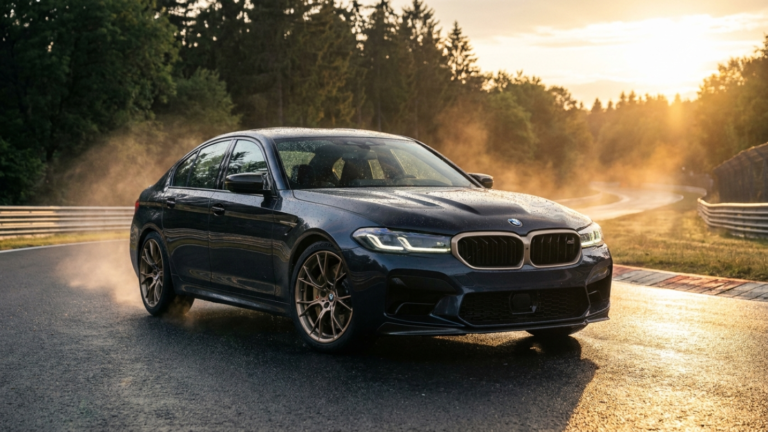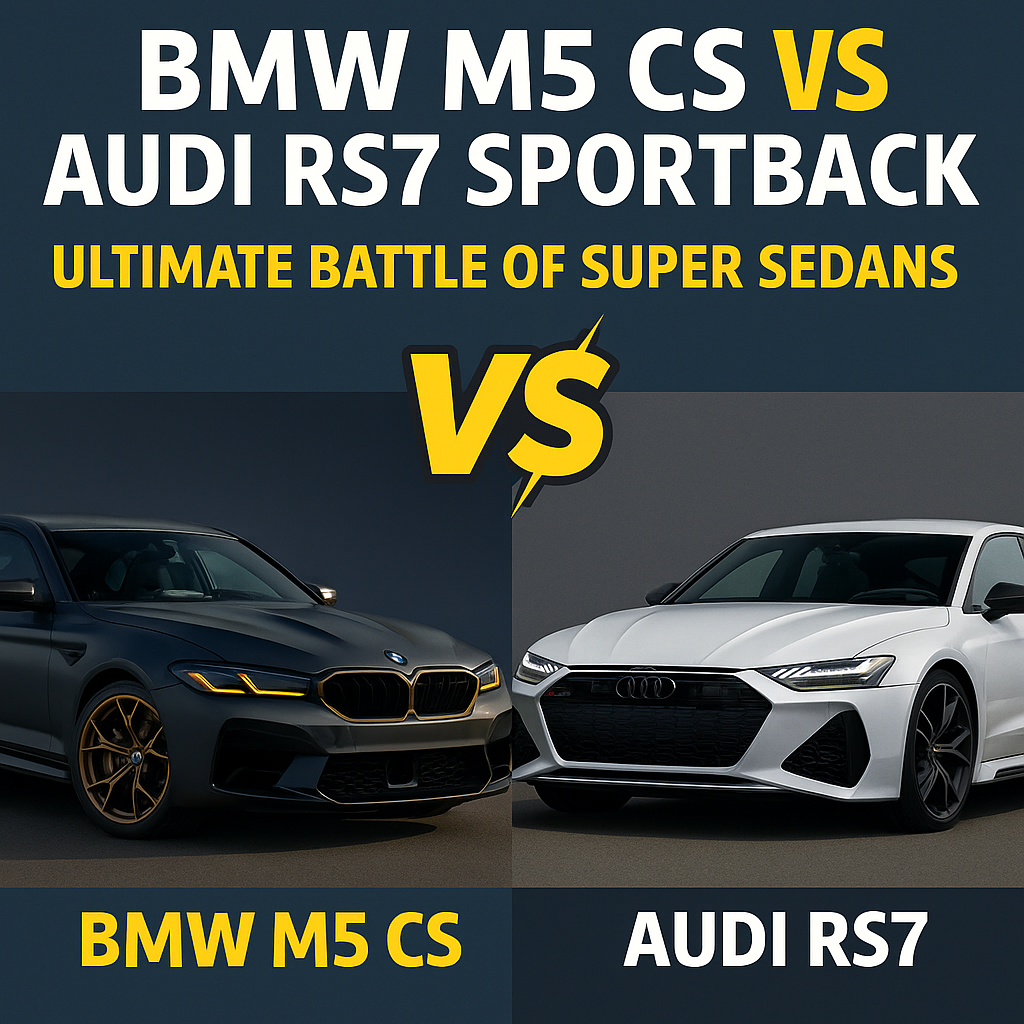
The BMW M5 CS vs Audi RS7 comparison brings together two of the most impressive German super sedans of the modern era. BMW’s M division and Audi Sport have competed for decades, and these two cars show their philosophies at their sharpest. The BMW M5 CS is a lightweight, track-focused version of the F90 M5. The Audi RS7 Sportback is a stylish, technology-packed fastback built for effortless speed in any weather. Both use twin-turbo V8 engines and all-wheel drive, and both can embarrass many supercars, yet they feel completely different on the road.
In this comparison we break down engines, performance, handling, design, interiors, technology, practicality, ownership costs and value to help you decide which super sedan fits you best. For the full story on each car, see our BMW M5 CS review and our Audi RS7 Sportback review.

Table of Contents
- Background of Both Cars
- BMW M5 CS vs Audi RS7: Specifications
- Engine and Performance
- BMW M5 CS
- Audi RS7 Sportback
- Handling and Driving Experience
- Design and Interior
- Sound and Character
- Technology
- Braking and Track Use
- Practicality
- Price, Value and Ownership
- Reliability and What to Check When Buying Used
- Alternatives to Consider
- Category Winners
- Frequently Asked Questions
- Is the BMW M5 CS faster than the Audi RS7?
- Which car is better for daily driving?
- Which car will hold its value better?
- Final Verdict: BMW M5 CS vs Audi RS7
Background of Both Cars
The BMW M5 has been the benchmark super sedan since the original E28 model arrived in the 1980s. The F90 generation introduced all-wheel drive to the M5 for the first time, and the CS, revealed in 2021, became its most focused version. It was the first M5 to wear the CS badge and was built in limited numbers.
The Audi RS7 Sportback first appeared in 2013, based on the stylish A7. The second-generation C8 model arrived in the US for the 2021 model year with a much more aggressive body, sharing only a few panels with the regular A7. It was designed as a stylish alternative to traditional super sedans, combining fastback looks with Quattro traction and a powerful V8.
BMW M5 CS vs Audi RS7: Specifications
| Specification | BMW M5 CS (2022) | Audi RS7 Sportback (C8) |
|---|---|---|
| Engine | 4.4L twin-turbo V8 | 4.0L twin-turbo V8 mild hybrid |
| Horsepower | 627 hp | 591 hp (621 hp Performance) |
| Torque | 553 lb-ft | 590 lb-ft (627 lb-ft Performance) |
| Transmission | 8-speed M Steptronic | 8-speed Tiptronic |
| Drivetrain | M xDrive AWD with 2WD mode | Quattro AWD |
| 0-60 mph (official) | 2.9 seconds | About 3.5 seconds |
| Seats | 4 | 5 |
| Original US price | About $142,000 | About $125,000 |
Engine and Performance
BMW M5 CS
The M5 CS was the most powerful BMW M car of its time when it launched. Its 4.4-liter twin-turbo V8 produces 627 hp and 553 lb-ft of torque, sent through an eight-speed automatic to BMW’s M xDrive all-wheel-drive system. Drivers can choose a rear-biased setting or even pure rear-wheel drive on a closed course. BMW quotes a 0-60 mph time of 2.9 seconds, and independent tests have recorded even quicker results. Weight reduction of roughly 230 pounds compared with the M5 Competition comes from carbon fiber parts, a titanium exhaust silencer and lightweight seats.
Audi RS7 Sportback
The RS7 uses a 4.0-liter twin-turbo V8 with a 48-volt mild-hybrid system. The standard car produces 591 hp and 590 lb-ft of torque, while the later RS7 Performance raises that to 621 hp and 627 lb-ft. Quattro all-wheel drive delivers grip in all conditions, and an eight-speed Tiptronic automatic shifts smoothly. Audi’s official 0-60 mph figure is about 3.5 seconds, although US testers have recorded times closer to three seconds.
The BMW M5 CS wins this round with quicker acceleration and a sharper, more aggressive character. The RS7 remains enormously fast and feels effortless, especially in poor weather.
Handling and Driving Experience
The M5 CS was developed with track driving in mind. Its suspension is firmer and more precise than a regular M5, its standard carbon ceramic brakes resist fade and its steering delivers strong feedback. On a winding road it feels smaller and more agile than its size suggests. The ability to send more power to the rear wheels makes it playful for skilled drivers.
The RS7 is tuned more as a grand tourer. Its adaptive air suspension, available Dynamic Ride Control and all-wheel steering make it comfortable and stable at high speeds. It is precise and composed, but it does not communicate as much as the BMW. For long highway trips and daily driving, many owners prefer the Audi’s calmer nature.
Design and Interior
Aggression defines the M5 CS from every angle. It has Laserlight headlights with distinctive yellow daytime running lights inspired by BMW GT race cars, a carbon fiber hood, Gold Bronze wheels and grille details, and a carbon rear spoiler. Inside, carbon bucket seats up front, Alcantara trim and two individual rear seats make it a strict four-seater with a motorsport atmosphere.
The RS7 is more elegant. It is wide, low and sleek, with frameless doors, a sloping fastback roofline, flared fenders and Matrix LED or laser headlights. Inside, it offers Audi’s dual touchscreens, the virtual cockpit, Valcona leather, ambient lighting and soft-touch materials. It seats five and feels like a luxury grand tourer.
The RS7 takes this round with a more luxurious and versatile interior, while the M5 CS deliberately trades some comfort for performance.
Sound and Character
Both V8 engines sound strong, but in different ways. The M5 CS has a deep, aggressive tone that becomes sharper as revs rise, and its titanium exhaust adds extra crackle. The RS7’s V8 delivers a smoother, more muscular rumble, especially with the optional RS sport exhaust. The BMW feels more urgent and raw, while the Audi feels more refined and confident.
Technology
The M5 CS uses BMW’s iDrive 7 system with a digital instrument cluster, head-up display and a full set of driver assistance features. Its M1 and M2 buttons let drivers save favorite setups. The RS7 offers Audi’s MMI touch response system with haptic feedback, a configurable virtual cockpit, a premium Bang and Olufsen audio option and advanced driver assistance. For everyday tech and convenience, the Audi has the edge.
Braking and Track Use
Standard carbon ceramic brakes give the M5 CS excellent fade resistance during repeated hard stops, and its firmer chassis keeps the car composed lap after lap. The RS7 offers optional carbon ceramic brakes, and its huge steel brakes are strong on the road, but its heavier weight and comfort-oriented tuning make it less suited to regular track days.
Practicality
The RS7’s liftback tailgate gives it a large, flexible cargo area that is far more practical than the M5 CS’s sedan trunk. It also offers a rear bench for three passengers. The M5 CS has four seats only, which limits its usefulness as a family car.
Price, Value and Ownership
The M5 CS started at about $142,000 and was sold in the US for a single model year, while the RS7 started at roughly $125,000 and came better equipped as standard. Thanks to its rarity, the M5 CS has held its value better than most luxury sedans. Both cars need premium fuel, expensive tires and specialist servicing, and the M5 CS’s carbon ceramic brakes are very costly to replace.
Reliability and What to Check When Buying Used
Both cars use proven engines. The BMW S63 V8 in the F90 generation is far more robust than earlier versions of the engine, and the Audi 4.0-liter V8 is widely used across the Volkswagen Group, including in Porsche, Bentley and Lamborghini models. When buying either car used, check for a complete service history, oil leaks, tire and brake condition, evidence of track use and any open recalls. On the RS7, inspect the air suspension and the condition of large wheels, which are easily damaged by curbs. On the M5 CS, check the exposed carbon fiber parts for chips and cracks.
Alternatives to Consider
Buyers considering the BMW M5 CS vs Audi RS7 should also look at the Mercedes-AMG E63 S, which offers 603 hp, a luxurious cabin and, in some markets, a wagon body. The Porsche Panamera Turbo S is another strong option with excellent handling and a premium interior. The Cadillac CT5-V Blackwing offers a supercharged V8 and a manual transmission for drivers who want a more analog experience. For a broader look at the rivalry, read our Audi RS vs BMW M comparison.
Category Winners
| Category | Winner |
|---|---|
| Power and acceleration | BMW M5 CS |
| Handling and feedback | BMW M5 CS |
| Interior and comfort | Audi RS7 |
| Technology and convenience | Audi RS7 |
| Practicality | Audi RS7 |
| Exclusivity and value retention | BMW M5 CS |
Frequently Asked Questions
Is the BMW M5 CS faster than the Audi RS7?
Yes. The M5 CS has more power, less weight and a quicker official 0-60 mph time, and it is sharper on a racetrack.
Which car is better for daily driving?
The Audi RS7 is the better daily driver thanks to its softer ride, five seats, larger cargo area and more luxurious cabin.
Which car will hold its value better?
The BMW M5 CS is more likely to hold its value because it was built in limited numbers and is already considered a collectible.
Final Verdict: BMW M5 CS vs Audi RS7
If you want a raw, track-bred super sedan with few compromises, the BMW M5 CS is the clear choice. It is one of the most celebrated performance sedans ever built and a likely future classic. If you want supercar performance combined with luxury, comfort and everyday practicality, the Audi RS7 Sportback is hard to beat. Whichever you choose, you will be driving one of the finest performance cars of its generation.