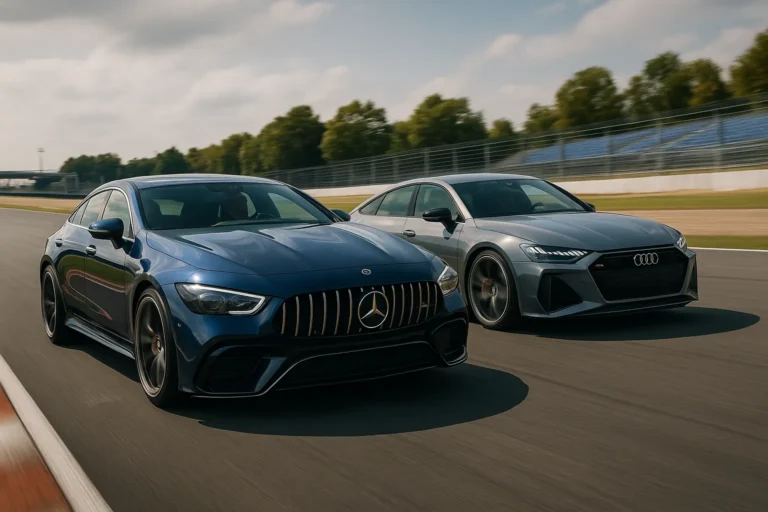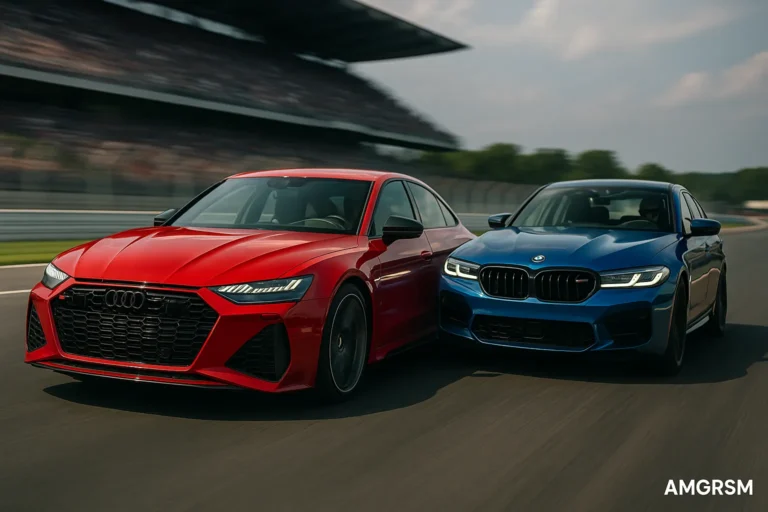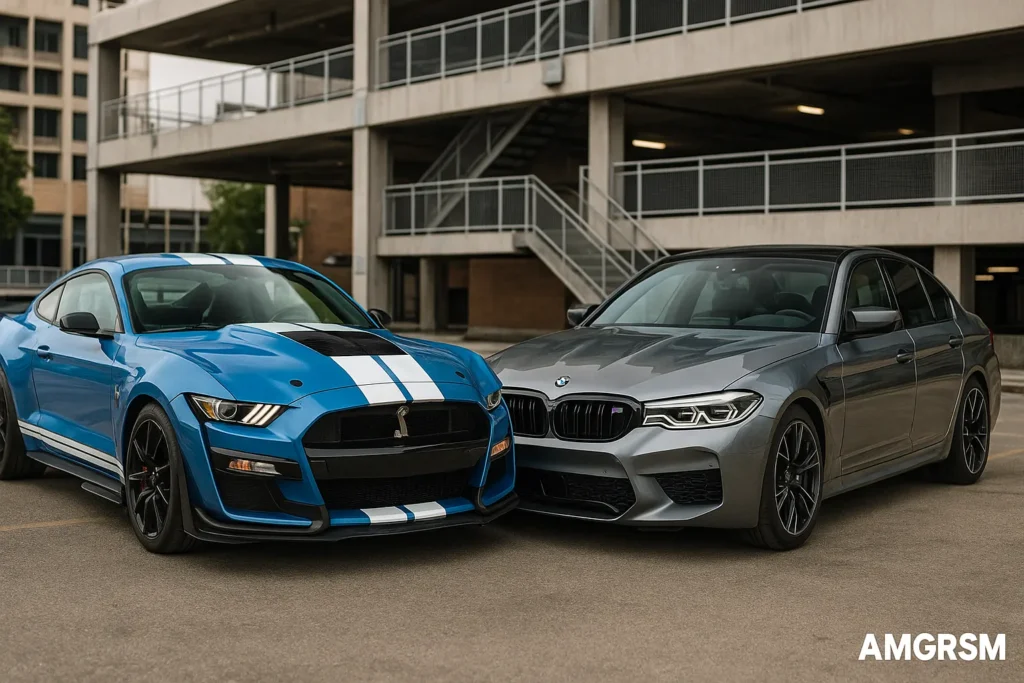
The debate over American muscle vs German precision has raged for decades. On one side are big, loud, V8-powered cars like the Ford Mustang Shelby GT500, the Dodge Challenger SRT Hellcat and the Chevrolet Camaro ZL1, built around raw horsepower, drama and incredible value. On the other side are carefully engineered machines like the BMW M5, the Mercedes-AMG E63 S and the Porsche 911, built around precision, technology and the ability to perform in every condition.
Both approaches have passionate fans, and both have produced some of the most exciting cars ever made. In this guide we compare the two philosophies across horsepower, handling, technology, build quality, real-world speed, running costs and value, then match up key rivals head to head. For more German contenders, read our list of the top German performance cars.
Table of Contents
- Two Cultures, Two Philosophies
- Brute Horsepower: Why Americans Love Muscle
- Handling and Precision: Germany Strikes Back
- Technology, Quality and Real-World Speed
- Daily Driving and Practicality
- Head-to-Head Matchups
- Sound and Emotion
- Price and Value for Money
- Running Costs and Reliability
- The End of an Era for Muscle Cars
- Frequently Asked Questions
- Are American muscle cars faster than German cars?
- Which is cheaper to own?
- Which is better on a racetrack?
- Final Verdict: American Muscle vs German Precision
- Related Reading
Two Cultures, Two Philosophies
The American muscle car was born in the 1960s with cars like the Pontiac GTO, the Ford Mustang and the Dodge Charger. The formula was simple: put the biggest possible V8 into a mid-size car, sell it at an affordable price and let young buyers enjoy straight-line speed. Gas was cheap, highways were long and drag racing was a national pastime.
German performance cars grew from a different environment. Unrestricted sections of the Autobahn, demanding mountain roads and a strong motorsport culture encouraged engineers to build cars that were stable at very high speeds, precise in corners and durable under hard use. Brands like BMW M, Mercedes-AMG, Audi Sport and Porsche refined that approach over decades, adding technology to make their cars faster on every kind of road.
Brute Horsepower: Why Americans Love Muscle
A true American muscle car is all about attitude. The final Ford Mustang Shelby GT500 produced 760 hp from a supercharged 5.2-liter V8. The Dodge Challenger SRT Hellcat Redeye delivered 797 hp from its supercharged 6.2-liter HEMI V8. The Chevrolet Camaro ZL1 offered 650 hp and an available manual transmission. These cars delivered enormous power for well under $100,000, a level of horsepower per dollar that German rivals rarely match.
Start a Hellcat on a quiet morning and the supercharger whine and V8 rumble announce its presence to the entire street. This is theatrical performance designed for fun, intimidation and noise. For many buyers, that emotion is exactly the point. The cars are also relatively simple mechanically, which makes them popular with tuners who can unlock even more power at a modest cost.
Handling and Precision: Germany Strikes Back
German performance cars take a different approach. Instead of focusing purely on peak horsepower, they balance power with chassis engineering, weight distribution and advanced electronics. The BMW M5 CS, for example, had 627 hp, less than the top American muscle cars, but its M xDrive all-wheel drive, adaptive suspension and carbon ceramic brakes made it devastatingly effective on a winding road. Read our full BMW M5 CS review for more detail.
The Porsche 911 GT3 takes precision even further, with a naturally aspirated flat-six, race-derived suspension and rear-wheel steering. It is one of the most celebrated driver’s cars ever built. Where a big, heavy muscle car can feel lively and sometimes unruly at the limit, the best German cars feel composed, predictable and confidence-inspiring.
That said, American engineers have closed much of the gap. The Camaro ZL1 1LE and the Mustang GT500 with its Carbon Fiber Track Package were genuinely fast on a racetrack and earned praise from testers for their handling.
Technology, Quality and Real-World Speed
This is where Germany usually leads. Dual-clutch transmissions, rear-wheel steering, active anti-roll systems, torque-vectoring differentials and sophisticated all-wheel-drive systems allow German cars to deliver their performance consistently. The Mercedes-AMG E63 S, for example, weighs about as much as a large muscle sedan, yet its 4MATIC+ all-wheel drive lets it launch hard in rain or shine. Rear-wheel-drive muscle cars with more than 700 hp often struggle for traction, especially on cold or wet roads.
Inside, German brands typically offer higher-quality materials, more refined designs and more advanced infotainment. American muscle car interiors improved greatly in their final generations, but they were designed to hit a lower price, and that sometimes shows in the plastics and switchgear.
Daily Driving and Practicality
Muscle cars like the Mustang and Camaro are two-door coupes with small rear seats and modest trunks, although the Dodge Charger offered four doors and real space for adults. Their ride quality can be firm, and visibility in the Camaro in particular was often criticized. German performance sedans like the BMW M5 and Mercedes-AMG E63 S offer four doors, large trunks, comfortable rear seats and adaptive suspension that softens the ride for daily use. They can serve as family cars during the week and performance cars on the weekend, which is a major reason many buyers choose them despite the higher price.
All-weather capability matters too. Most German performance sedans now offer all-wheel drive, which makes them usable year-round in snowy regions. High-horsepower rear-wheel-drive muscle cars are often stored during winter in colder states.
Head-to-Head Matchups
| Matchup | American power | German power | Key difference |
|---|---|---|---|
| Mustang Shelby GT500 vs BMW M5 CS | 760 hp | 627 hp | Supercharged RWD vs twin-turbo AWD |
| Challenger Hellcat Redeye vs Mercedes-AMG E63 S | 797 hp | 603 hp | Muscle coupe vs AWD super sedan |
| Camaro ZL1 vs Porsche 911 GT3 | 650 hp | 502 hp | Supercharged V8 vs high-revving flat-six |
The numbers show the pattern clearly. American cars win on raw horsepower and price, while German cars use technology, traction and chassis tuning to deliver strong performance with less power. In the real world, the German cars are often quicker from a standstill thanks to all-wheel drive, while the American cars are spectacular once traction is no longer a problem.
Sound and Emotion
Sound is one of the biggest reasons people fall in love with performance cars. American muscle cars deliver a deep, loose, rumbling V8 sound that has become part of popular culture, from drag strips to Hollywood car chases. Supercharged engines add a distinctive whine that fans adore. German performance cars tend to sound more refined and technical. The AMG V8 is the exception, with a thunderous crackle that rivals any American engine, while BMW’s inline-six and Porsche’s flat-six produce higher-pitched, more mechanical notes. Which one sounds better is purely a matter of taste.
Price and Value for Money
Value is where American muscle shines brightest. A new Mustang GT with a 5.0-liter V8 has long been one of the most affordable ways to get more than 450 hp, and used Hellcats and ZL1s offer supercar-level power for the price of a well-equipped family SUV. German performance cars are considerably more expensive to buy, and the most capable models, such as the BMW M5, Mercedes-AMG E63 S and Porsche 911 GT3, often cost twice as much or more. German cars also tend to depreciate quickly, which can make a used example an attractive alternative for buyers who want precision without the new-car price.
Running Costs and Reliability
Muscle cars generally cost less to buy and maintain. Their engines are proven, parts are widely available and many independent shops can service them. German performance cars usually need specialist servicing, expensive parts and more frequent attention to complex systems such as adaptive suspension, turbochargers and dual-clutch transmissions. On the other hand, German cars often include more standard safety and luxury equipment.
The End of an Era for Muscle Cars
The American muscle car landscape has changed dramatically. Dodge ended production of the gasoline Challenger and Charger in 2023, Chevrolet ended the Camaro after the 2024 model year and the Shelby GT500 was discontinued after 2022. The Mustang continues with a modern V8, and the new Mustang GTD is aimed squarely at the Porsche 911 on track. German brands are also changing, with hybrid systems in the BMW M5 and Mercedes-AMG C63. Both cultures are adapting to stricter emissions rules, but their enthusiasts remain as passionate as ever.
Frequently Asked Questions
Are American muscle cars faster than German cars?
American muscle cars often have more horsepower, but German performance cars are frequently quicker in real-world conditions thanks to all-wheel drive, advanced transmissions and better traction.
Which is cheaper to own?
American muscle cars are usually cheaper to buy, insure and maintain, while German performance cars need more specialist servicing and expensive parts.
Which is better on a racetrack?
Track-focused German cars like the Porsche 911 GT3 are among the best track cars available, but special American models like the Camaro ZL1 1LE and the Mustang GTD are also extremely capable.
Final Verdict: American Muscle vs German Precision
If you want tire smoke, loud V8 thunder, outrageous looks and huge horsepower for the money, American muscle cars are hard to beat. They deliver drama and fun that make every drive feel like an event. If your goal is to go fast in every condition, on track, in bad weather and in daily driving, German performance cars deliver more technology, repeatable acceleration and precise handling.
In the American muscle vs German precision debate, there is no single winner. Muscle cars win on emotion and value; German cars win on engineering and versatility. The best choice depends on how and where you drive.
Official specifications for the cars in this comparison are available on the BMW USA and Chevrolet websites.
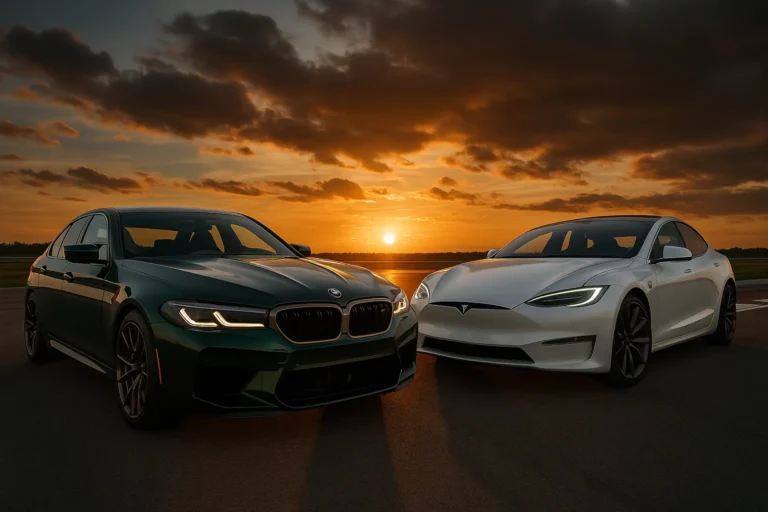
The clash between combustion and electric power is explored further in our BMW M5 CS vs Tesla Model S Plaid comparison.