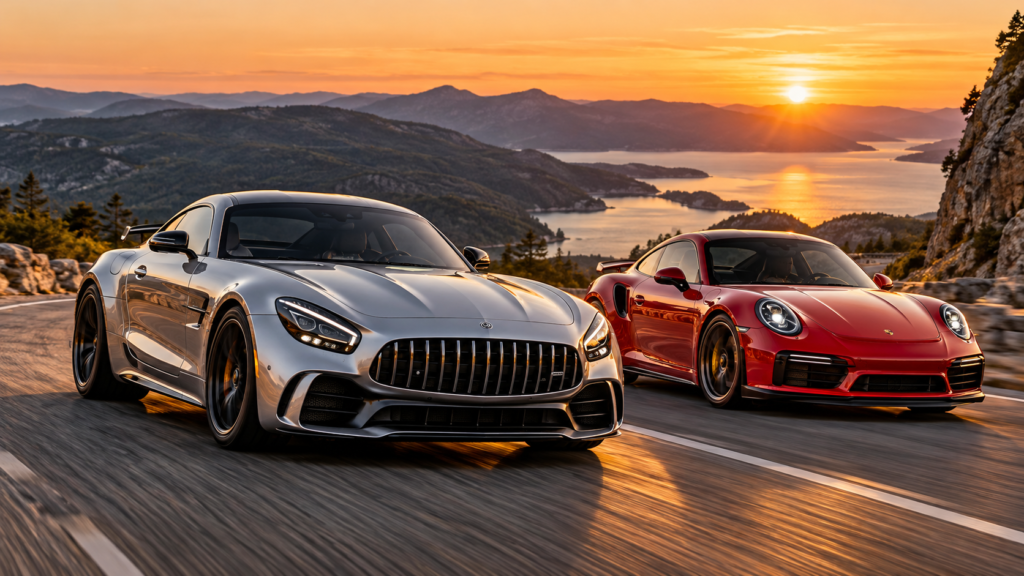
AMG GT 63 vs Porsche 911 Turbo S is one of the most interesting grand tourer battles on sale today. For decades, the Porsche 911 Turbo S has been the benchmark for an all-weather supercar you can drive every day. It is fast enough to embarrass exotic cars on a back road, yet comfortable and practical enough for a long highway trip. The second-generation Mercedes-AMG GT 63 was designed to take that crown. It now has all-wheel drive, rear seats and a twin-turbo V8 with almost 600 horsepower, and it costs significantly less than the Porsche.
So which grand tourer is the better buy? In this comparison we look at performance, technology, driving character, comfort, running costs and value to help you decide between the Mercedes-AMG GT 63 and the Porsche 911 Turbo S. If you are new to the AMG range, our Top 10 Mercedes-AMG models guide explains where the GT sits in the lineup.
Table of Contents
- Two Different Philosophies
- Mercedes-AMG GT 63 at a Glance
- Porsche 911 Turbo S at a Glance
- AMG GT 63 vs Porsche 911 Turbo S: Specifications Compared
- Performance and Driving Experience
- Straight-Line Speed
- Handling and Steering
- Sound and Character
- Interior, Comfort and Practicality
- Technology and Engineering
- Price, Running Costs and Value
- AMG GT 63 vs Porsche 911 Turbo S: Which One Should You Buy?
- Choose the Mercedes-AMG GT 63 If:
- Choose the Porsche 911 Turbo S If:
- AMG GT 63 vs Porsche 911 Turbo S: The Verdict
Two Different Philosophies
In the AMG GT 63 vs Porsche 911 Turbo S comparison, the two cars reach a similar goal from opposite directions. The Porsche 911 Turbo S has been refined over generations around a rear-mounted flat-six engine, a compact footprint and an obsession with lap times. The latest version adds a performance hybrid system, making it the most powerful production 911 ever built.
The Mercedes-AMG GT 63 takes a more traditional grand touring approach. A big twin-turbo V8 sits in the front, power goes to all four wheels, and the cabin is designed to cover long distances in comfort. The current generation was developed alongside the Mercedes-AMG SL, which explains why it is larger, more practical and more luxurious than the original two-seat AMG GT.
Mercedes-AMG GT 63 at a Glance
The GT 63 4MATIC+ is powered by AMG’s hand-built 4.0-liter twin-turbo V8, producing 577 hp and 590 lb-ft of torque. It uses the AMG SPEEDSHIFT MCT 9-speed transmission and the fully variable 4MATIC+ all-wheel-drive system. Mercedes-AMG quotes a 0-60 mph time of 3.1 seconds and a top speed of 196 mph. For buyers who want more, the GT 63 PRO raises output to 603 hp and 627 lb-ft, and the plug-in hybrid GT 63 S E Performance pushes combined output beyond 800 hp.
Porsche 911 Turbo S at a Glance
The 2026 Porsche 911 Turbo S uses a 3.6-liter flat-six engine combined with a T-Hybrid system. Two electric turbochargers and an electric motor integrated into the eight-speed PDK transmission help produce a total of 701 hp and 590 lb-ft of torque. Porsche quotes 0-60 mph in just 2.4 seconds, and all-wheel drive is standard. The hybrid system is powered by a compact 1.9 kWh, 400-volt battery and is designed purely for performance rather than electric-only driving.
AMG GT 63 vs Porsche 911 Turbo S: Specifications Compared
| Specification | Mercedes-AMG GT 63 4MATIC+ | Porsche 911 Turbo S (2026) |
|---|---|---|
| Engine | 4.0L twin-turbo V8 | 3.6L flat-six with T-Hybrid |
| Horsepower | 577 hp | 701 hp (system) |
| Torque | 590 lb-ft | 590 lb-ft |
| Transmission | 9-speed AMG SPEEDSHIFT MCT | 8-speed PDK |
| Drivetrain | All-wheel drive (4MATIC+) | All-wheel drive |
| 0-60 mph | 3.1 seconds | 2.4 seconds |
| Seating | 2+2 | 2+2 |
| US starting price (coupe) | About $180,000 | $272,650 |
Looking at the AMG GT 63 vs Porsche 911 Turbo S specifications, the Porsche is clearly the faster car on paper. It has more than 120 additional horsepower and is significantly quicker to 60 mph. However, the numbers do not tell the whole story, especially when price enters the conversation.
Performance and Driving Experience
Straight-Line Speed
The 911 Turbo S is one of the quickest-accelerating production cars on sale. Its rear-engine layout puts weight over the driven rear wheels, and the electric turbochargers virtually eliminate turbo lag. Launch it from a standstill and it reaches 60 mph in a time that rivals many hypercars. The AMG GT 63 is still extremely fast, but it cannot match the Porsche’s launch. In real-world driving, though, both cars deliver more acceleration than most owners will ever use on public roads.
Handling and Steering
Both cars use advanced chassis technology. The AMG GT 63 comes with rear-axle steering and an active suspension system with hydraulic roll stabilization, which keeps the body flat in corners without making the ride harsh. The Porsche also offers rear-axle steering and active anti-roll systems, and its steering is widely praised by road testers for its precision and feedback.
Most reviews agree that the 911 Turbo S feels more compact and agile, while the GT 63 feels larger and more planted, especially at high speed. The Porsche rewards precision; the AMG rewards confidence. On a tight mountain road the Porsche has the edge, while on a fast sweeping highway the AMG is arguably the more relaxed companion.
Sound and Character
This is where the AMG has a clear advantage. The 4.0-liter twin-turbo V8 delivers the deep, aggressive soundtrack AMG is famous for, with crackles on the overrun in its sportiest modes. The Porsche’s flat-six has a more technical, mechanical sound. Some buyers will prefer the Porsche’s precision, but for many enthusiasts the V8’s character is a major reason to choose the Mercedes.
Interior, Comfort and Practicality
In the AMG GT 63 vs Porsche 911 Turbo S cabin comparison, both cars offer 2+2 seating, but the rear seats in each are best suited to children, short trips or extra luggage space. The AMG GT 63 has a larger cabin overall and a hatchback-style rear trunk, which makes it slightly more practical for weekend trips. The Porsche has a small front trunk and folding rear seat backs, which together offer surprisingly useful storage for a sports car.
Inside, the AMG uses the latest MBUX infotainment system with a portrait-style central touchscreen and a fully digital instrument display. The design is dramatic and luxurious, with plenty of ambient lighting and premium materials. The Porsche’s interior is more driver-focused, with a curved digital instrument display and a cleaner, more traditional layout. Buyers who value a luxury atmosphere often prefer the Mercedes, while those who value ergonomics and simplicity often prefer the Porsche.
For daily comfort, both cars are excellent long-distance cruisers. The AMG’s longer wheelbase and adaptive suspension give it a slightly more relaxed ride on rough roads, while the Porsche remains impressively comfortable for a car with such strong performance credentials.
Technology and Engineering
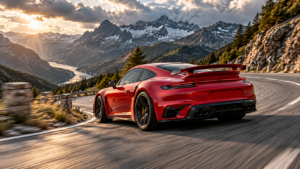
The new 911 Turbo S is a technical showcase. Its T-Hybrid system uses electric turbochargers that spool almost instantly and recover energy, while the electric motor in the transmission adds torque at low speeds. Unlike a plug-in hybrid, it cannot drive on electric power alone, but it significantly improves response and performance. The trade-off is added weight and complexity compared with the previous generation.
The AMG GT 63 relies on proven engineering. Its 4.0-liter V8 is a hand-assembled engine with the turbochargers mounted in the “hot vee” between the cylinder banks for faster response. This engine family has been used across many AMG models for years, which gives buyers some confidence about its long-term development. For an even more extreme take on the AMG GT formula, see our feature on the AMG GT Black Series.
Price, Running Costs and Value
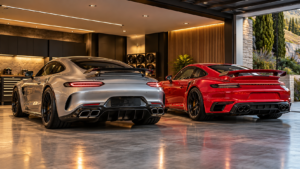
Price is the biggest difference in the AMG GT 63 vs Porsche 911 Turbo S matchup. The Mercedes-AMG GT 63 starts at around $180,000 in the US, while the 2026 Porsche 911 Turbo S coupe starts at $272,650 before options. That gap of roughly $90,000 is enough to buy a second performance car.
Running costs are high for both. Expect expensive tires, large brake replacements, premium fuel and high insurance premiums. Porsche’s options list is famously long and expensive, and it is easy to add tens of thousands of dollars to the final price. The AMG also has costly options, but it typically comes with a higher level of standard equipment for the money.
On the used market, the previous-generation 911 Turbo S (992.1, with 640 hp) is an interesting alternative for buyers who want Porsche performance at a lower price. Historically, the 911 Turbo has held its value very well, which can offset some of its higher purchase price over time. AMG models traditionally depreciate faster, which is bad news for the first owner but good news for used buyers.
AMG GT 63 vs Porsche 911 Turbo S: Which One Should You Buy?
Choose the Mercedes-AMG GT 63 If:
- You want a powerful V8 with a dramatic sound and strong character
- You prefer a more luxurious cabin and a slightly more relaxed ride
- You will use the car for long-distance touring and weekend trips
- You want supercar performance while saving tens of thousands of dollars
Choose the Porsche 911 Turbo S If:
- You want the quickest, most precise car in this comparison
- You value cutting-edge hybrid technology and lap-time performance
- You prefer a compact car that feels agile on twisty roads
- Strong resale value is important to you
If you are also considering other German performance cars, our guide to the best German performance cars covers more alternatives from Mercedes-AMG, Audi RS and BMW M.
AMG GT 63 vs Porsche 911 Turbo S: The Verdict
The Porsche 911 Turbo S remains the benchmark for outright performance. With 701 hp, a 2.4-second 0-60 mph time and highly advanced hybrid technology, it is one of the most capable sports cars money can buy. If budget is not a concern and you want the very best, the Porsche is hard to beat. Full details are available on the official Porsche USA website.
The Mercedes-AMG GT 63, however, offers something different and arguably more appealing to many buyers: a charismatic V8, a luxurious cabin, everyday usability and performance that is more than enough for the road, all for a much lower price. It is the better grand tourer for drivers who want emotion and comfort as much as speed. You can configure the latest model on the official Mercedes-Benz USA website.
In the AMG GT 63 vs Porsche 911 Turbo S debate, the Porsche wins on performance and precision, while the AMG wins on value, sound and grand touring character. The right choice depends on whether you want the fastest car, or the car that makes every journey feel like an event.