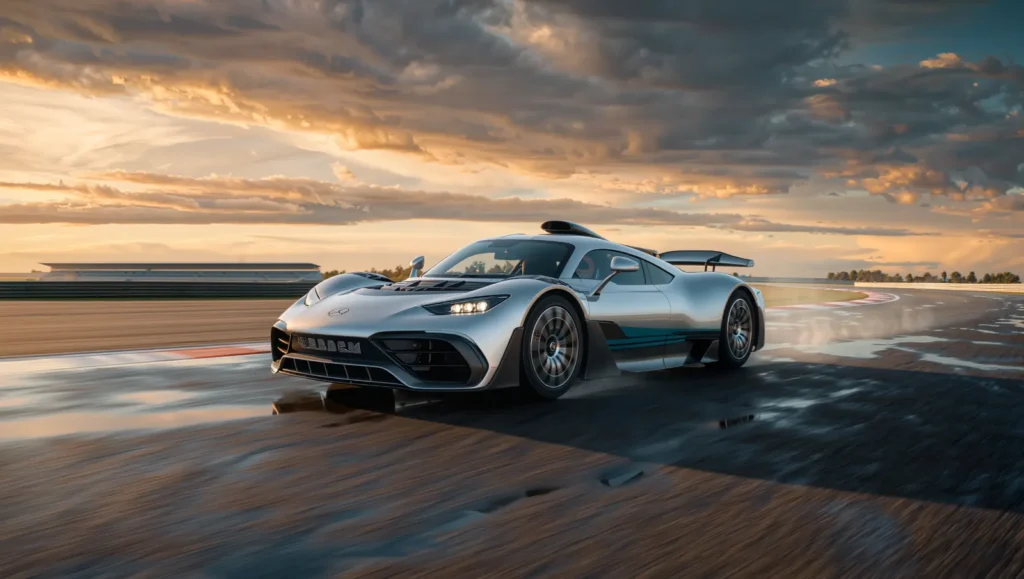
The Mercedes-AMG ONE hypercar is the closest thing to a Formula 1 car that has ever worn license plates. Instead of borrowing styling cues or marketing language from the race team, Mercedes-AMG took the actual hybrid power unit concept that powered its championship-winning F1 cars, adapted it for public roads, and wrapped it in a carbon-fiber body with active aerodynamics. The result is a two-seat machine with a 1.6-liter turbocharged V6 that revs to 11,000 rpm, four electric motors, and a combined output of 1,063 PS (about 1,049 hp).
It was also one of the most difficult cars Mercedes-AMG has ever built. First shown as Project ONE at the 2017 Frankfurt motor show, it took until mid-2022 for the production car to be revealed and until January 2023 for the first customer delivery. In this guide we explain how the powertrain works, what the numbers really mean, why the car is not sold in the United States, and where it sits in the history of AMG and the wider hypercar world.
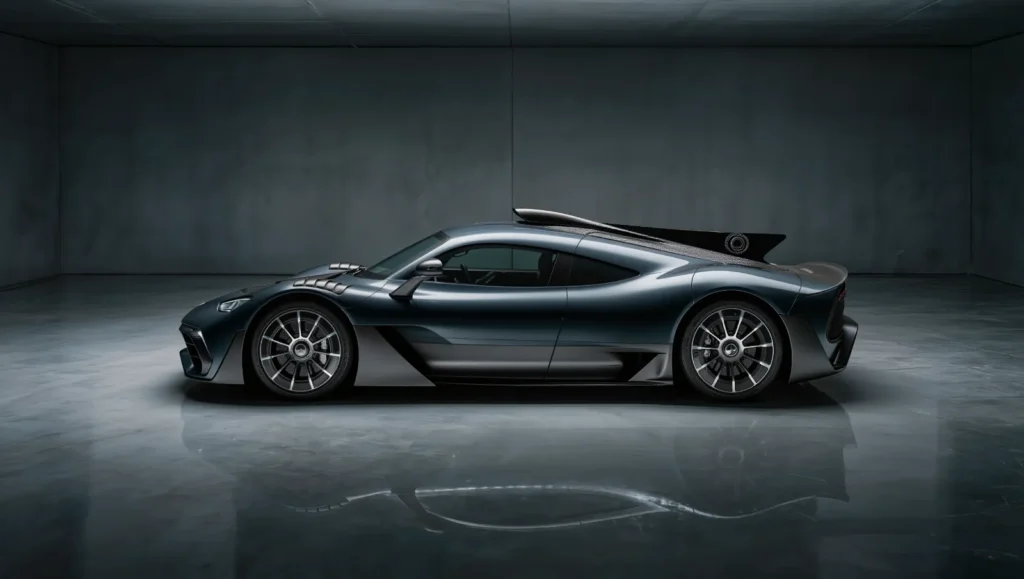
Table of Contents
- What Is the Mercedes-AMG ONE Hypercar?
- From Project ONE to Production Car
- The F1 Powertrain Explained
- The 1.6-Liter Turbocharged V6
- MGU-K and MGU-H
- Front Electric Motors and Battery
- Transmission
- Mercedes-AMG ONE Hypercar Specs and Performance
- Active Aerodynamics and Chassis
- Race Modes and DRS
- Suspension and Tires
- Nürburgring Records and Track Pedigree
- Why the Mercedes-AMG ONE Hypercar Is Not Sold in the US
- Ownership Realities and Maintenance
- Daily Usability
- Running Costs
- Where the AMG ONE Fits in AMG History
- Who Is the Mercedes-AMG ONE Hypercar For?
- Frequently Asked Questions
- How much horsepower does the Mercedes-AMG ONE have?
- Is the AMG ONE street legal in the US?
- How many Mercedes-AMG ONE cars were made?
- Conclusion
What Is the Mercedes-AMG ONE Hypercar?
At its core, the Mercedes-AMG ONE hypercar is a road-legal application of Formula 1 hybrid technology. The internal combustion engine is derived from the Mercedes-AMG PU106B Hybrid, the power unit family that launched the Mercedes F1 team’s era of dominance in 2014. The engine was assembled by Mercedes-AMG High Performance Powertrains in Brixworth, England, the same organization that builds the Formula 1 engines, while final vehicle assembly was handled with partner Multimatic in Coventry.
Production was limited to 275 hand-built cars. According to widely reported figures, demand exceeded that number several times over, yet Mercedes-AMG did not raise the cap. The price is commonly reported at around $2.7 million, although every example was spoken for long before the first car was delivered.
From Project ONE to Production Car
The concept appeared at the 2017 IAA in Frankfurt with a target of reaching customers within a couple of years. That timeline slipped repeatedly. The main obstacle was making a racing engine designed for high idle speeds, very short service intervals, and track-only fuel and emissions conditions behave acceptably in traffic, at low speeds, and under road-car emissions rules. Issues such as idle quality and exhaust emissions took years of engineering to solve. The production model was officially revealed on June 1, 2022, with production beginning that August.
The F1 Powertrain Explained
Understanding the Mercedes-AMG ONE hypercar starts with its powertrain, which combines five power sources: one combustion engine and four electric motors.
The 1.6-Liter Turbocharged V6
The combustion engine is a 1.6-liter (1,598 cc) 90-degree V6 with a single turbocharger. On its own it produces 422 kW, or roughly 566 hp, and it revs to 11,000 rpm. That is a lower ceiling than Formula 1 regulations allowed, a deliberate choice that helps durability in road use. Even so, it remains a racing engine at heart: idle speed sits at roughly 1,280 rpm, and the internal tolerances are far tighter than in any conventional road car engine.
MGU-K and MGU-H
Two electric machines are attached directly to the engine, just as in Formula 1. The MGU-K (Motor Generator Unit, Kinetic) is connected to the crankshaft and adds 120 kW, or about 161 hp. The MGU-H (Motor Generator Unit, Heat) sits on the turbocharger shaft and provides 90 kW. The MGU-H spins the turbocharger up to speed electrically, which removes turbo lag almost completely, and it can also recover energy from exhaust gases to charge the battery. This is one of the most technically remarkable features of the car, because MGU-H technology is so complex that Formula 1 itself is dropping it from the 2026 regulations.
Front Electric Motors and Battery
Two additional 120 kW electric motors drive the front wheels, giving the car all-wheel drive with torque vectoring at the front axle. Power is stored in an 800-volt lithium-ion battery whose cell technology is derived from the F1 program. The car can travel roughly 11 miles (18.1 km) on electric power alone, and in its default road mode it moves off silently on electricity before the V6 joins in.
Transmission
The rear wheels are driven through a seven-speed automated manual gearbox with a single carbon clutch. It is not a dual-clutch unit, and road testers have noted that it prioritizes low weight and compact packaging over the seamless smoothness of a modern DCT.
Mercedes-AMG ONE Hypercar Specs and Performance
The table below summarizes the key published figures. Mercedes-AMG has not released an official combined torque figure, because the interaction between the electric motors and the engine makes a single number misleading.
| Specification | Mercedes-AMG ONE |
|---|---|
| Engine | 1.6-liter turbocharged 90-degree V6, F1-derived |
| Engine output | 422 kW (approx. 566 hp) |
| Redline | 11,000 rpm |
| MGU-K / MGU-H | 120 kW / 90 kW |
| Front electric motors | 2 x 120 kW |
| Combined output | 782 kW / 1,063 PS (approx. 1,049 hp) |
| Transmission | 7-speed automated manual, single clutch |
| Drive | All-wheel drive |
| 0-62 mph (0-100 km/h) | 2.9 seconds |
| 0-124 mph (0-200 km/h) | 7.0 seconds |
| Top speed | 219 mph (352 km/h), electronically limited |
| Electric range | About 11 miles (18.1 km) |
| Production | 275 units |
| Reported price | About $2.7 million |
The 2.9-second sprint to 62 mph is quick but not record-breaking in a world of 1,000-plus horsepower electric hypercars. Where the car truly separates itself is at higher speeds and on a racetrack, where its aerodynamics and power delivery come into play. The 0-124 mph time of 7.0 seconds and a 0-186 mph (0-300 km/h) time of 15.6 seconds show how relentless the acceleration remains as speed builds.
Active Aerodynamics and Chassis
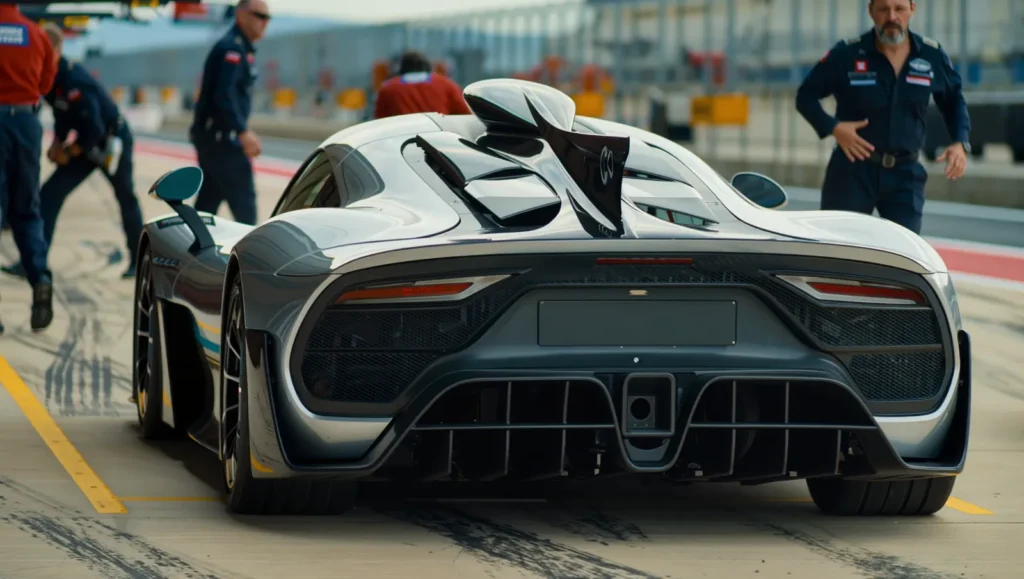
The body is built around a carbon-fiber monocoque, and the shape is dominated by functional aerodynamics. The roof carries an F1-style air intake above the cabin, and a large shark fin runs down the engine cover for stability.
Race Modes and DRS
In the Race Plus mode, the rear wing extends, louvers in the front fenders open, the car lowers itself, and flaps in the front diffuser fold up. Mercedes-AMG states that downforce can increase up to five times compared with the standard setting. Like a Formula 1 car, the ONE has a Drag Reduction System (DRS) that the driver can activate on straights, cutting downforce by about 20 percent to increase straight-line speed. Braking automatically closes the DRS. The most aggressive mode, called Strat 2, adds firmer suspension settings and full electric deployment from all motors.
Suspension and Tires
The suspension uses a pushrod layout borrowed from motorsport, and Race Plus lowers the body by 37 mm at the front and 30 mm at the rear while firming up the setup. The car rides on Michelin Pilot Sport Cup 2 R MO tires that were developed specifically for the model. Published curb weight figures range from about 1,695 to 1,745 kg (roughly 3,737 to 3,847 lb), depending on specification.
Nürburgring Records and Track Pedigree
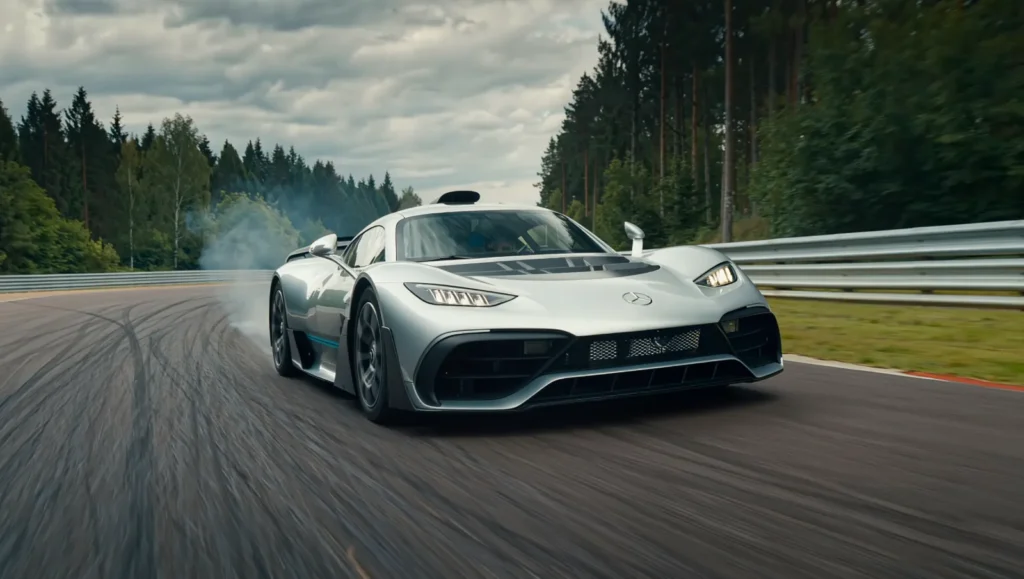
If any single achievement defines the Mercedes-AMG ONE hypercar, it is its performance at the Nürburgring Nordschleife. On October 28, 2022, factory driver Maro Engel set a lap of 6:35.183, taking the production car record from the Manthey-Racing-modified Porsche 911 GT2 RS by more than three seconds. According to reports at the time, the run was completed on a partially damp track just one minute before the session closed.
Two years later, the car beat its own record. On September 23, 2024, Engel completed a lap of 6:29.090, the first time a road-legal production car broke the 6:30 barrier on the Nordschleife. According to Motor1’s report on the record, the car was inspected by TÜV Rheinland in standard condition, used the Race Plus program with its ride height lowered, and ran within factory delivery tolerances for camber. This AMG One Nurburgring record remains one of the strongest arguments that the car is more than a technology showcase.
The ONE has also posted production-car records at other circuits, including the Hockenheimring, the Nürburgring Grand Prix track, the Red Bull Ring, and Monza, according to published Mercedes-AMG data.
Why the Mercedes-AMG ONE Hypercar Is Not Sold in the US
For American readers, the most frustrating fact about the Mercedes-AMG ONE hypercar is that it was never offered for road use in the United States. In a letter to prospective US customers, reported by Carscoops and Motor1, Mercedes explained that meeting U.S. road standards would significantly compromise the car’s performance and overall driving character. Rather than detune the F1-derived powertrain, the company chose not to certify it for the American market.
That decision means a US-based buyer would face the same import hurdles that apply to any non-certified car. Federal rules generally keep such vehicles off public roads unless they qualify under narrow exemptions, and the 25-year import rule will not apply to the ONE for decades. Collectors in the US who want one typically keep it abroad, use it on private tracks, or treat it as a display piece.
Ownership Realities and Maintenance
Owning a car with a racing engine comes with racing-style maintenance. The engine is expected to last around 50,000 km (about 31,000 miles) before it must be returned to Mercedes-AMG for a full refurbishment. For an F1-derived unit that is a remarkable figure, since race engines last only a fraction of that distance, but it is still far below the life expectancy of a normal road car engine.
Daily Usability
Road tests from major publications have consistently described the ONE as loud, stiff, and demanding at low speeds, with limited visibility and a spartan cabin. The interior has AMG Motorsport seats whose backrests offer only two positions, a pedal box that adjusts in eleven steps, an electrically adjustable steering wheel, a pair of free-standing 10-inch displays, a camera-based rear-view mirror, and very little storage space. Start-up involves a warm-up procedure for the engine, and in the default mode the car leaves on electric power. None of this is unexpected for a vehicle conceived around a race engine, but it means the car rewards track days far more than errands.
Running Costs
Mercedes-AMG has not published official maintenance pricing, so specific dollar figures should be treated with caution. What is clear is that servicing is handled through the factory rather than any ordinary dealership, and costs reflect the bespoke nature of the components. Anyone considering an AMG ONE on the secondary market should budget accordingly and confirm the engine’s service history and remaining distance before purchase.
Where the AMG ONE Fits in AMG History
AMG began as an independent tuning firm that turned Mercedes sedans into giant-killers on the racetrack. The ONE represents the opposite path: taking technology developed at the very top of motorsport and bringing it down to the road. Readers who want the full background can explore our overview of the history of AMG from racetrack rebels to Mercedes royalty.
The ONE also previewed the brand’s wider electrification strategy. Ideas tested here, including electric turbochargers and high-voltage hybrid systems, have filtered into models like the C63 S E Performance. Our guide to hybrid AMG performance and efficiency explains how those lessons reach more attainable cars. For those who prefer a pure combustion experience on track, the AMG GT Black Series remains a fascinating counterpoint.
Who Is the Mercedes-AMG ONE Hypercar For?
Buyer’s advice for a car of this kind is different from typical shopping guidance, but the same principles of fit and purpose apply.
- Collectors of motorsport technology: With only 275 cars built and a direct link to one of the most successful eras in F1 history, the car has clear historical significance.
- Track-focused owners: The aerodynamics, record lap times, and race modes make it most rewarding on a circuit, ideally with factory support.
- Not for comfort-oriented drivers: Anyone seeking a refined grand tourer will be better served by cars such as the AMG GT 63 or a Porsche 911 Turbo S.
- Not a practical US road car: American buyers should understand the legal and logistical limits before pursuing one.
For the vast majority of enthusiasts, the Mercedes-AMG ONE hypercar will remain something to study, admire at events, and follow through official data, such as the Mercedes-AMG ONE page on the official AMG website.
Frequently Asked Questions
How much horsepower does the Mercedes-AMG ONE have?
The combined system output is 782 kW, which equals 1,063 PS or roughly 1,049 hp. The 1.6-liter V6 contributes about 566 hp, with the rest coming from the MGU-K, the MGU-H, and two front electric motors.
Is the AMG ONE street legal in the US?
No. Mercedes-AMG chose not to certify the car for American roads, stating that meeting U.S. road standards would significantly compromise its performance and character. It is road legal in Europe and several other markets.
How many Mercedes-AMG ONE cars were made?
Production was limited to 275 hand-built examples, and the first customer delivery took place in January 2023.
Conclusion
The Mercedes-AMG ONE hypercar is not the fastest accelerating car in the world, the most comfortable, or the most practical. What makes it unique is authenticity: it uses a genuine F1-derived hybrid power unit, an 11,000 rpm V6, an electrified turbocharger, and active aerodynamics with DRS, all in a car that can legally be driven on European roads. Its 6:29.090 Nürburgring lap proved that the long and difficult development was worth it. For American enthusiasts it remains out of reach on public roads, but as a statement of what Mercedes-AMG can engineer, few modern cars come close.