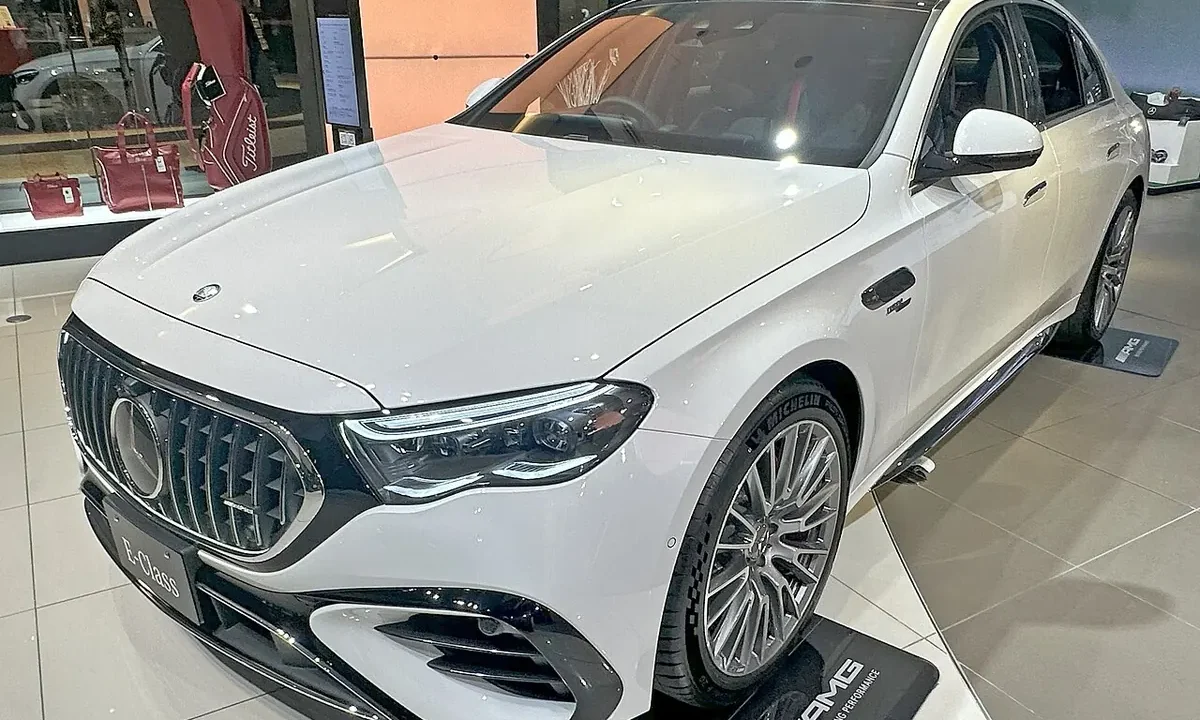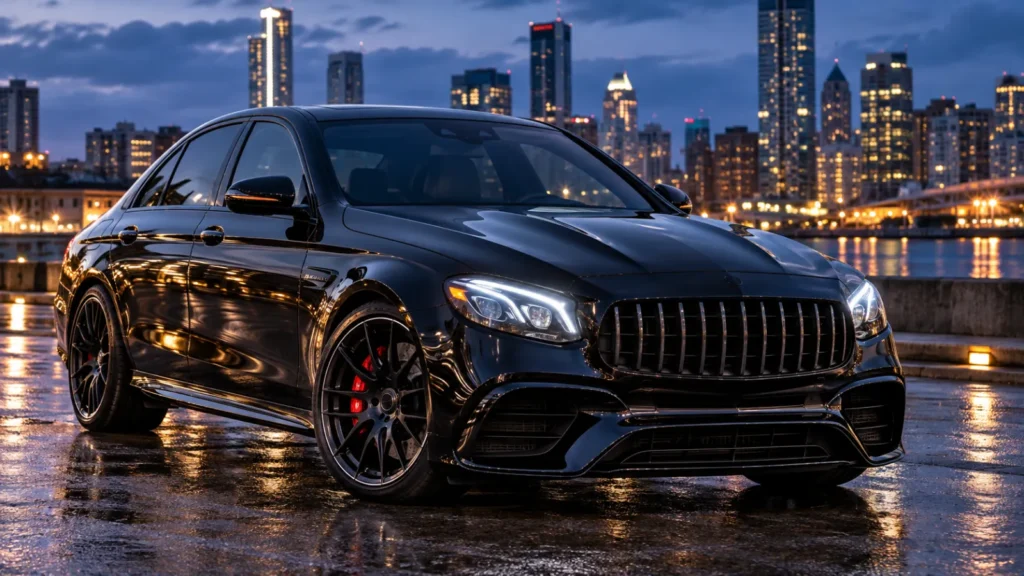
Mercedes-AMG E63 S reliability is one of the most searched questions among American enthusiasts shopping for a used super sedan, and for good reason. Few cars combine a hand-built V8, four-door practicality and supercar-rivaling acceleration the way the E63 does, yet few cars can also generate repair invoices as large as a well-used example. Between the naturally aspirated W211, the twin-turbo W212 and the all-wheel-drive W213, the E63 nameplate covers three very different engines, two transmission philosophies and nearly two decades of technology.
This guide breaks down the known weak points of each generation, drawing on Mercedes-AMG technical data, published road tests, service bulletins and the long-running owner discussions on enthusiast forums. The goal is simple: help buyers understand which E63 years carry the biggest risks, which problems are inexpensive annoyances, and what a smart pre-purchase inspection should focus on before any money changes hands.

Mercedes-AMG Reliability: The Short Answer
Mercedes AMG reliability is better than the internet reputation suggests, but it depends far more on the engine and the car’s history than on the badge. Across published specialist guides, technical service bulletins and owner reports, the pattern is consistent:
This guide is part of the Mercedes-AMG problems and reliability hub, which links every engine, gearbox and fault-code guide for the brand.
- Most robust: the older supercharged 5.4-liter M113K V8 in cars such as the C55, CLK55 and E55 AMG.
- Strong when sorted: the 6.2-liter M156 V8, whose early 2007 to 2011 cars need documented head bolt and camshaft work, and the 5.5-liter twin-turbo M157, where 2014-on cars are the safer bet.
- Solid core, known leaks and misfires: the 4.0-liter twin-turbo M177/M178 V8, which is generally strong internally but has a well-documented oil separator, rear main seal and ignition coil pattern.
- Newer four-cylinder and six-cylinder AMGs: good engines overall, with specific items to verify, from the M133 turbo oil line campaign to the M260 valve seat warranty extension on 2019 to 2022 A 35 models and the 48-volt system on 53-series cars.
The full engine-by-engine table is in the Mercedes-AMG reliability by engine section below. The rest of this guide stays focused on the E63 S, the clearest case study of how reliability changed across three generations. For the broader picture across the whole AMG range, including C63 problems by generation, read our Mercedes-AMG reliability guide.
Mercedes-AMG E63 S Reliability at a Glance
Before diving into each generation, it helps to see the three cars side by side. The table below summarizes the core hardware that defines each era, because the engine and transmission are where the largest reliability differences live. If you are new to the brand and want background on what separates an AMG from a regular Mercedes, our explainer on the difference between AMG and Mercedes-Benz is a useful primer.
| Generation | US Model Years | Engine | Output | Transmission | Drive |
|---|---|---|---|---|---|
| W211 E63 AMG | 2007 to 2009 | M156 6.2-liter naturally aspirated V8 | 507 hp / 465 lb-ft | 7-speed automatic | Rear-wheel drive |
| W212 E63 AMG (early) | 2010 to 2011 | M156 6.2-liter naturally aspirated V8 | 518 hp / 465 lb-ft | AMG Speedshift MCT 7-speed | Rear-wheel drive |
| W212 E63 AMG (biturbo) | 2012 to 2016 | M157 5.5-liter twin-turbo V8 | 518 to 577 hp | AMG Speedshift MCT 7-speed | RWD, then 4MATIC from 2014 |
| W213 E63 S | 2018 to 2023 | M177 4.0-liter twin-turbo V8 | 603 hp / 627 lb-ft | AMG Speedshift MCT 9-speed | 4MATIC+ all-wheel drive |
In broad terms, the story of E63 durability is one of steady improvement. The early M156 cars have the most serious documented engine concerns, the M157 cars introduced turbocharging with a handful of well-understood fixes, and the M177 in the W213 is generally regarded by owners and independent specialists as the most robust of the three, provided it has been maintained properly.
W211 E63 AMG (2007 to 2009): The Naturally Aspirated Original
The first E63 replaced the supercharged E55 and introduced the M156, the first V8 designed entirely by Mercedes-AMG in Affalterbach. With 507 hp and a 7,200 rpm character, it delivered a 0-60 mph time of about 4.4 seconds according to published specifications. It is a thrilling engine, but it is also the source of the two most discussed problems in E63 history.
Cylinder Head Bolts
M156 engines built from roughly 2007 through 2011 are associated with head bolt failures. The original torque-to-yield bolts could stretch or break, which in turn allowed coolant to enter the cylinders and, in the worst cases, led to catastrophic engine damage. Mercedes later revised the bolts, and owner forums commonly reference a specific engine serial number range after which the updated hardware was used. Buyers should ask for documentation showing the head bolts were replaced or confirm the engine number falls after the revision. Warning signs include unexplained coolant loss, white exhaust smoke and misfires on startup.
Camshaft and Lifter Wear
The second M156 weakness is premature wear of the camshaft lobes and valve lifters. A class action lawsuit filed in 2011 alleged that the camshafts and lifters of 2007 to 2011 AMG models wore prematurely. According to the M156 engine history, the court dismissed the amended complaint for lack of standing, and the case was closed in January 2013. Regardless of the legal outcome, the symptom is well documented: a ticking noise on cold start that grows louder over time. Correcting it typically requires new camshafts and lifters, which is a labor-intensive job.
Other W211 Considerations
- Airmatic air suspension components age and eventually leak, a common trait of Mercedes models from this era.
- The 7-speed automatic is generally durable, but fluid service is often neglected by previous owners.
- Age-related items such as engine mounts, rubber hoses and interior electronics should be expected on any car of this vintage.
From a Mercedes-AMG E63 S reliability perspective, the W211 is the highest-risk generation simply because of age and the M156’s known issues. It remains a rewarding purchase for buyers who verify the head bolt fix and budget for a camshaft job.
W212 E63 AMG (2010 to 2016): Two Engines, One Chassis
The W212 generation is really two cars. The 2010 and 2011 models kept the naturally aspirated 6.2-liter M156, now rated at 518 hp and paired with the new AMG Speedshift MCT 7-speed, which replaced the torque converter with a wet multi-disc start-up clutch. From 2012, AMG switched to the M157 5.5-liter twin-turbo V8. For 2014, the facelifted car added 4MATIC all-wheel drive and an S-Model with 577 hp and 590 lb-ft of torque, while the standard car produced 550 hp and 531 lb-ft. Mercedes quoted 3.5 seconds to 60 mph for the S-Model.
Early M156 Carryover Cars
The 2010 and 2011 cars share the same head bolt and camshaft concerns as the W211. Because these engines sit at the end of the affected production window, some will already have the updated bolts from the factory while others will not. Verification is essential.
M157 Timing Chain and Tensioners
The M157 is widely considered a stronger engine, but early versions had a timing chain issue. On 2012 and 2013 cars in particular, oil could drain from the tensioner when the engine sat, leading to chain slap at startup and, over time, a stretched chain. Mercedes addressed this with revised tensioners, guides and a check valve, and later service information covered the startup rattle. Long cranking, a brief rattle on cold start and timing-related fault codes are the symptoms to watch for.
Other Common M157 Items
- Spark plugs and coils: Turbocharged engines wear plugs faster, especially when tuned. Misfires under boost are an early sign.
- Valve cover and timing cover leaks: Oil seepage around the front covers is common and labor-intensive to reseal.
- Coolant hoses: Age and heat cycles cause leaks that must be addressed quickly to avoid overheating.
- MCT behavior: Some owners report jerky low-speed engagement, often improved with software updates and fresh fluid.
For shoppers prioritizing Mercedes-AMG E63 S reliability on a budget, a 2014 to 2016 W212 with the M157 and documented service history is often viewed as the sweet spot of the older cars. Owners also point to rear Airmatic struts, control arm bushings and, on cars from salted states, rear subframe corrosion as items worth inspecting.
W213 E63 S (2018 to 2023): The Most Robust E63
The W213 E63 S arrived for the 2018 model year with the M177 4.0-liter twin-turbo V8, rated at 603 hp and 627 lb-ft, a 9-speed AMG Speedshift MCT and the 4MATIC+ system with a variable torque split and a rear-drive Drift Mode. Mercedes quoted 0-60 mph in 3.3 seconds for the sedan and 3.4 seconds for the wagon, which was also sold in the United States. The model ended with the 2023 Final Edition, as the next E-Class moved away from a V8 for its AMG variants, a change reported by Motor Authority.
M177 Engine Strengths
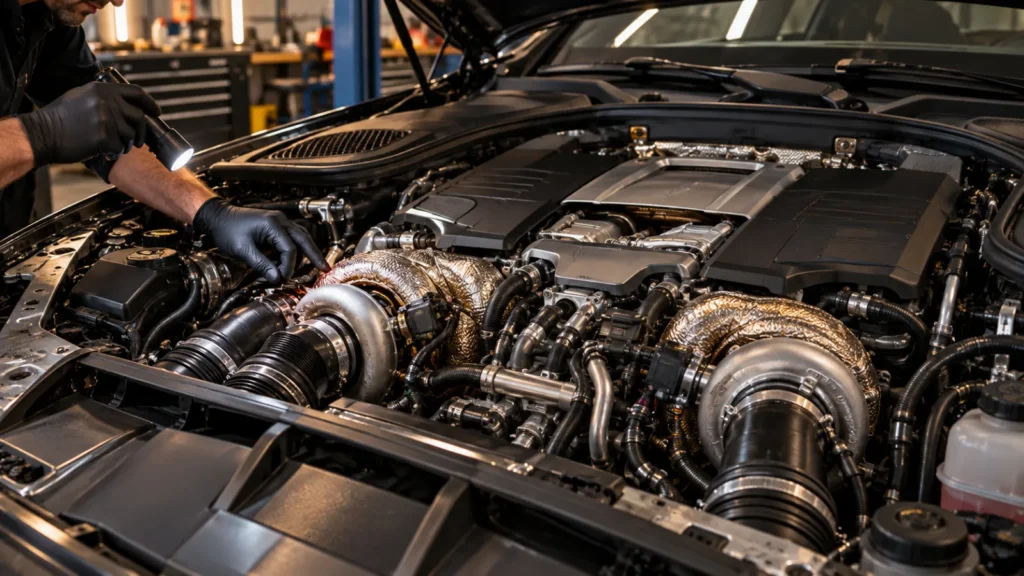
The M177 uses a hot-vee layout with the turbochargers mounted between the cylinder banks, and it shares its basic architecture with the AMG GT and the C63 S of the same period. Independent specialists generally describe it as the most durable of the three E63 engines, with no systemic failure comparable to the M156 head bolts. That is a major reason Mercedes-AMG E63 S reliability improved so noticeably with this generation. Our separate deep dive on C63 AMG reliability covers many of the same M177 traits.
Known M177 Weak Points
- Turbo oil feed lines: The hot-vee layout exposes oil lines and seals to intense heat. Seepage, an oil smell after driving and light smoke at cold start are typical signs, usually at higher mileage.
- Spark plugs and ignition coils: Like the M157, the M177 is sensitive to worn plugs, especially with an ECU tune.
- Intake valve carbon buildup: As a direct-injection engine, deposits can accumulate on intake valves over time, reducing smoothness.
- Cooling system: Water pumps and thermostats should be monitored as mileage climbs, since overheating is particularly harmful to aluminum heads.
Electronics and Chassis
The W213 carries far more electronics than earlier cars, including digital displays, driver assistance systems and air suspension. Software-related glitches are among the more common owner complaints, and many are resolved with dealer updates. Buyers should check the car’s recall status through the NHTSA recall database using the VIN before purchase.
Best and Worst E63 Years at a Glance
Based on the issues covered above, here is how the US model years compare for buyers focused on Mercedes-AMG E63 S reliability. This is a summary of known risks, not a guarantee for any individual car, which always depends on its maintenance history.
| Model years | Engine | Main risk | Verdict |
|---|---|---|---|
| 2007 to 2009 (W211) | M156 | Head bolts, camshafts and lifters, age | Highest risk, verify repairs |
| 2010 to 2011 (W212) | M156 | Head bolts, camshafts and lifters | High risk, verify repairs |
| 2012 to 2013 (W212) | M157 | Early timing chain tensioners | Moderate risk, check chain history |
| 2014 to 2016 (W212) | M157 | Leaks, plugs and coils, age | Best value of the older cars |
| 2018 to 2023 (W213) | M177 | Turbo oil lines, plugs, electronics | Most robust E63 |
Mercedes-AMG Reliability by Engine: All Models Compared
If you are comparing AMG models rather than E63 generations, start with the engine. The table below summarizes what independent specialists, Mercedes technical service bulletins and NHTSA records say about each major AMG engine family. Years are approximate and apply to the AMG models that used each engine; always confirm a specific car by VIN.
| Engine | Typical AMG models | Approx. years | Reliability verdict | Main watch items |
|---|---|---|---|---|
| M113 / M113K 5.4L V8 (supercharged on “55” models) | C55, CLK55, E55, SLK55, SL55 | Late 1990s to about 2011 | Most robust AMG V8 | Oil leaks and rocker cover gaskets, supercharger clutch spring cracks, air suspension and rust on older chassis |
| M156 / M159 6.2L naturally aspirated V8 | C63, E63, CLS63, SL63, SLS AMG (M159) | 2006 to 2015 | Mixed: excellent when the known faults are fixed | Cylinder head bolts (2007 to 2011 production), camshaft, lifter and cam phaser wear |
| M157 5.5L twin-turbo V8 | E63, CLS63, S63, CL63, GL63, ML63 | About 2011 to 2019 | Reliable with disciplined maintenance; later cars better | Early cold-start timing chain tensioner rattle, coolant hoses, timing cover leaks, reports of cylinder scoring |
| M177 / M178 4.0L twin-turbo V8 | C63, E63, GT, GLC63, GLE63, G63 | 2014 to present | Strong core, known seal and coil items | Ignition coils and misfires, oil separators and rear main seal, active engine mounts, 2018 to 2019 turbo oil feed line recall |
| M133 2.0L turbo four | A45, CLA45, GLA45 | 2013 to 2019 | Durable if serviced on time | Turbo oil feed line (service campaign on 2014 to 2015 cars), water pump and thermostat housing leaks, gearbox noise |
| M139 2.0L turbo four | A45 S, CLA45 S, GLA45 S, 43-series cars | 2019 to present | Strong but still young | Broken valve spring bulletin covering M139 engines, plus a small 2020 spark plug recall |
| M260 2.0L turbo four | A 35, CLA 35, GLA 35 | 2019 to 2022 cars of concern | Good, with a known valve seat issue | Exhaust valve seat and guide wear, covered by an extended warranty on eligible 2019 to 2022 cars |
| M276 3.0L V6 biturbo | C43, E43, GLC43 | From about 2015 | Generally durable | Cold-start timing chain and camshaft adjuster rattle, oil consumption under hard driving |
| M256 3.0L inline-six with 48-volt EQ Boost | E53, CLS53, GLE53, GT53 | 2019 to present | Sound engine, 48-volt electrical system is the weak point | 48-volt battery and DC/DC faults, integrated starter-generator, rear crankshaft seal leaks on early engines |
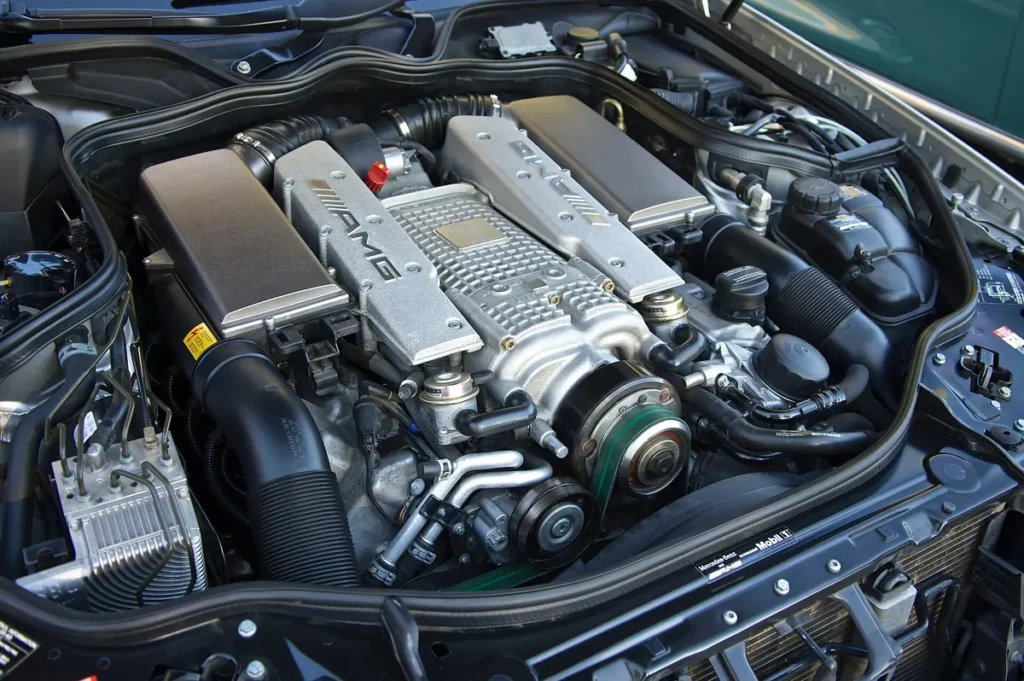
M113 and M113K: The Reliability Benchmark
Both evo and FCP Euro describe the supercharged 5.4-liter V8 as one of the most dependable AMG engines ever built, and the E55 is often called the most reliable Mercedes V8 to date. Wikipedia notes the same praise for the M113K. The weak points are mostly age-related: rocker cover gaskets, oil leaks, supercharger clutch springs and, on the heavier cars, air suspension. Older chassis such as the W210 E55 and W202 C43 can also rust. That is why many owners point to the simpler C55, CLK55 and SLK55 as the most trouble-free AMGs.
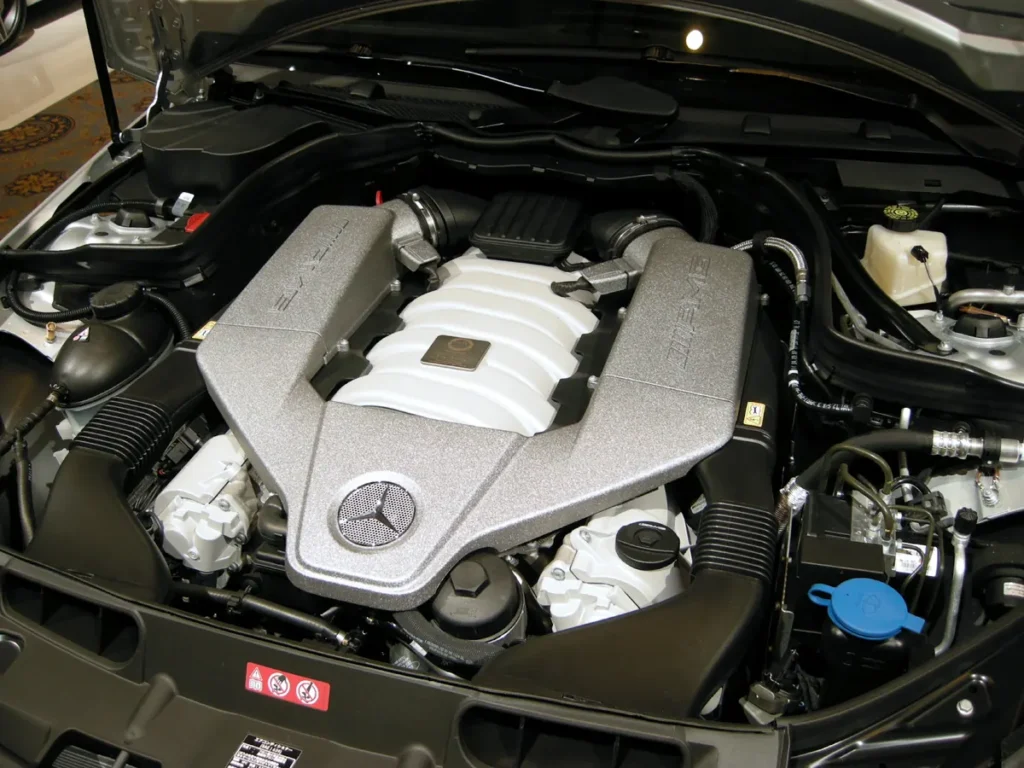
M156: Great Engine, Documented Weak Points
The naturally aspirated 6.2-liter V8 powered the W204 C63 as well as the E63 covered above. Production from roughly 2007 to 2011 is tied to cylinder head bolt failures, and the engine family is also associated with camshaft, lifter and cam phaser wear, usually first noticed as a cold-start tick. Many owners and specialists consider a corrected, well-maintained M156 very dependable, but an undocumented early car is a gamble. Our C63 AMG reliability guide covers the W204 in more depth.
M157: Reliable if You Choose the Right Year
The twin-turbo 5.5-liter V8 gets consistently positive remarks from independent specialists, with the standard caveat that early 2011 to 2013 cars could develop timing chain tensioner rattle because oil drains from the tensioners when the engine sits. Mercedes documented the condition in a technical service bulletin and revised the tensioners and added check valves. Other recurring items are coolant hose leaks, timing cover seepage and, in some owner reports, cylinder scoring, so a compression and leak-down test is worth the money.
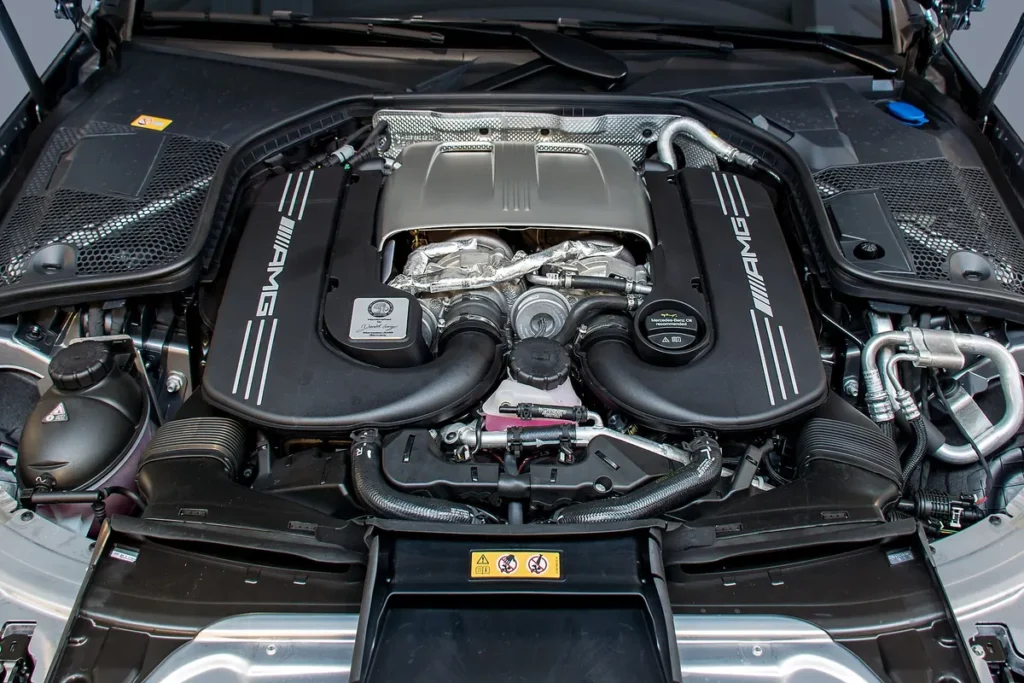
M177 and M178: Strong Core, Predictable Weak Points
The 4.0-liter twin-turbo V8 is widely regarded as the most robust modern AMG V8 at the bottom end. Three patterns show up in specialist guides and owner reports: ignition coils and spark plugs that cause misfires, clogged air/oil separators that raise crankcase pressure and push oil past the rear main seal (which needs the transmission out to repair), and worn or leaking active engine mounts. Owners report the separator problem more often on E63 and G63 models than on the C63, but the evidence is anecdotal, so treat it as something to check on every example. Because these repairs are labor-intensive, a warranty or a repair fund is sensible on any out-of-warranty M177 car.
Four-Cylinder and Six-Cylinder AMGs
The 2.0-liter AMG fours deliver astonishing power per liter, and specialist guides generally rate them as durable if serviced on schedule. The first-generation M133 had a turbo oil feed line problem: Mercedes ran service campaign 2014120001 on 2014 to 2015 cars, and Mercedes estimated that about a quarter of the cars would need a new turbo, according to the campaign details reported by AustralianCar.Reviews and Kicktyres. On the newer M139, a Mercedes technical service bulletin filed with NHTSA covers broken valve springs, and the A 35’s M260 engine has a Mercedes extended warranty for exhaust valve seat and guide wear on eligible 2019 to 2022 cars. The 3.0-liter V6 in the C43 is generally durable but needs a cold-start listen for chain rattle, and the 53-series inline-six is mechanically sound while its 48-volt system is where most of the documented faults sit. Our CLE 53 review and hybrid AMG guide explain how that newer hardware works, and the C 63 S E Performance review covers the four-cylinder plug-in hybrid, which is too new for long-term reliability data.
Most Reliable Mercedes-AMG Models and Which Ones to Approach With Care
Best bets for reliability
- C55, CLK55, SLK55 and E55 AMG (M113/M113K): the consistent favorites of specialists and owners, especially the simpler cars without complex suspension.
- 2014-on M157 cars with full records: widely viewed as the value sweet spot among the twin-turbo 63 models.
- M177-powered cars with warranty cover and documented servicing: the strongest modern V8, as long as the known leak and coil items are monitored.
- Well-serviced A45 and A 45 S hatchbacks: durable engines when oil and transmission fluid services are done on time.
Approach with care
- 2007 to 2011 M156 cars without paperwork: verify head bolt and camshaft work before buying.
- 2011 to 2013 M157 cars: check the timing chain tensioner history and listen for a cold-start rattle.
- 2014 to 2015 CLA 45 and A45 cars: confirm that the turbo oil feed line service campaign was done.
- 2019 to 2022 A 35 cars: confirm whether the valve seat extended warranty applies to the VIN.
- 53-series cars with the 48-volt system: ask for a clean fault history and check software updates.
- 2016 to 2018 AMG GT cars: confirm that the carbon-fiber driveshaft recalls were completed.
For a ranking built around buying appeal rather than durability, see our list of the top 10 Mercedes-AMG models. For the 4.0-liter V8 in different bodystyles, see the AMG GT 63 vs Porsche 911 Turbo S and G63 guides.
Verified AMG Recalls and Typical Repair Costs
These recalls were checked against NHTSA records. A VIN lookup at nhtsa.gov/recalls or at a Mercedes-Benz dealer is still the only way to know whether a given car is affected or already repaired.
| Recall | Cars | Issue |
|---|---|---|
| 20V-048 | 2018 to 2019 E63, E63 S wagon, S63 and 2019 G63, AMG GT 63 and GT 63 S with the 4.0L V8 | Turbocharger oil feed line may leak |
| 21V-961 | Certain 2019 to 2020 AMG cars, including G63, GT 63, GT 53, A 35, C43 and C63 | Particles between fuel rail and injectors can cause a fuel leak |
| 19V-457 and 21V-478 | 2016 to 2018 AMG GT models, including the GT S | Carbon-fiber driveshaft bonding may be insufficient |
Repair costs vary widely by country, shop and model, so use these as indicative ranges only. Published specialist estimates put an M177 ignition coil and spark plug refresh at roughly 400 to 600 euros at an independent shop (Carchecker) and about 600 to 1,200 dollars on an AMG GT (CarBuzz). Replacing the oil separators and rear main seal is quoted at roughly 2,000 to 3,000 euros at a specialist (Carchecker) and about 2,500 to 4,500 dollars (CarBuzz), with dealer prices higher. Always get a written quote and ask exactly which parts are included.
Buyer’s Checklist for Any Used Mercedes-AMG
- Identify the engine first. The engine code decides which problems to look for, not the model name.
- Demand invoices, not stamps. Regular oil changes with the correct Mercedes approval are the cheapest insurance on every AMG engine.
- Start the car cold. Listen for a timing chain rattle, a cam tick or a rough idle in the first 30 seconds.
- Scan for stored faults. Misfire, camshaft timing and 48-volt codes are early warnings.
- Look for oil and coolant seepage around the rear of the engine, timing covers and hoses.
- Check open recalls and campaigns by VIN at a dealer and on NHTSA.
- Test the transmission cold and in traffic, including reverse engagement on dual-clutch cars.
- Pay for a pre-purchase inspection by an independent AMG specialist, ideally with a compression or leak-down test on higher-risk engines.
Maintenance Costs That Shape Mercedes-AMG E63 S Reliability
Much of what owners call poor reliability is really deferred maintenance catching up with a car. The E63 is engineered for high performance, and it expects high-performance care. Several cost categories deserve attention regardless of generation.
Brakes and Tires
High-performance brakes are expensive, and cars equipped with optional carbon-ceramic rotors can carry replacement costs far higher than steel setups. Wide, staggered performance tires also wear quickly on a heavy, powerful sedan. Checking rotor condition and remaining tire tread can reveal thousands of dollars in near-term expenses.
Fluids and Service Intervals
- Engine oil changes at or before the factory interval, with many specialists recommending shorter intervals for hard-driven turbo cars.
- Transmission fluid service on the MCT, which is often skipped because it is not always emphasized by previous owners.
- Transfer case and differential fluid on 4MATIC and 4MATIC+ cars.
- Coolant and brake fluid replacement on schedule.
The Impact of Tuning
Both the M157 and M177 respond strongly to ECU tunes, and many used E63s on the market have been modified. A tune increases stress on plugs, coils, turbochargers, the transmission clutch packs and the drivetrain. A stock or professionally tuned car with records is preferable to one with an unknown modification history.
How to Inspect a Used E63 Before Buying
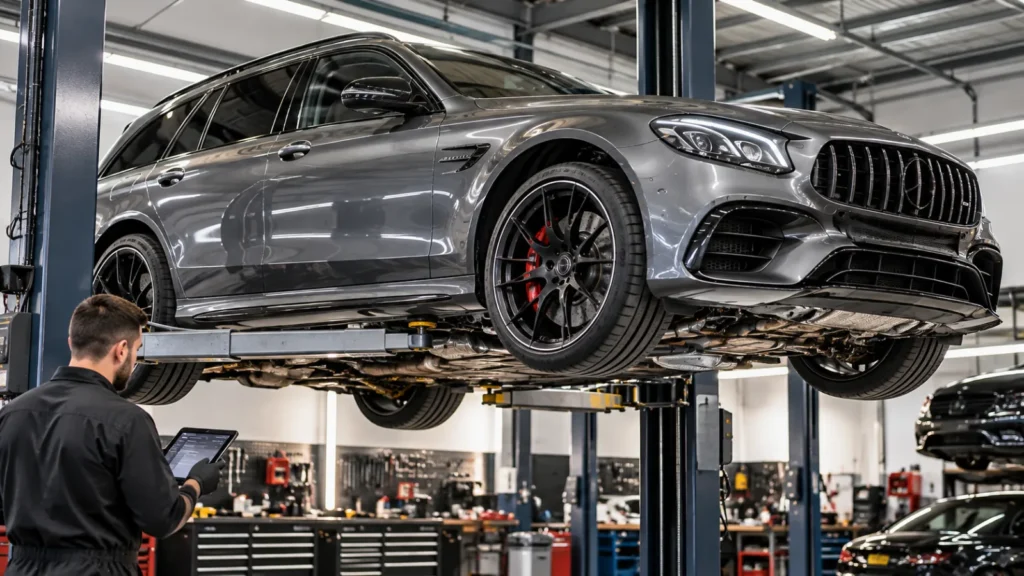
A thorough pre-purchase inspection at an independent Mercedes-AMG specialist or a dealer is the single best investment an E63 buyer can make. When it comes to Mercedes-AMG E63 S reliability, what a specialist finds on the lift matters far more than mileage alone. The inspection should be tailored to the generation in question.
Generation-Specific Checks
- W211 and 2010 to 2011 W212: Confirm the head bolt revision by engine number or records, listen for cold-start camshaft ticking and perform a coolant pressure test.
- 2012 to 2016 W212: Listen for startup chain rattle, check timing-related fault codes and inspect for oil leaks around the covers.
- W213: Inspect for turbo oil line seepage, scan for stored misfire codes, verify software updates and check for open recalls.
Universal Checks
- A full diagnostic scan of all modules, not only the engine.
- Air suspension behavior, including ride height after the car sits overnight.
- Underbody corrosion, especially on cars from the Northeast and Midwest.
- Complete service records showing oil changes and transmission service.
Buyer’s Advice: Which E63 Should You Buy?
The right E63 depends on budget, risk tolerance and what kind of driving experience matters most. Here is how the generations compare for different buyers. For a broader look at what makes the model special, see our feature on why the Mercedes-AMG E63 is a sedan that scares supercars.
The Enthusiast Who Wants a Classic V8
The W211 and early W212 offer the naturally aspirated M156 soundtrack that many consider one of the best V8s of the century. These cars make the most sense for buyers who verify the head bolt repair, budget for a possible camshaft job and plan to keep the car as a weekend machine rather than a daily driver.
The Value-Focused Daily Driver
A 2014 to 2016 W212 E63, particularly an S-Model with 4MATIC, delivers serious performance and all-weather usability for a fraction of its original price. The revised M157 timing components make the later cars a more sensible bet than the 2012 and 2013 models.
The Buyer Who Wants the Best Overall Ownership
The W213 E63 S is the clear choice for buyers who want the strongest balance of performance and dependability. Strong Mercedes-AMG E63 S reliability, modern safety technology and the option of a wagon body make it the most complete E63, though purchase prices remain the highest of the three generations.
More guides: Looking for other models and fault codes? Browse our Common Problems & Reliability Guides hub for BMW, Mercedes-AMG and Audi reliability articles.
Frequently Asked Questions
What are the E63 AMG generations?
In the United States, the E63 AMG has been sold in three generations: the W211 (2007 to 2009) with the naturally aspirated 6.2-liter M156 V8, the W212 (2010 to 2016) with the M156 at first and the 5.5-liter twin-turbo M157 from 2012, and the W213 E63 S (2018 to 2023) with the 4.0-liter twin-turbo M177 V8 and 4MATIC+ all-wheel drive.
Which E63 AMG generation is the most reliable?
The W213 E63 S is generally regarded as the most robust E63 generation, while early M156-powered cars carry the most documented engine risks, such as head bolt and camshaft issues.
What is the best year E63 to buy?
For the best balance of performance and dependability, a 2018 to 2023 W213 E63 S with full records is the strongest choice. On a tighter budget, a 2014 to 2016 W212 with the M157 twin-turbo V8 is often seen as the sweet spot of the older cars.
What are the most common E63 AMG problems?
The most common issues are head bolt and camshaft wear on M156 cars, early timing chain tensioner problems on 2012 and 2013 M157 cars, and turbo oil line seepage, spark plugs, coils and electronics on the M177-powered W213. Air suspension wear affects older cars of every generation.
Is a high-mileage E63 worth buying?
It can be, but only with complete service records, proof of key repairs for its generation and a pre-purchase inspection by an AMG specialist. A well-maintained high-mileage car is usually a safer bet than a low-mileage car with gaps in its history.
Are Mercedes-AMG cars reliable?
They can be. Reliability depends mostly on the engine and the car’s maintenance history. The older M113K V8 cars are often described as the most dependable, the M157 and M177 V8s are strong when serviced properly, and every AMG engine has a short list of known issues that a pre-purchase inspection should check.
What is the most reliable AMG engine?
The supercharged 5.4-liter M113K V8, used in the C55, CLK55 and E55, is the engine most often named as the most reliable. Among modern AMG engines, the 4.0-liter M177/M178 V8 is generally regarded as having a robust bottom end, while the 2014-on M157 is commonly seen as the safer twin-turbo choice among earlier 63 models.
What is the most reliable AMG model?
Owner and specialist feedback most often points to the simpler M113-powered cars, such as the C55, CLK55 and SLK55, because they avoid complex air suspension and modern electronics. For a modern car, a well-documented, warranty-covered M177 model or a well-serviced A 45 S is the more practical choice.
Which AMG engines or years should I avoid?
Be most careful with 2007 to 2011 M156 cars without proof of head bolt and camshaft work, early 2011 to 2013 M157 cars with unresolved timing chain tensioner issues, 2014 to 2015 CLA 45 and A45 cars without the turbo oil line campaign, and 2019 to 2022 A 35 cars that have not been checked for the valve seat warranty extension. Documented repairs change the picture significantly.
Are AMGs expensive to maintain?
Yes. Even routine items such as ignition coils, spark plugs, brakes and tires cost more than on a standard Mercedes, and big repairs such as an M177 rear main seal job involve removing the transmission. Budget for specialist maintenance and, ideally, a warranty on any car with a complex or out-of-warranty powertrain.
Is the AMG 63 V8 reliable out of warranty?
It can be, but it is where bills get large. Repairs such as oil separator and rear main seal work are labor-intensive, so a warranty or a repair fund is sensible on any out-of-warranty M177 car. A documented service history, a clean inspection and a financial reserve matter more than mileage alone.
If you are considering the wagon version, read our RS6 Avant vs E63 S Wagon comparison.
Shopping across brands? Our BMW M5 Competition review covers reliability, best years and what to check on the E63 S’s main rival.
Comparing German V8s? Our guide to BMW N63 engine problems explains the twin-turbo BMW alternative and the years to avoid.
Conclusion: Is the E63 a Reliable Car?
The honest answer is that Mercedes-AMG E63 S reliability depends heavily on generation and history. The M156 cars carry real, well-documented engine risks that demand verification. The M157 cars resolved most of those concerns but introduced early timing chain issues that later production fixed. The M177-powered W213 is broadly regarded as the most dependable E63 ever built, with its weak points mostly limited to manageable maintenance items.
Across all three generations, the most reliable E63 is the one with complete records, a clean pre-purchase inspection and an owner who treated it as the precision machine it is. Buyers who do their homework, choose the right year and budget for proper maintenance can enjoy one of the most rewarding super sedans ever produced without unpleasant surprises.
Sources and Further Reading
Engine-by-engine statements in this guide were cross-checked against at least two independent sources, including the following:
- NHTSA recalls database, campaigns 20V-048, 21V-961, 19V-457 and 21V-478
- Mercedes-Benz technical service bulletin on M139 broken valve springs (NHTSA)
- Mercedes-Benz USA exhaust valve extended warranty notice for 2019 to 2022 A-Class, CLA, GLA and GLB (NHTSA)
- evo: Mercedes E55 AMG W211 buying guide
- RepairAhead: Mercedes M177/M178 known problems, recalls and costs
- Autocar: Mercedes-AMG A 45 (2013 to 2018) reliability
- Wikipedia: Mercedes-Benz M113 engine
Reliability reflects the experience of owners and specialists and is not a guarantee for any individual car. Always verify recalls by VIN and have a used AMG inspected by a qualified specialist.