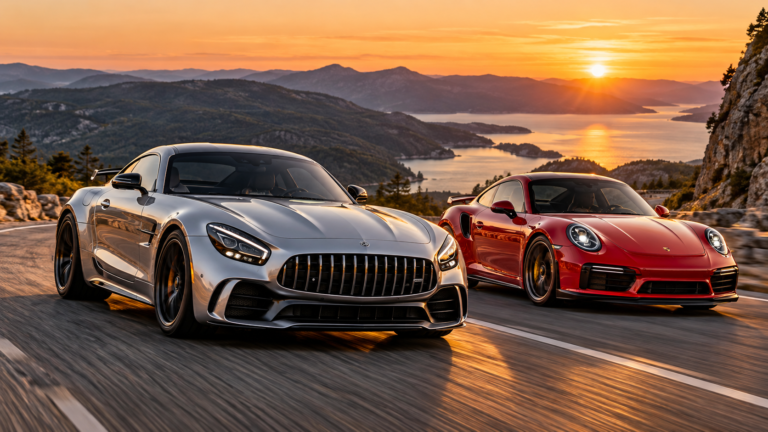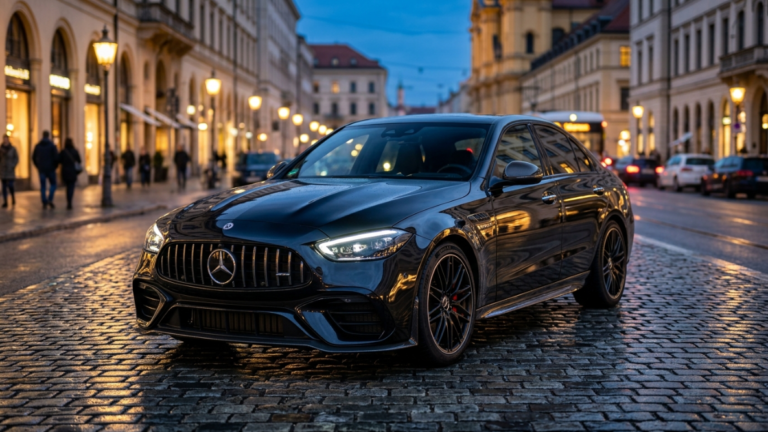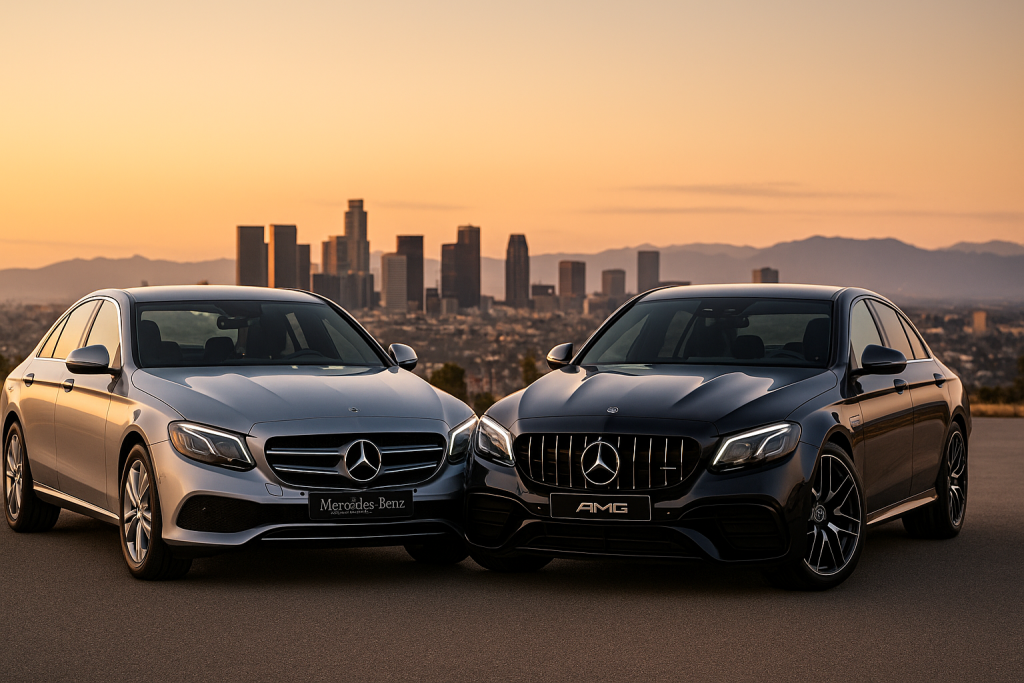
AMG vs Mercedes-Benz is one of the most common questions among people shopping for a luxury car. If you have ever browsed Mercedes models or watched a high-speed scene in a movie, you have probably seen the letters “AMG” proudly displayed on the back of a Mercedes. But what exactly does AMG mean, and how is an AMG different from a regular Mercedes-Benz?
In this guide we explain the history of AMG, the different levels of AMG models, and the key differences in engines, performance, design, interior, price and ownership costs. By the end, you will know exactly which option fits your needs. For a broader comparison with BMW and Audi, see our BMW M vs Audi RS vs Mercedes-AMG guide.
Table of Contents
- What Does AMG Stand For?
- AMG vs Mercedes-Benz: Key Differences at a Glance
- The Different Levels of AMG
- AMG Line
- AMG 35, 43 and 53 Models
- AMG 45 and 63 Models
- Black Series and Special Editions
- Examples: Regular Models vs Their AMG Versions
- Engine and Performance
- Suspension, Steering and Brakes
- Sound and Feel
- Design Differences
- AMG in Motorsport Today
- Electric AMG Models
- Price and Running Costs
- Warranty and Certified Pre-Owned Options
- Resale Value
- AMG vs Mercedes-Benz: Is AMG Worth the Extra Cost?
- Choose a Regular Mercedes-Benz If:
- Choose a Mercedes-AMG If:
- Final Thoughts on AMG vs Mercedes-Benz
What Does AMG Stand For?
AMG stands for Aufrecht, Melcher and Großaspach: the names of founders Hans Werner Aufrecht and Erhard Melcher, plus Großaspach, Aufrecht’s hometown in Germany. The company was founded in 1967 as an independent engineering firm that specialized in tuning Mercedes-Benz engines for racing.
AMG gained fame in 1971 when its modified 300 SEL 6.8, nicknamed the “Red Pig,” finished second in class at the Spa 24 Hours endurance race. Over the following decades AMG built a reputation for powerful, hand-built engines, and it began working closely with Mercedes-Benz. Daimler took a majority stake in AMG at the end of the 1990s and later full ownership. Today, Mercedes-AMG is the official performance division of Mercedes-Benz, based in Affalterbach, Germany.
AMG vs Mercedes-Benz: Key Differences at a Glance
| Feature | Mercedes-Benz | Mercedes-AMG |
|---|---|---|
| Engine | Efficient, refined engines | High-output engines, top V8s hand-built |
| Performance | Smooth, comfortable acceleration | Strong, track-capable performance |
| Suspension | Comfort-focused | Sport-tuned, adaptive |
| Brakes | Standard luxury brakes | Larger performance brakes, ceramic options |
| Exhaust sound | Quiet and refined | Loud, sporty, adjustable |
| Interior | Luxurious | Sport-luxury with AMG details |
| Price | Premium | Higher premium |
| Running costs | Moderate for the class | Higher: tires, brakes, fuel, insurance |
The Different Levels of AMG
One reason the AMG vs Mercedes-Benz question is confusing is that AMG badges appear on several levels of cars:
AMG Line
The AMG Line is a styling and equipment package available on regular Mercedes-Benz models. It adds sporty bumpers, AMG-style wheels, sport seats and a sport steering wheel, but it does not change the engine. An AMG Line car looks sportier but is not a true AMG performance model.
AMG 35, 43 and 53 Models
These “entry” AMG models sit between regular Mercedes-Benz cars and full AMG models. They use more powerful turbocharged four-cylinder or six-cylinder engines, AMG-tuned suspension, sportier transmissions and AMG-specific design details. They are fast and fun while remaining comfortable for daily driving.
AMG 45 and 63 Models
These are the full AMG models. The 45 models use a hand-built 2.0-liter turbocharged four-cylinder, while the 63 models traditionally use AMG’s hand-built 4.0-liter twin-turbo V8 or high-performance hybrid systems. They offer the biggest performance gains, wider bodywork, stronger brakes and the most aggressive character.
Black Series and Special Editions
At the top are rare, track-focused models such as the AMG GT Black Series. These limited-production cars are closer to race cars than road cars and are highly collectible.
Examples: Regular Models vs Their AMG Versions
The easiest way to understand the AMG vs Mercedes-Benz difference is to compare specific models. A C-Class sedan is a comfortable compact luxury car, while the AMG C 63 S E Performance turns it into a 671-hp plug-in hybrid performance machine. A regular G-Class is already an iconic luxury off-roader, but the AMG G 63 adds a hand-built twin-turbo V8 with 577 hp and side-exit exhausts. A GLE SUV becomes the AMG GLE 63 S, a family vehicle with sports car acceleration. In every case, the AMG version keeps the practicality of the base model but adds a completely different level of performance.
Engine and Performance
Regular Mercedes-Benz models prioritize comfort, refinement and efficiency. AMG models use more powerful engines, many of them built by hand under the “one man, one engine” philosophy, where a single technician assembles each engine from start to finish and signs a plaque on top.
The performance difference can be dramatic. Where a regular Mercedes sedan focuses on smooth, quiet acceleration, a full AMG model can reach 60 mph in well under four seconds. AMG engineers also upgrade the transmission, cooling systems, differential and all-wheel-drive calibration so the car can handle the extra power on the road and on track.
Suspension, Steering and Brakes
AMG models receive their own suspension tuning, often with adaptive damping and, on some models, active roll stabilization. Steering is quicker and more direct, and the brakes are significantly larger, with carbon ceramic brakes available on many top models. The result is a car that corners flatter, stops harder and communicates more with the driver. The trade-off is a firmer ride than a regular Mercedes-Benz, although adaptive suspension helps reduce the difference in comfort modes.
Sound and Feel
Start a standard Mercedes and it purrs quietly. Start an AMG, especially a V8 model, and it growls, crackles and pops with every downshift in its sportier modes. AMG performance exhaust systems use valves that open and close depending on the drive mode, allowing the car to be relatively quiet when cruising and loud when you want to enjoy it. Driving an AMG is not just transportation; it is an experience.
Design Differences
On the outside, AMG models stand out with more aggressive bumpers, larger air intakes, side skirts, rear diffusers, spoilers, exclusive wheel designs and, on many models, the vertical-slat Panamericana grille. Full AMG models often have wider fenders to fit a wider track and larger tires.
Inside, AMG models take things up a notch with:
- AMG sport seats with contrast stitching
- The AMG Performance steering wheel with drive-mode controls
- Carbon fiber or aluminum trim
- AMG-specific displays and performance data, including track timers on some models
AMG in Motorsport Today
AMG’s connection to racing remains strong. The brand works closely with the Mercedes Formula 1 team, and its AMG GT3 and GT4 race cars compete in customer racing series around the world. Technology from Formula 1, such as advanced hybrid systems and battery cooling, has influenced AMG’s E Performance road cars. This motorsport link is a key part of what separates an AMG from a regular Mercedes-Benz.
Electric AMG Models
As Mercedes-Benz moves toward electrification, AMG is also developing electric performance models. AMG versions of the EQE and EQS offer more power, sportier suspension and AMG-specific design, while future dedicated electric AMG models are planned. Electric AMGs deliver instant torque and impressive acceleration, but they lack the traditional engine sound, so AMG has added synthetic performance sounds to keep the emotional experience.
Price and Running Costs
AMG models cost significantly more than equivalent Mercedes-Benz models. The premium can range from a modest increase for an entry AMG model to a very large difference for a top V8 or hybrid AMG. Running costs are also higher: performance tires wear faster, brakes are more expensive, fuel consumption is higher and insurance premiums are usually greater.
Maintenance must be done carefully, ideally by a Mercedes-Benz dealer or an independent AMG specialist. For an example of what to expect, read our guide to Mercedes C63 AMG reliability.
Warranty and Certified Pre-Owned Options
New AMG models come with the same basic factory warranty as regular Mercedes-Benz vehicles, and both can be purchased as certified pre-owned cars from Mercedes-Benz dealers with extended coverage. Because AMG models contain more specialized and expensive components, many buyers consider extended warranty coverage especially valuable on a used AMG.
Resale Value
Regular Mercedes-Benz models and most AMG models both depreciate significantly in the first years of ownership. However, special AMG models with strong enthusiast demand, such as the G 63, Black Series cars and some limited editions, often hold their value better than standard luxury cars. Entry AMG models usually depreciate in a similar way to regular Mercedes models.
AMG vs Mercedes-Benz: Is AMG Worth the Extra Cost?
It depends on what you want from your car. If you love performance, sound and having something special, an AMG is absolutely worth considering. If you want a calm luxury ride with lower running costs and better fuel economy, a standard Mercedes-Benz, perhaps with the AMG Line styling package, may be the smarter choice.
Choose a Regular Mercedes-Benz If:
- Comfort and quietness are your top priorities
- You want lower purchase and running costs
- You mostly drive in the city or on long, relaxed highway trips
Choose a Mercedes-AMG If:
- You enjoy driving and want strong acceleration and sharper handling
- You love the sound of a performance engine
- You plan to attend track days or enjoy spirited driving on back roads
Final Thoughts on AMG vs Mercedes-Benz
The difference between Mercedes-Benz and AMG is like the difference between a tailored suit and a racing suit. Both are premium, but AMG is built to thrill. Next time you see the AMG badge, you will know it represents decades of racing heritage and the peak of German performance engineering.
To explore current models, visit the official Mercedes-AMG USA website, or read our list of the top Mercedes-AMG models.