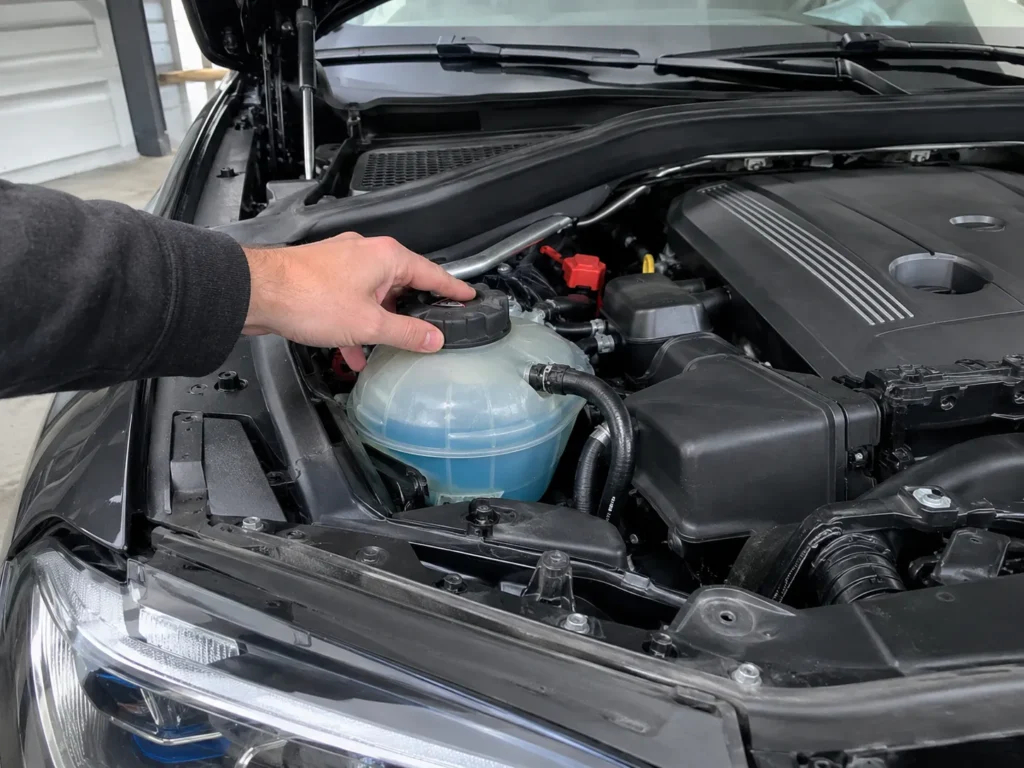
A BMW coolant level low warning is one of the most common messages BMW drivers see, and it is also one of the most important not to ignore. Depending on the model, the car may display “Coolant level too low,” “Top up coolant” or a similar Check Control message, sometimes with a warning that engine damage is possible. In some cases the fix is as simple as topping up the expansion tank, but in others the message is the first sign of a leak that needs attention.
In this guide we explain what the warning means, what to do the moment it appears, how to check and top up coolant safely, which leaks cause it most often, and what BMW’s own service bulletins say about false warnings and factory fill issues. Everything is based on BMW service information filed with NHTSA and published guidance from BMW specialists.
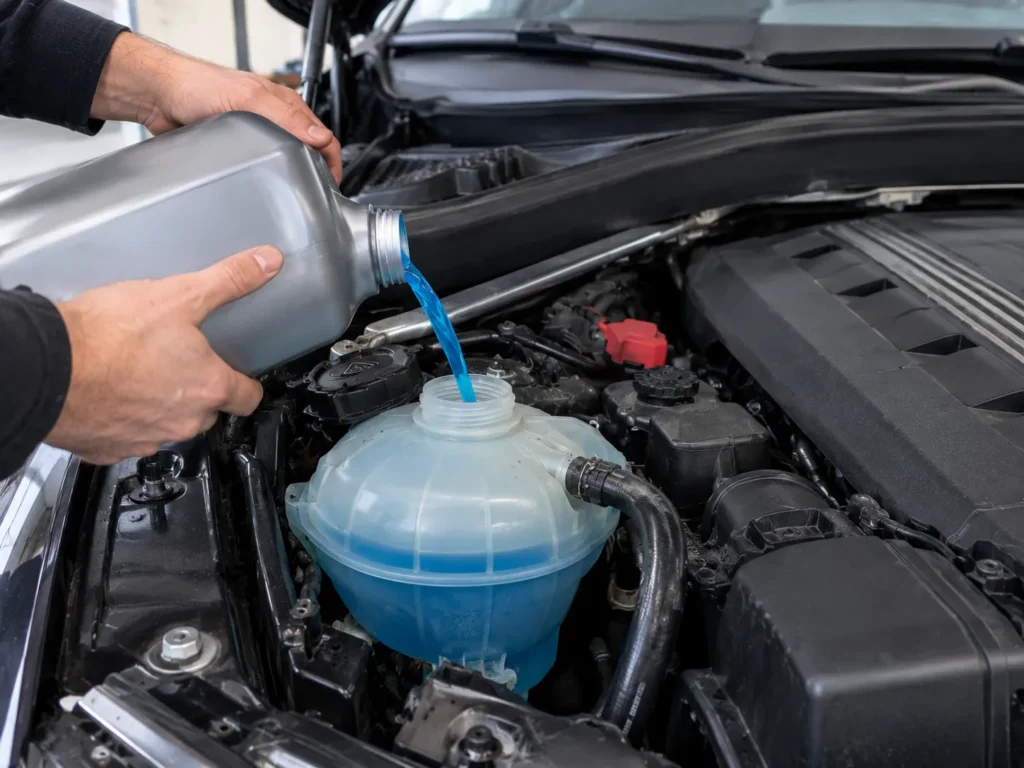
Table of Contents
- What Does the BMW Coolant Level Low Warning Mean?
- Low Coolant Warning Versus Overheating Warning
- What to Do When the BMW Coolant Level Low Warning Appears
- How to Check and Top Up BMW Coolant Safely
- Which Coolant Should You Use?
- When a Top-Up Is Not Enough
- Common Causes of a BMW Coolant Level Low Warning
- Cracked Expansion Tank or Faulty Cap
- Hoses and Plastic Fittings
- Water Pump and Thermostat Housing
- Radiator and Oil Filter Housing
- Head Gasket or Cylinder Head
- Signs of a Coolant Leak to Look For
- BMW Service Bulletins on Coolant Warnings
- False “Top Up Coolant” Warning on BMW SUVs
- Factory Fill Not Fully Bled
- Coolant Vent Line on Four-Cylinder Engines
- Is It Safe to Drive With a BMW Coolant Level Low Warning?
- Repair Costs and Prevention
- Tips to Prevent Coolant Problems
- FAQ
- Why does my BMW say coolant level low but the tank looks full?
- Can I use water instead of coolant in my BMW?
- How often should BMW coolant be topped up?
- Can I drive my BMW with the low coolant light on?
- How do I reset the BMW low coolant warning?
- Conclusion
What Does the BMW Coolant Level Low Warning Mean?
Modern BMWs use a level sensor in the coolant expansion tank. When the coolant drops below the minimum level, the car shows a Check Control message on the instrument cluster or iDrive screen. According to YOUCANIC, one common version of the message reads “Risk of engine damage! Top up the coolant at the earliest opportunity.”
Coolant does more than prevent freezing. It carries heat away from the engine, protects aluminum parts from corrosion and helps keep the engine at its ideal temperature. If the level drops far enough, air enters the system, temperatures rise and an aluminum cylinder head can be damaged by overheating. That is why a BMW coolant level low message should be treated seriously, even when the temperature gauge still looks normal.
Low Coolant Warning Versus Overheating Warning
A low coolant message means the level in the tank is too low. An engine temperature or overheating warning means the engine is already running too hot. If both appear, or if the temperature warning appears on its own, the situation is more urgent. The safest move is to stop as soon as it is safe and switch off the engine.
What to Do When the BMW Coolant Level Low Warning Appears
- Do not ignore it: reduce load, switch off unnecessary electrical consumers and plan to stop soon.
- Watch for overheating: if an engine temperature warning appears, pull over safely and switch off the engine.
- Let the engine cool: never open the expansion tank cap on a warm engine. The system is pressurized, and hot coolant can spray out and cause burns.
- Check the level when cold: once the engine has fully cooled, check the expansion tank and top up if needed.
- Look for leaks: check under the car and around the engine bay for drips, wet spots or dried coolant residue.
- Get it inspected: if the warning returns after a top-up, the car has a leak or another fault that needs diagnosis.
How to Check and Top Up BMW Coolant Safely
The procedure is similar on most modern BMWs, although the location of the expansion tank varies. YOUCANIC notes that it is usually on the left side of the engine bay, while some models, such as the 3 Series, have it on the right. The owner’s manual shows the exact location and markings for each model.
- Park on level ground and wait until the engine is completely cold.
- Open the expansion tank cap slowly to release any remaining pressure before removing it.
- Check the level against the minimum and maximum markings on the tank or float.
- Top up with the coolant BMW specifies, mixed with distilled water if it is a concentrate, as described in the owner’s manual.
- Close the cap firmly and recheck the level after the next drive, once the engine has cooled again.
Which Coolant Should You Use?
BMW cooling systems are designed for a specific long-life coolant that protects aluminum components. The safest choice is BMW’s own coolant or a product that meets the specification listed in the owner’s manual. YOUCANIC recommends mixing concentrate 50/50 with distilled water unless the coolant is premixed. Mixing random coolant types is not recommended, because incompatible formulas can reduce corrosion protection.
When a Top-Up Is Not Enough
If more than about a liter is needed, YOUCANIC says this may indicate a leak or air trapped in the system. Air pockets can cause false readings and overheating, so the system may need to be bled. Many modern BMWs use an electric water pump, and the bleeding procedure differs by model, so it is best done following BMW’s repair instructions or by a specialist.
Common Causes of a BMW Coolant Level Low Warning
A healthy cooling system should not need regular top-ups. If the level keeps dropping, one of these components is usually responsible.
Cracked Expansion Tank or Faulty Cap
BMW expansion tanks are made of plastic and can become brittle with age and heat cycles. YOUCANIC lists cracks, especially along the seams, and caps that no longer seal as common causes of coolant loss. A leaking cap may allow coolant to escape as steam when the system is hot, leaving little visible evidence.
Hoses and Plastic Fittings
Many BMW coolant hoses use plastic connectors and quick-release fittings. Over time these can crack or their seals can fail. Dried, crusty residue around a hose joint is a typical sign of a slow seep.
Water Pump and Thermostat Housing
The water pump and thermostat housing are frequent leak points on BMWs. On many newer engines the water pump is electric, and failure can cause both coolant loss and overheating warnings. Our guide to BMW B48 engine problems explains how electric water pump failures affect one of BMW’s most common four-cylinder engines.
Radiator and Oil Filter Housing
Radiator end tanks can crack, and on some engines a leaking oil filter housing allows coolant to escape or mix with oil. If the expansion tank shows oil traces, or the oil looks milky, the car should be inspected immediately.
Head Gasket or Cylinder Head
Less commonly, coolant loss without an external leak can point to a head gasket or cracked cylinder head. YOUCANIC lists sweet-smelling exhaust smoke, a milky deposit under the oil cap and bubbling in the expansion tank as warning signs that require prompt professional attention.
Signs of a Coolant Leak to Look For
Not every leak leaves a puddle. Some coolant escapes as steam when the engine is hot, so it is worth knowing the less obvious signs of a leak in addition to the BMW coolant level low message.
- A sweet smell around the car after driving, which is typical of hot coolant.
- Dried, crusty residue on hoses, the expansion tank, the radiator or around the water pump.
- Drops or a small puddle under the front of the car after it has been parked.
- The heater blowing cooler air than normal, which can happen when air enters the system.
- Steam from under the hood after a drive.
A specialist can confirm a hidden leak with a cooling system pressure test, which pressurizes the system while the engine is cold and shows where coolant escapes.
BMW Service Bulletins on Coolant Warnings
BMW has issued several service bulletins that explain why a BMW coolant level low warning can appear on certain models. They are worth knowing because they can save owners from unnecessary repairs.
False “Top Up Coolant” Warning on BMW SUVs
BMW bulletin SIB 17 01 22, revised in January 2024 and filed with NHTSA, covers Check Control message ID 166, “Top up coolant,” appearing even though the coolant level is not below minimum with the engine cold. It applies to G01 X3, G02 X4, G05 X5, G06 X6, G07 X7 and the F97 X3 M and F98 X4 M with four- and six-cylinder engines built up to August 2022.
BMW says the cause is corrosion on the pin contacts of the coolant level sensor connector in the expansion tank. The repair involves inspecting the connector and, if it is corroded, replacing the expansion tank and repairing the sensor wiring with a repair kit.
Factory Fill Not Fully Bled
Bulletin SI B17 02 17, dated May 2017 and also filed with NHTSA, covers G30 5 Series and G12 7 Series models with B46, B58 and plug-in hybrid engines built through February 2017. It states that the message “Coolant level too low!” could appear because the cooling system was not fully bled during the factory coolant fill. After checking for leaks, the repair is to fill the expansion tank to the full mark with the engine cold.
Coolant Vent Line on Four-Cylinder Engines
On F-series models with B46 and B48 engines built between April 2015 and September 2019, BMW bulletin SIB 17 01 21 covers a cylinder head coolant vent line that can break at its quick-disconnect coupling, causing real coolant loss. A revised line is installed under the service action.
| Bulletin | Models | Message | Cause |
|---|---|---|---|
| SIB 17 01 22 | G01, G02, G05, G06, G07, F97, F98 (up to August 2022) | Top up coolant (ID 166) | Corroded level sensor connector, false warning |
| SI B17 02 17 | G30, G12 with B46, B58, PHEV (through February 2017) | Coolant level too low! | Factory fill not fully bled |
| SIB 17 01 21 | F22, F23, F30 to F36 with B46, B48 (2015 to 2019) | Coolant loss | Broken cylinder head vent line |
Is It Safe to Drive With a BMW Coolant Level Low Warning?
A short, gentle drive to a safe place or nearby shop may be possible if the temperature stays normal, but continued driving with a BMW coolant level low warning is not recommended. YOUCANIC advises not to drive with the coolant warning on, and to stop, let the engine cool and check the level. If an overheating warning appears, the engine should be switched off as soon as it is safe, because overheating can warp an aluminum cylinder head and lead to a very expensive repair.
Repair Costs and Prevention
Costs depend entirely on the cause. Topping up coolant or replacing a cap is inexpensive. An expansion tank, hose or thermostat housing is a moderate repair, while a water pump, oil filter housing or head gasket costs considerably more because of parts and labor. If the car is covered by one of BMW’s service bulletins and is still under warranty, the dealer may perform the repair at no cost.
Tips to Prevent Coolant Problems
- Check the coolant level regularly with the engine cold, not only when a warning appears.
- Use only the coolant type BMW specifies for the car.
- Inspect hoses, the expansion tank and the area under the car at every service.
- Replace an aging expansion tank or cap before it fails, especially on older cars.
- Fix small leaks early, before they lead to overheating.
For more on BMW ownership costs, see our BMW 535d reliability report and our guide to BMW N63 engine problems, where cooling system leaks are a known issue.
FAQ
Why does my BMW say coolant level low but the tank looks full?
On some models, the warning can be false. BMW bulletin SIB 17 01 22 explains that corrosion on the coolant level sensor connector can trigger the “Top up coolant” message on G01 to G07 SUVs even when the level is correct. Air trapped in the system can also cause incorrect readings.
Can I use water instead of coolant in my BMW?
In an emergency, a small amount of distilled water can help reach a safe place, but it dilutes the coolant and reduces protection against freezing, overheating and corrosion. The system should be refilled with the correct BMW coolant mix as soon as possible.
How often should BMW coolant be topped up?
A healthy BMW cooling system should not need regular top-ups. If the level drops repeatedly, there is a leak or another fault that should be diagnosed.
Can I drive my BMW with the low coolant light on?
It is not recommended. Driving with low coolant can lead to overheating and serious engine damage. Stop, let the engine cool and check the level before continuing.
How do I reset the BMW low coolant warning?
The warning normally clears on its own once the coolant level is above the minimum mark and the engine has been restarted. If it stays on after a correct top-up, the level sensor or its connector may be faulty.
Conclusion
A BMW coolant level low warning is the car’s way of protecting the engine. Sometimes it is a simple top-up or a known false warning covered by a BMW bulletin, but often it signals a leak from the expansion tank, hoses, water pump or another part of the cooling system. Checking the level only when the engine is cold, using the correct coolant and fixing leaks early are the best ways to avoid overheating and expensive engine repairs.