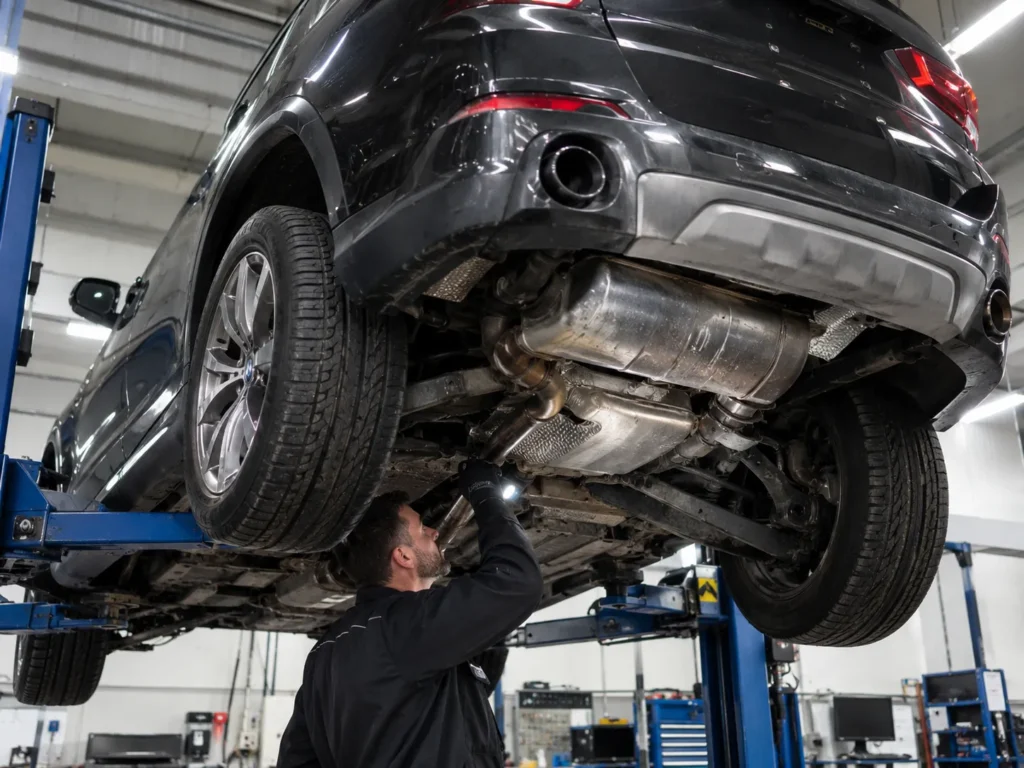
BMW DPF problems are among the most common issues owners of BMW diesel models face, from the 335d and X5 xDrive35d to the 328d and 535d. The diesel particulate filter, or DPF, traps soot from the exhaust so the car can meet strict emissions rules. When it works properly, owners never notice it. When it cannot clean itself, the result can be a warning light, reduced power and an expensive repair bill.
In this guide we explain how a BMW DPF works, why it clogs, which warning signs and fault codes to watch for, what BMW’s own service bulletin says about regeneration, how the problem is fixed and why removing the filter is not a legal solution in the United States. The technical details are based on BMW service information filed with NHTSA, EPA guidance and published explanations from diesel specialists.
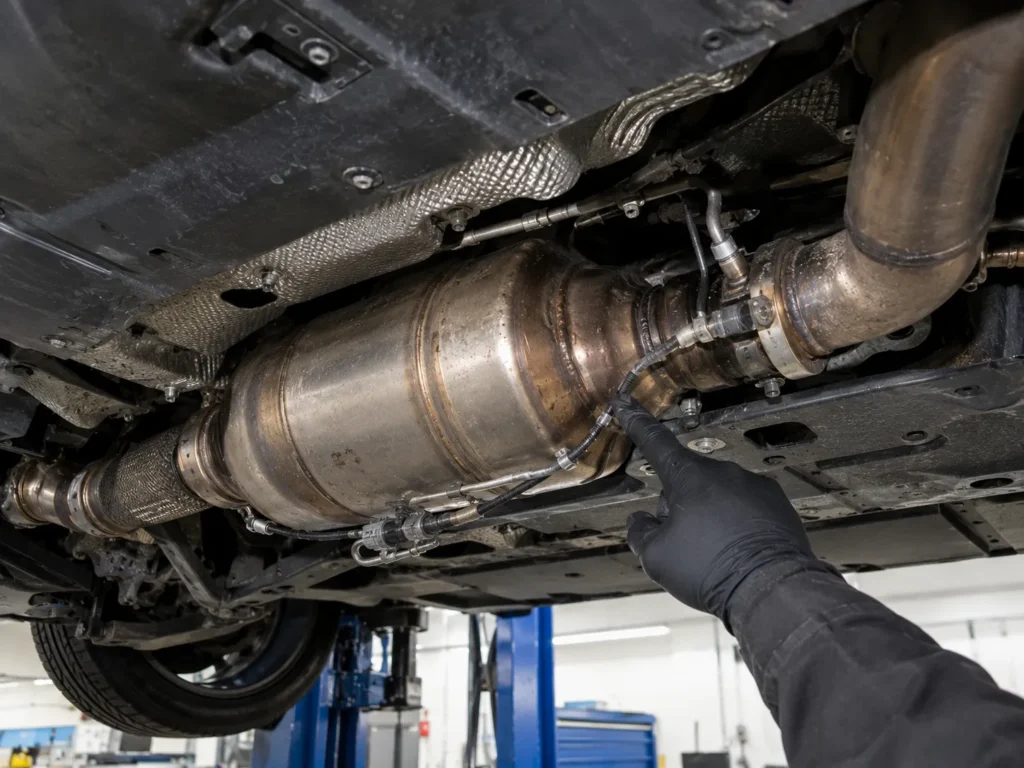
Table of Contents
- What Is a DPF and How Does It Work?
- How BMW Regenerates the DPF
- BMW Diesel Models in the United States
- Common Causes of BMW DPF Problems
- Short Trips and Low-Speed Driving
- Exhaust System and Sensor Faults
- Engine Problems That Create Extra Soot
- Ash Accumulation at High Mileage
- Warning Signs and Symptoms
- How to Fix BMW DPF Problems
- Repair Costs
- Is It Legal to Remove a BMW DPF?
- How to Prevent BMW DPF Problems
- DPF Versus AdBlue
- Buyer’s Advice: Checking a Used BMW Diesel
- FAQ
- How often does a BMW diesel regenerate the DPF?
- Can I drive my BMW with a DPF warning?
- Will a highway drive clean a BMW DPF?
- What are the BMW DPF fault codes?
- Is a DPF delete legal in the US?
- How long does a BMW DPF last?
- Do short trips damage a BMW DPF?
- Conclusion
What Is a DPF and How Does It Work?
A diesel particulate filter is a ceramic honeycomb fitted in the exhaust system. According to Rick’s Free Auto Repair Advice, its channels are alternately plugged, so exhaust gas has to pass through the porous walls, where soot particles are trapped. Over time the trapped soot builds up and restricts exhaust flow, so the filter has to be cleaned by burning the soot off. That process is called regeneration.
How BMW Regenerates the DPF
BMW explains the process in service bulletin SI B18 03 10, which is summarized on CarComplaints from the NHTSA filing. During normal driving, continuous regeneration takes place at exhaust temperatures of roughly 280 to 350 degrees Celsius. In addition, the engine control unit, called the DDE, starts a periodic regeneration at the latest after about 600 miles, or after about 250 to 500 miles on cars that make many short trips.
During a periodic regeneration, BMW says the throttle reduces the incoming air, one or two extra post-injections of fuel take place and the exhaust temperature rises to about 600 degrees Celsius so the soot can burn off. In most cases the process runs in the background while the car is being driven.
BMW Diesel Models in the United States
BMW sold diesel models in the US for about a decade. According to The Autopian, the diesel return began with the 335d and X5 xDrive35d for the 2009 model year, the 535d followed for 2014, and the 540d xDrive arrived in 2018. BMW then discontinued its entire US diesel range for the 2019 model year.
| Model | Engine family | Typical BMW DPF fault codes |
|---|---|---|
| 335d, X5 xDrive35d (E70) | M57 six-cylinder | 480A, 481A |
| 328d | N47 four-cylinder | 245700, 245800 |
| 535d, X5 xDrive35d (F15) | N57 six-cylinder | 245700, 245800 |
| 540d xDrive | B57 six-cylinder | Model-specific, read with a BMW-capable scan tool |
The fault codes listed for the M57, N47 and N57 engines come from BMW’s bulletin SI B18 03 10. Because all of these cars are now used vehicles, many are reaching the age and mileage where BMW DPF problems become more likely.
Common Causes of BMW DPF Problems
Short Trips and Low-Speed Driving
The most common cause of BMW DPF problems is a driving pattern that never lets the filter get hot enough. BMW’s bulletin lists an “unfavorable recent driving profile” as a cause and specifically mentions “prolonged short trips or an exhaust system which never reaches soot burn-off temperatures.” A car used mainly for short city trips may start a regeneration but never finish it, so soot keeps building up.
Exhaust System and Sensor Faults
BMW’s bulletin also lists faults in the exhaust system that affect how the DDE monitors the DPF. The engine computer relies on exhaust temperature and pressure readings to decide when to regenerate. If a sensor or one of its lines gives incorrect information, regeneration may not start when it should, or the filter may be reported as blocked when it is not.
Engine Problems That Create Extra Soot
Anything that makes the engine produce more soot than normal loads the filter faster. Diesel specialists commonly point to worn or leaking injectors, a faulty EGR valve, boost leaks and turbocharger problems. In these cases, cleaning the DPF only treats the symptom, and the filter will clog again unless the engine fault is repaired first.
Ash Accumulation at High Mileage
Regeneration burns off soot, but it cannot remove ash, which comes mainly from engine oil additives. Ash builds up slowly over the life of the filter. Rick’s Free Auto Repair Advice notes that most systems call for removal and cleaning of the DPF typically every 100,000 to 125,000 miles, and that some filters are designed to be replaced rather than cleaned. Using the correct low-ash diesel engine oil specified by BMW helps slow this process.
Warning Signs and Symptoms
BMW DPF problems usually develop gradually. Owners and specialists commonly report the following signs:
- The Service Engine Soon or check engine light comes on, which BMW lists as the main symptom in its bulletin
- Noticeably reduced power or the engine running in a limited power mode
- Higher fuel consumption than usual
- The cooling fan running for longer after the engine is switched off, which can indicate frequent regeneration attempts
- A strong, hot smell from the exhaust after driving
- Stored fault codes such as 245700, 245800, 480A or 481A on a BMW-capable scan tool
According to BMW’s bulletin, codes 245700 and 245800 on N47 and N57 engines indicate that the filter is highly loaded or heavily contaminated with high exhaust back pressure. Codes 480A and 481A on the M57 indicate heavy contamination with back pressure that is too high or above maximum.
How to Fix BMW DPF Problems
The right fix for BMW DPF problems depends on how far the issue has progressed. In general, specialists work through these steps in order, from the least to the most expensive:
- Read the fault memory: use a BMW-capable diagnostic tool to read the exact DDE codes and soot load data, not only generic OBD-II codes.
- Repair the root cause: fix any sensor, injector, EGR or boost leak problem first, otherwise the filter will clog again.
- Allow a regeneration: if the soot load is not too high, a longer drive at steady highway speed can allow the DDE to complete a regeneration.
- Service regeneration: a dealer or specialist can command a regeneration with diagnostic software when the soot level allows it.
- Clean or replace the filter: if the filter is heavily loaded or full of ash, it must be professionally cleaned or replaced.
Repair Costs
Costs vary widely. Reading codes and fixing a sensor or line is relatively inexpensive. A service regeneration costs more because of diagnostic time. Professional cleaning of the filter is a mid-level repair, while a new DPF is one of the most expensive exhaust repairs on a BMW diesel, often running into the thousands of dollars. Acting early, before the filter is badly blocked, keeps costs much lower.
Is It Legal to Remove a BMW DPF?
Some owners consider removing the filter, often called a DPF delete, as a cheap way to avoid BMW DPF problems. In the United States, that is not a legal option for a road car. According to the EPA enforcement alert on tampering and defeat devices, the Clean Air Act prohibits knowingly removing or rendering inoperative emissions controls, and it lists diesel particulate filters, EGR systems and SCR systems among the protected parts.
The same alert explains that the ban also covers manufacturing, selling or installing parts that bypass or defeat emissions controls, and that civil penalties can reach $4,819 per device or per tampered vehicle, based on figures in effect as of January 2020. The EPA also states that vehicles with defeat devices can produce significantly more air pollution than compliant vehicles. A properly working or professionally cleaned DPF is the only lawful solution for a car used on public roads.
How to Prevent BMW DPF Problems
The best way to avoid BMW DPF problems is to give the filter the conditions it needs to clean itself. These habits make a real difference:
- Include regular longer drives: a steady highway drive allows the exhaust to reach regeneration temperature, especially for cars used mainly for short trips.
- Do not interrupt regeneration repeatedly: switching off the engine during a regeneration, again and again, leaves soot behind.
- Use the correct engine oil: choose the low-ash diesel oil BMW specifies, which reduces ash build-up in the filter.
- Fix engine faults quickly: injector, EGR, boost and sensor problems should be repaired before they overload the filter.
- Watch for early warnings: a check engine light or a drop in power should be checked before the filter becomes heavily blocked.
DPF Versus AdBlue
BMW’s US diesel models also use selective catalytic reduction with diesel exhaust fluid, commonly known as AdBlue. That system reduces nitrogen oxides and is separate from the DPF, which traps soot. A warning about diesel exhaust fluid is a different issue from a DPF warning, although both are part of the same emissions system and are protected under the Clean Air Act.
For more on owning a BMW diesel, read our BMW 535d reliability report. Owners dealing with other warning messages may also find our guides to the BMW coolant level low warning and the BMW increased battery discharge warning useful.
Buyer’s Advice: Checking a Used BMW Diesel
A used BMW diesel can be an excellent long-distance car, but the DPF should be part of every inspection. Before buying, follow these steps:
- Scan the car with a BMW-capable tool and check for stored DPF and exhaust faults.
- Ask for service records, including any DPF cleaning or replacement.
- Ask how the car was used. A car used mainly for short trips is at higher risk.
- Check that the original emissions equipment is present and has not been removed or modified.
- Take a test drive long enough to check for smooth power and no warning lights.
FAQ
How often does a BMW diesel regenerate the DPF?
According to BMW service information, the engine control unit starts a periodic regeneration at the latest after about 600 miles, or after about 250 to 500 miles on cars that make many short trips. Continuous regeneration also takes place during normal driving.
Can I drive my BMW with a DPF warning?
Short drives to a specialist are usually possible, but continued driving with a blocked filter is not recommended. As soot builds up, back pressure rises, power drops and the filter can become too loaded for a normal regeneration, which increases repair costs.
Will a highway drive clean a BMW DPF?
Often, yes, if the filter is not heavily blocked. A steady drive allows the exhaust to reach the temperatures needed for regeneration. If the filter is heavily loaded or the warning does not clear, the car needs diagnosis.
What are the BMW DPF fault codes?
BMW’s bulletin lists 245700 and 245800 for N47 and N57 engines, and 480A and 481A for the M57 engine. Generic OBD-II scanners may show different codes, so a BMW-capable tool gives the most accurate information.
Is a DPF delete legal in the US?
No. The EPA states that the Clean Air Act prohibits removing or disabling emissions controls such as diesel particulate filters on road vehicles, and penalties can apply to both the installer and the vehicle.
How long does a BMW DPF last?
A DPF can last a long time, and BMW DPF problems stay rare, when the car is driven in a way that allows regular regeneration, but ash slowly builds up over its life. Rick’s Free Auto Repair Advice notes that most systems call for removal and cleaning of the filter typically every 100,000 to 125,000 miles, while some filters are designed to be replaced instead of cleaned.
Do short trips damage a BMW DPF?
Short trips do not damage the filter immediately, but they are the main cause of BMW DPF problems because the filter becomes blocked. BMW’s own service information lists prolonged short trips and an exhaust system that never reaches soot burn-off temperatures as conditions that can restrict the DPF. Adding a regular longer drive helps the filter clean itself.
Conclusion
BMW DPF problems are usually caused by short trips that prevent regeneration, sensor or exhaust faults, engine problems that create extra soot or ash build-up at high mileage. BMW’s own service information explains how the system regenerates and which fault codes to watch for. Regular longer drives, the correct oil, quick repairs of engine faults and early diagnosis are the best ways to keep a BMW diesel running cleanly and avoid an expensive filter replacement.