Mercedes-AMG E63 S reliability is one of the most searched questions among American enthusiasts shopping for a used super sedan, and for good reason. Few cars combine a hand-built V8, four-door practicality and supercar-rivaling acceleration the way the E63 does, yet few cars can also generate repair invoices as large as a well-used example. Between the naturally aspirated W211, the twin-turbo W212 and the all-wheel-drive W213, the E63 nameplate covers three very different engines, two transmission philosophies and nearly two decades of technology.
This guide breaks down the known weak points of each generation, drawing on Mercedes-AMG technical data, published road tests, service bulletins and the long-running owner discussions on enthusiast forums. The goal is simple: help buyers understand which E63 years carry the biggest risks, which problems are inexpensive annoyances, and what a smart pre-purchase inspection should focus on before any money changes hands.

Table of Contents
- Mercedes-AMG E63 S Reliability at a Glance
- W211 E63 AMG (2007 to 2009): The Naturally Aspirated Original
- Cylinder Head Bolts
- Camshaft and Lifter Wear
- Other W211 Considerations
- W212 E63 AMG (2010 to 2016): Two Engines, One Chassis
- Early M156 Carryover Cars
- M157 Timing Chain and Tensioners
- Other Common M157 Items
- W213 E63 S (2018 to 2023): The Most Robust E63
- M177 Engine Strengths
- Known M177 Weak Points
- Electronics and Chassis
- Maintenance Costs That Shape Mercedes-AMG E63 S Reliability
- Brakes and Tires
- Fluids and Service Intervals
- The Impact of Tuning
- How to Inspect a Used E63 Before Buying
- Generation-Specific Checks
- Universal Checks
- Buyer’s Advice: Which E63 Should You Buy?
- The Enthusiast Who Wants a Classic V8
- The Value-Focused Daily Driver
- The Buyer Who Wants the Best Overall Ownership
- Conclusion: Is the E63 a Reliable Car?
Mercedes-AMG E63 S Reliability at a Glance
Before diving into each generation, it helps to see the three cars side by side. The table below summarizes the core hardware that defines each era, because the engine and transmission are where the largest reliability differences live. If you are new to the brand and want background on what separates an AMG from a regular Mercedes, our explainer on the difference between AMG and Mercedes-Benz is a useful primer.
| Generation | US Model Years | Engine | Output | Transmission | Drive |
|---|---|---|---|---|---|
| W211 E63 AMG | 2007 to 2009 | M156 6.2-liter naturally aspirated V8 | 507 hp / 465 lb-ft | 7-speed automatic | Rear-wheel drive |
| W212 E63 AMG (early) | 2010 to 2011 | M156 6.2-liter naturally aspirated V8 | 518 hp / 465 lb-ft | AMG Speedshift MCT 7-speed | Rear-wheel drive |
| W212 E63 AMG (biturbo) | 2012 to 2016 | M157 5.5-liter twin-turbo V8 | 518 to 577 hp | AMG Speedshift MCT 7-speed | RWD, then 4MATIC from 2014 |
| W213 E63 S | 2018 to 2023 | M177 4.0-liter twin-turbo V8 | 603 hp / 627 lb-ft | AMG Speedshift MCT 9-speed | 4MATIC+ all-wheel drive |
In broad terms, the story of E63 durability is one of steady improvement. The early M156 cars have the most serious documented engine concerns, the M157 cars introduced turbocharging with a handful of well-understood fixes, and the M177 in the W213 is generally regarded by owners and independent specialists as the most robust of the three, provided it has been maintained properly.
W211 E63 AMG (2007 to 2009): The Naturally Aspirated Original
The first E63 replaced the supercharged E55 and introduced the M156, AMG’s first engine developed entirely in-house in Affalterbach. With 507 hp and a 7,200 rpm character, it delivered a 0-60 mph time of about 4.4 seconds according to published specifications. It is a thrilling engine, but it is also the source of the two most discussed problems in E63 history.
Cylinder Head Bolts
M156 engines built from roughly 2007 through 2011 are associated with head bolt failures. The original torque-to-yield bolts could stretch or break, which in turn allowed coolant to enter the cylinders and, in the worst cases, led to catastrophic engine damage. Mercedes later revised the bolts, and owner forums commonly reference a specific engine serial number range after which the updated hardware was used. Buyers should ask for documentation showing the head bolts were replaced or confirm the engine number falls after the revision. Warning signs include unexplained coolant loss, white exhaust smoke and misfires on startup.
Camshaft and Lifter Wear
The second M156 weakness is premature wear of the camshaft lobes and valve lifters. A 2011 class action lawsuit alleged a defect in the camshafts and lifters of 2007 to 2011 AMG models, although the case was dismissed in 2012 on procedural grounds. Regardless of the legal outcome, the symptom is well documented: a ticking noise on cold start that grows louder over time. Correcting it typically requires new camshafts and lifters, which is a labor-intensive job.
Other W211 Considerations
- Airmatic air suspension components age and eventually leak, a common trait of Mercedes models from this era.
- The 7-speed automatic is generally durable, but fluid service is often neglected by previous owners.
- Age-related items such as engine mounts, rubber hoses and interior electronics should be expected on any car of this vintage.
From a Mercedes-AMG E63 S reliability perspective, the W211 is the highest-risk generation simply because of age and the M156’s known issues. It remains a rewarding purchase for buyers who verify the head bolt fix and budget for a camshaft job.
W212 E63 AMG (2010 to 2016): Two Engines, One Chassis
The W212 generation is really two cars. The 2010 and 2011 models kept the naturally aspirated 6.2-liter M156, now rated at 518 hp and paired with the new AMG Speedshift MCT 7-speed, which replaced the torque converter with a wet multi-disc start-up clutch. From 2012, AMG switched to the M157 5.5-liter twin-turbo V8. For 2014, the facelifted car added 4MATIC all-wheel drive and an S-Model with 577 hp and 590 lb-ft of torque, while the standard car produced 550 hp and 531 lb-ft. Mercedes quoted 3.5 seconds to 60 mph for the S-Model.
Early M156 Carryover Cars
The 2010 and 2011 cars share the same head bolt and camshaft concerns as the W211. Because these engines sit at the end of the affected production window, some will already have the updated bolts from the factory while others will not. Verification is essential.
M157 Timing Chain and Tensioners
The M157 is widely considered a stronger engine, but early versions had a timing chain issue. On 2012 and 2013 cars in particular, oil could drain from the tensioner when the engine sat, leading to chain slap at startup and, over time, a stretched chain. Mercedes addressed this with revised tensioners, guides and a check valve, and later service information covered the startup rattle. Long cranking, a brief rattle on cold start and timing-related fault codes are the symptoms to watch for.
Other Common M157 Items
- Spark plugs and coils: Turbocharged engines wear plugs faster, especially when tuned. Misfires under boost are an early sign.
- Valve cover and timing cover leaks: Oil seepage around the front covers is common and labor-intensive to reseal.
- Coolant hoses: Age and heat cycles cause leaks that must be addressed quickly to avoid overheating.
- MCT behavior: Some owners report jerky low-speed engagement, often improved with software updates and fresh fluid.
For shoppers prioritizing Mercedes-AMG E63 S reliability on a budget, a 2014 to 2016 W212 with the M157 and documented service history is often viewed as the sweet spot of the older cars. Owners also point to rear Airmatic struts, control arm bushings and, on cars from salted states, rear subframe corrosion as items worth inspecting.
W213 E63 S (2018 to 2023): The Most Robust E63
The W213 E63 S arrived for the 2018 model year with the M177 4.0-liter twin-turbo V8, rated at 603 hp and 627 lb-ft, a 9-speed AMG Speedshift MCT and the 4MATIC+ system with a variable torque split and a rear-drive Drift Mode. Mercedes quoted 0-60 mph in 3.3 seconds for the sedan and 3.4 seconds for the wagon, which was also sold in the United States. The model ended with the 2023 Final Edition, as the next E-Class moved away from a V8 for its AMG variants, a change reported by Motor Authority.
M177 Engine Strengths
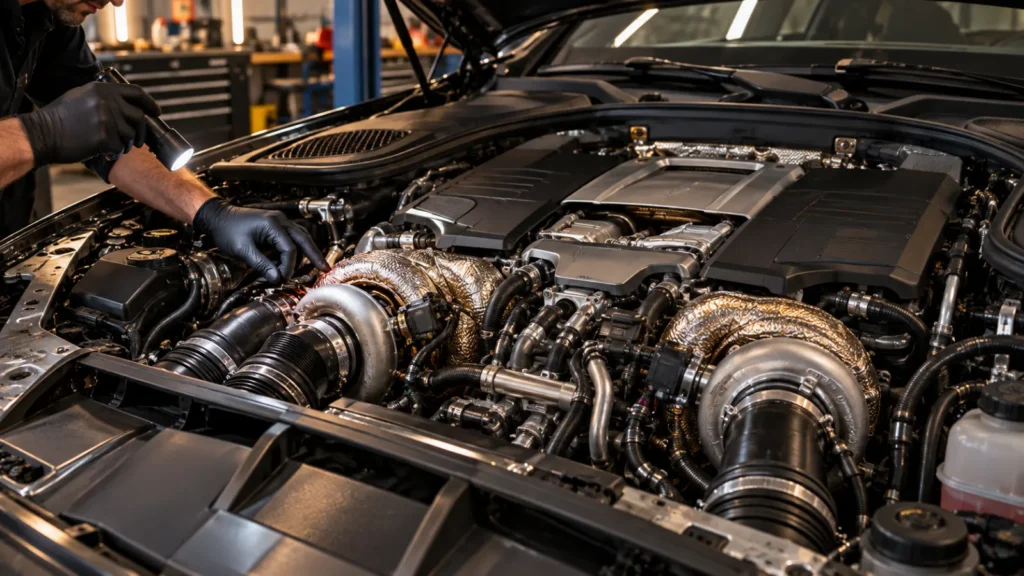
The M177 uses a hot-vee layout with the turbochargers mounted between the cylinder banks, and it shares its basic architecture with the AMG GT and the C63 S of the same period. Independent specialists generally describe it as the most durable of the three E63 engines, with no systemic failure comparable to the M156 head bolts. That is a major reason Mercedes-AMG E63 S reliability improved so noticeably with this generation. Our separate deep dive on C63 AMG reliability covers many of the same M177 traits.
Known M177 Weak Points
- Turbo oil feed lines: The hot-vee layout exposes oil lines and seals to intense heat. Seepage, an oil smell after driving and light smoke at cold start are typical signs, usually at higher mileage.
- Spark plugs and ignition coils: Like the M157, the M177 is sensitive to worn plugs, especially with an ECU tune.
- Intake valve carbon buildup: As a direct-injection engine, deposits can accumulate on intake valves over time, reducing smoothness.
- Cooling system: Water pumps and thermostats should be monitored as mileage climbs, since overheating is particularly harmful to aluminum heads.
Electronics and Chassis
The W213 carries far more electronics than earlier cars, including digital displays, driver assistance systems and air suspension. Software-related glitches are among the more common owner complaints, and many are resolved with dealer updates. Buyers should check the car’s recall status through the NHTSA recall database using the VIN before purchase.
Maintenance Costs That Shape Mercedes-AMG E63 S Reliability
Much of what owners call poor reliability is really deferred maintenance catching up with a car. The E63 is engineered for high performance, and it expects high-performance care. Several cost categories deserve attention regardless of generation.
Brakes and Tires
High-performance brakes are expensive, and cars equipped with optional carbon-ceramic rotors can carry replacement costs far higher than steel setups. Wide, staggered performance tires also wear quickly on a heavy, powerful sedan. Checking rotor condition and remaining tire tread can reveal thousands of dollars in near-term expenses.
Fluids and Service Intervals
- Engine oil changes at or before the factory interval, with many specialists recommending shorter intervals for hard-driven turbo cars.
- Transmission fluid service on the MCT, which is often skipped because it is not always emphasized by previous owners.
- Transfer case and differential fluid on 4MATIC and 4MATIC+ cars.
- Coolant and brake fluid replacement on schedule.
The Impact of Tuning
Both the M157 and M177 respond strongly to ECU tunes, and many used E63s on the market have been modified. A tune increases stress on plugs, coils, turbochargers, the transmission clutch packs and the drivetrain. A stock or professionally tuned car with records is preferable to one with an unknown modification history.
How to Inspect a Used E63 Before Buying
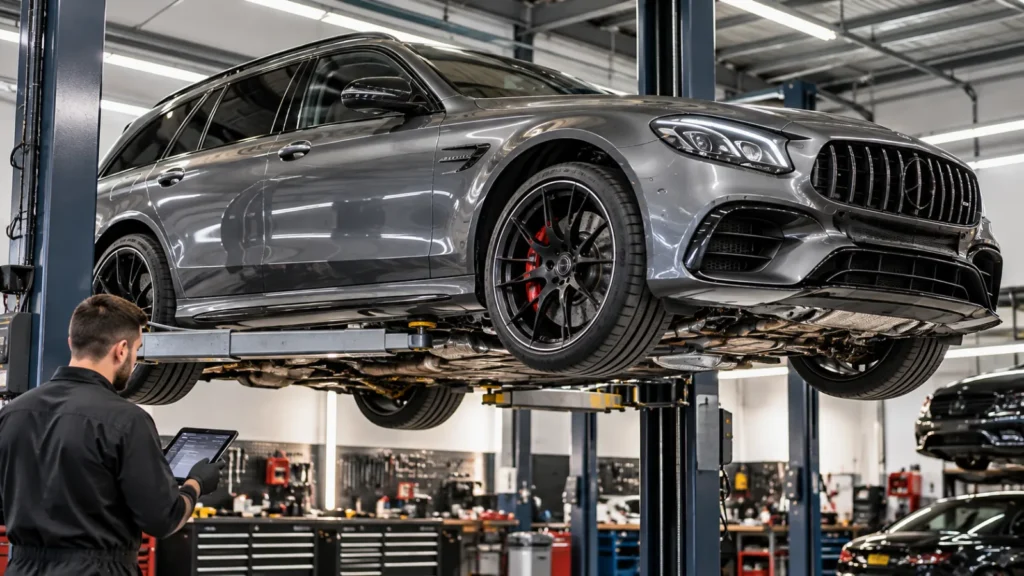
A thorough pre-purchase inspection at an independent Mercedes-AMG specialist or a dealer is the single best investment an E63 buyer can make. When it comes to Mercedes-AMG E63 S reliability, what a specialist finds on the lift matters far more than mileage alone. The inspection should be tailored to the generation in question.
Generation-Specific Checks
- W211 and 2010 to 2011 W212: Confirm the head bolt revision by engine number or records, listen for cold-start camshaft ticking and perform a coolant pressure test.
- 2012 to 2016 W212: Listen for startup chain rattle, check timing-related fault codes and inspect for oil leaks around the covers.
- W213: Inspect for turbo oil line seepage, scan for stored misfire codes, verify software updates and check for open recalls.
Universal Checks
- A full diagnostic scan of all modules, not only the engine.
- Air suspension behavior, including ride height after the car sits overnight.
- Underbody corrosion, especially on cars from the Northeast and Midwest.
- Complete service records showing oil changes and transmission service.
Buyer’s Advice: Which E63 Should You Buy?
The right E63 depends on budget, risk tolerance and what kind of driving experience matters most. Here is how the generations compare for different buyers. For a broader look at what makes the model special, see our feature on why the Mercedes-AMG E63 is a sedan that scares supercars.
The Enthusiast Who Wants a Classic V8
The W211 and early W212 offer the naturally aspirated M156 soundtrack that many consider one of the best V8s of the century. These cars make the most sense for buyers who verify the head bolt repair, budget for a possible camshaft job and plan to keep the car as a weekend machine rather than a daily driver.
The Value-Focused Daily Driver
A 2014 to 2016 W212 E63, particularly an S-Model with 4MATIC, delivers serious performance and all-weather usability for a fraction of its original price. The revised M157 timing components make the later cars a more sensible bet than the 2012 and 2013 models.
The Buyer Who Wants the Best Overall Ownership
The W213 E63 S is the clear choice for buyers who want the strongest balance of performance and dependability. Strong Mercedes-AMG E63 S reliability, modern safety technology and the option of a wagon body make it the most complete E63, though purchase prices remain the highest of the three generations.
Conclusion: Is the E63 a Reliable Car?
The honest answer is that Mercedes-AMG E63 S reliability depends heavily on generation and history. The M156 cars carry real, well-documented engine risks that demand verification. The M157 cars resolved most of those concerns but introduced early timing chain issues that later production fixed. The M177-powered W213 is broadly regarded as the most dependable E63 ever built, with its weak points mostly limited to manageable maintenance items.
Across all three generations, the most reliable E63 is the one with complete records, a clean pre-purchase inspection and an owner who treated it as the precision machine it is. Buyers who do their homework, choose the right year and budget for proper maintenance can enjoy one of the most rewarding super sedans ever produced without unpleasant surprises.