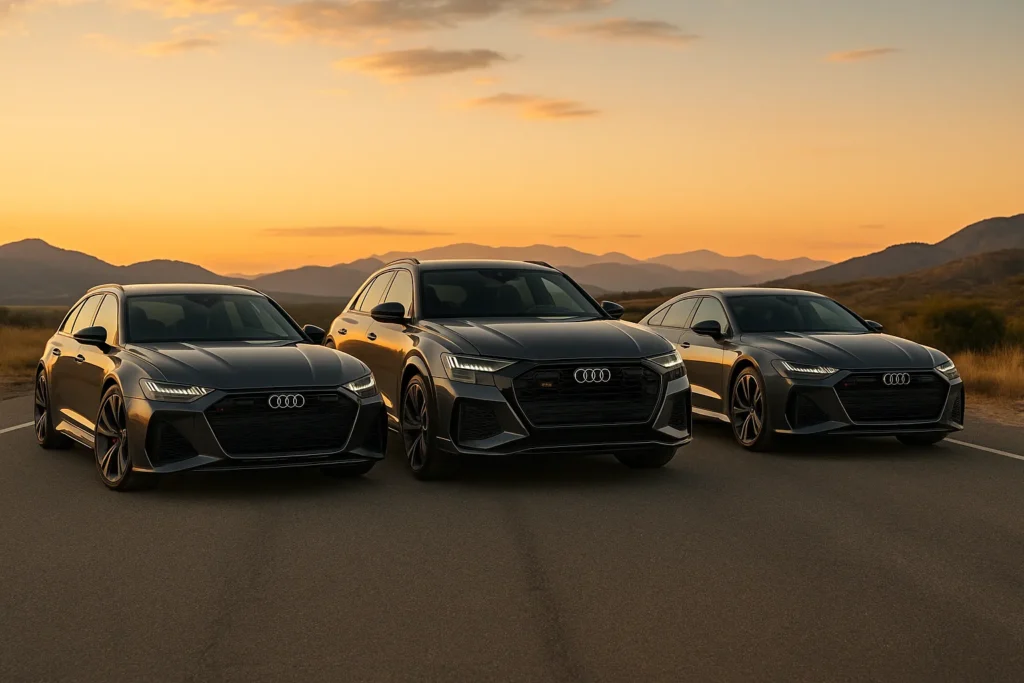
When you think of luxury performance, Audi RS models sit near the top of the food chain. Developed by Audi Sport GmbH, the RS lineup combines supercar performance, everyday practicality and sophisticated design, making these some of the most versatile performance cars in the world. From the compact RS3 to the iconic RS6 Avant and the electric RS e-tron GT, RS cars deliver speed you can use every day, in every season.
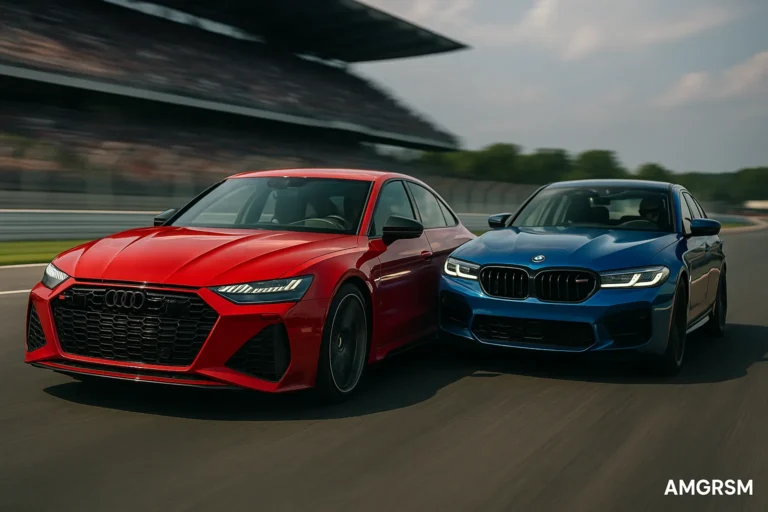
In this guide we explain what RS means, look at the history of Audi Sport, review the key models, explore the features that define every RS car and compare them with their rivals. For a direct brand battle, read our Audi RS vs BMW M comparison.
Table of Contents
- What Does RS Mean on Audi?
- A Short History of Audi RS
- Key Audi RS Models
- A Closer Look at the Lineup
- Audi RS3
- Audi RS6 Avant
- Audi RS7 Sportback
- Audi RS Q8
- Audi RS e-tron GT
- Audi R8
- Signature RS Features
- Quattro All-Wheel Drive
- Tuned Engines
- Aggressive Styling
- Dual Personality
- Audi RS Models in Motorsport
- Technology That Matches the Speed
- Daily Usability
- Audi RS vs the Competition
- Why Buyers Choose Audi RS Models
- Ownership Costs
- Which Audi RS Model Should You Buy?
- Frequently Asked Questions
- Are Audi RS models reliable?
- What is the difference between Audi S and RS models?
- Final Thoughts
What Does RS Mean on Audi?
The Audi RS meaning is simple: RS stands for RennSport, which is German for racing sport. RS cars are the most extreme versions of Audi’s lineup, sitting above the sporty S models. They are developed by Audi Sport GmbH, which was known as quattro GmbH until 2016. In other brands, the equivalent would be BMW M, Mercedes-AMG or Porsche’s Turbo and GTS models.
A Short History of Audi RS
Audi’s performance story began with the Quattro of the 1980s, which brought all-wheel drive to rallying and changed the sport forever. The first RS model, the RS2 Avant, arrived in 1994. Developed together with Porsche, it combined a turbocharged five-cylinder engine with Quattro all-wheel drive in a practical wagon body and shocked the world with its performance. It was followed by the RS4 Avant in 1999, which established the fast Audi wagon as a legend.
Since then, Audi has built RS versions of almost every model line. The RS6 Avant became an icon, especially after Audi finally brought it to the United States for the 2021 model year. The R8 supercar, with its naturally aspirated V10, carried the performance halo until production ended in 2024.
Key Audi RS Models
| Model | Engine | Output | 0-60 mph (approx.) |
|---|---|---|---|
| RS3 Sedan | 2.5L turbo five-cylinder | 401 hp | 3.6 sec |
| RS5 Sportback/Coupe (B9) | 2.9L twin-turbo V6 | 444 hp | 3.8 sec |
| RS6 Avant Performance | 4.0L twin-turbo V8 | 621 hp | 3.3 sec |
| RS7 Performance | 4.0L twin-turbo V8 | 621 hp | 3.3 sec |
| RS Q8 Performance | 4.0L twin-turbo V8 | 631 hp | 3.4 sec |
| RS e-tron GT Performance | Dual electric motors | Over 900 hp with boost | Under 2.5 sec |
| R8 V10 (final models) | 5.2L naturally aspirated V10 | 562 to 602 hp | About 3.1 sec |
The RS lineup spans sedans, coupes, wagons, SUVs, electric cars and, until recently, a mid-engine supercar.
A Closer Look at the Lineup
Audi RS3
The RS3 is the entry point to the RS family and one of the most exciting compact cars on sale. Its five-cylinder engine delivers a unique sound, and the RS torque splitter makes it more agile than any previous RS3. It is a practical sedan that can keep up with much more expensive sports cars. See how it compares in our Audi RS3 vs BMW M240i guide.
Audi RS6 Avant
The RS6 Avant is perhaps the most famous RS model of all. It combines a twin-turbo V8, Quattro all-wheel drive and a huge cargo area in a wagon body with wide fenders and an aggressive stance. In the US it has become a cult favorite among enthusiasts with families, and the limited RS6 Avant GT celebrated the model with motorsport-inspired details.
Audi RS7 Sportback
The RS7 shares its powertrain with the RS6 but wraps it in a sleek fastback body. It is a stylish grand tourer that offers comfort, technology and supercar-level acceleration. Read our full Audi RS7 Sportback review.
Audi RS Q8
The RS Q8 is Audi’s performance SUV, sharing much of its engineering with the Lamborghini Urus and the Porsche Cayenne. The RS Q8 Performance raises output to 631 hp and adds carbon ceramic brakes and advanced chassis technology, making it one of the fastest SUVs available.
Audi RS e-tron GT
The RS e-tron GT shows how Audi Sport sees the electric future. Sharing its platform with the Porsche Taycan, it uses dual motors and an 800-volt architecture for fast charging. The latest Performance version delivers more than 900 hp with launch boost, making it the most powerful production Audi ever.
Audi R8
The R8 was Audi’s mid-engine supercar, powered in its final form by a naturally aspirated 5.2-liter V10. Production ended in 2024 with the limited R8 GT, closing an important chapter in Audi history. Today used R8 models are increasingly valued by collectors.
Signature RS Features
Quattro All-Wheel Drive
Quattro is at the heart of nearly every RS model. It delivers outstanding traction in rain, snow and on dry roads, allowing RS cars to use their power effectively. Modern versions, like the torque splitter in the RS3, can actively send power to the outside rear wheel in corners for sharper handling.
Tuned Engines
Each RS model uses an engine tuned specifically for it, designed to deliver strong low-end torque and exciting high-rev power. The five-cylinder engine is a particular highlight and a direct link to Audi’s rally heritage.
Aggressive Styling
Wider fenders, honeycomb grilles, RS-specific wheels, oval exhaust tips and large brakes give RS cars a muscular presence. On the RS6 Avant, only a few body panels are shared with the regular A6 wagon.
Dual Personality
Despite their power, RS models remain refined. Drivers can cruise in Comfort mode or switch to Dynamic mode for maximum response, and the RS1 and RS2 buttons on newer models allow instant access to favorite settings.
Audi RS Models in Motorsport
Audi’s racing success gives the RS badge real credibility. The Quattro dominated the World Rally Championship in the early 1980s, and the Audi Sport team later won the 24 Hours of Le Mans many times with its R8, R10 and R18 prototypes, including pioneering diesel and hybrid race cars. In customer racing, the R8 LMS GT3 and RS3 LMS touring car have won championships around the world. Lessons from these programs, from all-wheel-drive control to lightweight construction and efficient turbocharging, have shaped the road-going RS models that buyers can drive today. Audi’s entry into Formula 1 continues that tradition.
Technology That Matches the Speed
Audi RS interiors blend sport and sophistication. Highlights include the Audi virtual cockpit with RS-specific graphics and shift lights, sport seats in Nappa leather or Alcantara, carbon fiber and aluminum trim, head-up displays, adaptive cruise control and night vision on larger models. RS cars are loaded with technology without feeling overwhelming.
Daily Usability
What sets RS apart is usability. All-wheel-drive confidence in snow and rain, spacious cabins and large cargo areas, especially in the RS6 Avant, and excellent infotainment make RS cars easy to live with every day. Whether it is a school run or a track day, an RS model can handle both.
Audi RS vs the Competition
| Rival brand | Example matchup |
|---|---|
| BMW M | RS5 vs M4 Competition |
| Mercedes-AMG | RS6 Avant vs E63 S Wagon |
| Porsche | RS7 vs Panamera Turbo S |
| Lamborghini | RS Q8 vs Urus |
RS cars often offer all-wheel drive as standard and include more comfort features than some rivals.
Why Buyers Choose Audi RS Models
Owners often describe RS cars as the perfect one-car solution. They are fast enough to satisfy enthusiasts, comfortable enough for long commutes, practical enough for families and discreet enough for buyers who prefer not to draw attention. That combination is rare among high-performance cars, and it explains why Audi RS models have such a loyal following around the world.
Ownership Costs
As with any high-performance car, RS models cost more to run than regular Audis. Premium fuel, performance tires, large brakes and specialist servicing are part of the package. Larger RS models with air suspension and carbon ceramic brakes can be especially expensive to maintain. Depreciation on the big sedans and SUVs is often steep in the first few years, which makes a lightly used RS model an attractive buy. A complete service history is essential.
Which Audi RS Model Should You Buy?
- Best value: the RS3, which delivers huge performance and character for its price
- Best all-rounder: the RS6 Avant, which combines family space with supercar speed
- Best grand tourer: the RS7 Sportback
- Best SUV: the RS Q8 Performance
- Best for the future: the RS e-tron GT
- Best collector car: the R8, especially the final V10 models
Frequently Asked Questions
Are Audi RS models reliable?
With proper maintenance, RS models can be reliable. The key is following service schedules and buying used cars with documented histories.
What is the difference between Audi S and RS models?
S models are sporty versions of regular Audis, while RS models are the most powerful and focused versions developed by Audi Sport.
Final Thoughts
Audi RS models represent a rare balance of power, polish and practicality. They are cars you can take to a track on Sunday and drive to work on Monday with style and confidence. Whether it is the mighty RS6 Avant, the spirited RS3 or the electric RS e-tron GT, Audi RS is not just about speed. It is about refinement without compromise. Explore the latest lineup on the official Audi USA website.