If you are shopping for a used BMW M3, M4 or M2 Competition, BMW S55 problems are the first thing worth researching. The S55 is the 3.0-liter twin-turbo straight-six that powers the F80 M3, the F82 and F83 M4 and the M2 Competition and M2 CS. It is fast, tunable and, for most owners, dependable. But it has one famous weak point, the crank hub, plus a handful of smaller turbo-era wear items that are easy to price in once you know about them.
This guide covers the real BMW S55 common problems: symptoms, causes, fault codes, repair cost ranges, recalls, the model years to be careful with and a buyer’s checklist. It is written for people comparing cars, not for tuners, and every figure is hedged where the sources disagree. For the wider picture of the car itself, see our overview of the BMW M3.
BMW S55 Problems at a Glance
This table summarizes what owners and independent specialists report most often. Each item is explained below. Costs are rough ranges from published quotes and retailer prices, not guarantees, and the detailed figures are explained in each section.
| Problem | Typical symptoms | How serious | Approx. cost |
|---|---|---|---|
| Crank hub slip | Sudden “Drivetrain Malfunction”, limp mode, rough running, no start | Rare but potentially engine-damaging | Hub upgrade about $2,000–$3,500 (UK £1,950–£2,050); repair after a slip from about $6,000 |
| Plastic charge pipes cracking | Hissing under boost, sudden power loss, boost faults | Common on tuned cars, cheap to fix | Low; labor-only quotes of about $114–$200 on forums |
| Charge cooler coolant loss | Coolant level falling with no puddle, white smoke, power faults | Moderate to serious if ignored | Parts about $800 (OEM-style) to $2,600 (uprated), plus labor |
| Valve cover, oil filter housing and oil pan gasket leaks | Oil smell, oil residue, low oil warning | Age and mileage related | Cheap parts; oil pan gasket needs the subframe lowered |
| Electric water pump and cooling wear | Rising temperature, coolant warning, weak heater | Wear item | About $500 for pump and thermostat (one maintenance guide) |
| Wastegate rattle | Faint rattle under load at low to mid rpm | Mostly a nuisance | Usually nothing unless faults appear |
| Rear differential mount knock | Clunk on load changes, droning in higher gears | Annoyance; covered by a BMW bulletin on early cars | Low to moderate |
| Rod bearing wear | Knocking, low oil pressure (late stage) | Debated; depends on use and oil care | Preventive service about $3,000–$5,000 in North America, £1,500–£2,200 in the UK |
What Is the BMW S55 Engine?
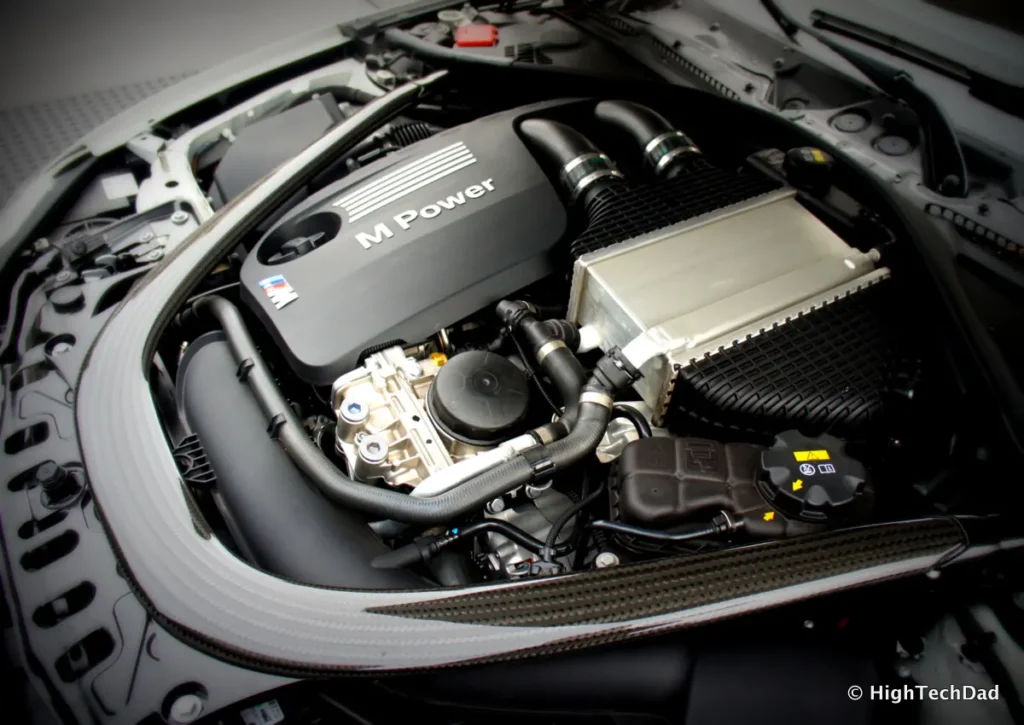
The S55 is BMW M’s high-performance development of the N55 six-cylinder. It replaced the naturally aspirated S65 V8 when the M3 and M4 went turbocharged in 2014. Compared with the N55 it has a closed-deck block, twin turbos, revised cooling and strengthened internals, and it comes with a six-speed manual or a seven-speed M DCT.
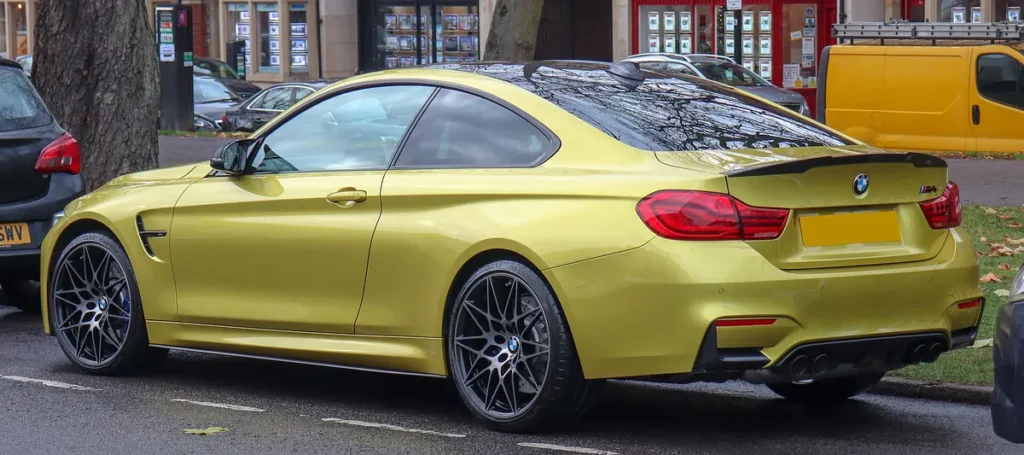
- F80 M3 sedan (2014–2018) and F82 coupe / F83 convertible M4 (2014–2020): about 425 hp (431 PS) as standard, and about 444 hp (450 PS) with the Competition Package.
- M3 CS and M4 CS: about 453 hp. M4 GTS: about 493 hp with water injection.
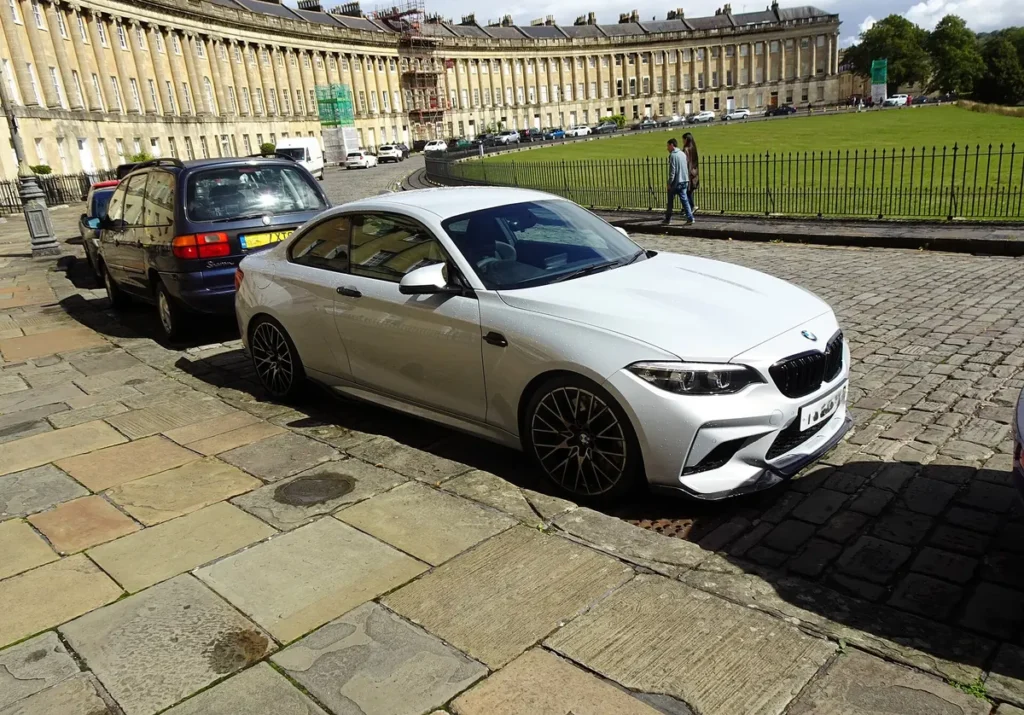
- F87 M2 Competition and M2 CS (from 2018): about 405 hp and 444 hp.
One common point of confusion: the original 2016–2018 BMW M2 does not have an S55. It uses a reinforced N55 that borrows S55 internals, so the crank hub discussion below applies to it far less. The newer G80 M3 and G82 M4 use the S58, the S55’s successor, with a different timing-drive layout, so S55 advice does not transfer directly.
Is the BMW S55 Reliable?
Yes, with caveats. Independent specialists generally describe the S55 as a strong engine and a step up from the S65 V8 in the E9X M3, and many cars cover high mileage without engine work. The caveats are the crank hub design, the plastic and rubber parts around the boost system, and the fact that these cars are often tuned and driven hard. A stock, well-documented example is a very different purchase from a modified car with no paperwork.
If you are weighing it against other performance engines, our guides to Mercedes C63 AMG reliability and BMW N63 engine problems show how it compares with rivals and with BMW’s own twin-turbo V8.
BMW S55 Crank Hub Problems
The crank hub is the single most discussed of all BMW S55 engine problems, so it deserves a careful look.
What the S55 crank hub does and why it can slip
The crank hub sits on the nose of the crankshaft and drives the timing chain. On the S55 it is held on by clamping force and friction rather than by a key or a spline. Under a sharp torque spike, such as a launch, an aggressive high-rpm downshift or a high-power tune, the hub can rotate on the crank. When that happens, camshaft timing moves relative to the crankshaft. In mild cases the engine runs badly and goes into a protective mode. In worse cases the valves and pistons can touch, which is a very expensive repair.
How common is it?
Nobody knows exactly, and BMW has not published a failure rate. Figures online range from well under 1% on stock cars to around 10–20% on heavily tuned cars, but they come from forum summaries and shops, not from BMW or an independent study. The sources do agree on the pattern: risk appears to rise with power, tuning, track use, repeated launches and aggressive downshifts on both manual and DCT cars, while a gently driven stock car sits at the low end. A slip can come with no warning, and reports exist on standard cars too.
Symptoms and fault codes
- A sudden “Drivetrain Malfunction” message, usually right after a hard pull or downshift.
- Engine warning light, limp mode and reduced power.
- Rough idle, misfires, hard starting or no start.
- Camshaft-to-crankshaft position faults. Two BMW codes that specialists commonly report on slipped S55 engines are 130E20 and 130F20 (camshaft offset to crankshaft out of tolerance). BMW has not officially confirmed which codes a slipped S55 hub sets, and a small slip can store nothing, so a clean scan does not clear the hub.
Do not confuse these with BMW’s VANOS oil-pressure codes such as 2A82 and 2A87, which point to a different problem. Our guide to the BMW 2A82 and 2A87 codes explains that fault. If an S55 shows a drivetrain warning after a hard pull, specialists advise not continuing to drive it until the timing has been checked mechanically.
Is there a BMW S55 crank hub recall?
No. We found no BMW recall, service bulletin, warranty extension or published redesign for the S55 crank hub, and we also checked the NHTSA recall lists for the M2, M3 and M4 from 2014 to 2021: none of the campaigns concern engine timing. Owners report mixed warranty outcomes, so treat any claim of free repairs as unverified.
Fixes and what they cost
BMW offers no approved upgraded hub, so every preventive fix is aftermarket. The usual options are a one-piece hub with the timing sprocket integrated (often pinned or keyed to the crank), a spline-lock hub, and a crank bolt capture plate. A capture plate alone is generally described as a partial measure, because it stops the bolt backing off but does not solve friction slip. The strength claims for each hub come mostly from the companies selling them, and independent test data is thin.
Published prices vary widely. UK specialists list supplied-and-fitted pinned one-piece hubs from roughly £1,950 to £2,050. In the US, advertised spline-lock installs run from about $1,750 to $2,600, owners often quote $3,000–$3,500 for a full upgrade, and one specialist estimates $3,000–$7,300 depending on whether the crankshaft is drilled. After a slip, the same specialist estimates about $6,000–$9,000 with no valve contact and $12,000 or more if valves touched the pistons. Treat these as ballpark figures and get a written quote.
Other Common BMW S55 Problems
Plastic charge pipes
The factory plastic charge pipes can crack under boost, particularly on tuned cars. Typical signs are a hissing or whooshing sound under load, a sudden loss of power and boost-related fault codes. The usual fix is a set of aluminum pipes with fresh silicone couplers. It is a short job compared with most items on this list, which is why many owners do it preventively.
Charge cooler coolant loss
The F8x uses an air-to-water charge cooler on top of the engine. Owners and specialists report that the cooler can crack or fail internally, so coolant disappears without any puddle under the car. Warning signs include a falling level in the small charge-cooler reservoir, white smoke, high intake temperatures and drivetrain warnings. Coolant reaching the combustion chamber can turn into an engine-out repair, so a falling level should never be ignored. An OEM-style replacement cooler costs roughly $800 in parts at one US retailer, while uprated aftermarket coolers run from about $1,600 to $2,600, plus labor.
Oil leaks: valve cover, oil filter housing and oil pan gaskets
The S55 shares several gasket designs with the N54 and N55, and rubber gaskets age. Valve cover and oil filter housing gasket leaks are the most likely, typically between about 80,000 and 100,000 miles, although some appear earlier. Symptoms include a burning-oil smell, oil on the spark plug threads, oil on the drive belt and a low oil warning. The parts are cheap, but the oil pan gasket needs the subframe lowered, so labor makes the bill. Fix leaks early to protect the belt, mounts and hot turbo parts.
Electric water pump and cooling system
A twin-turbo M engine makes a lot of heat. The electric water pump, expansion tank and coolant are treated as wear items, and track use stresses them more. Signs include rising temperatures, a coolant warning and a weak heater. If the pump is replaced, ask the shop to change the thermostat at the same time. Our guide to the BMW coolant level low warning explains what to check first.
Wastegate rattle
A faint, brief rattle from the turbos, usually at low to mid rpm under load, is a well-known S55 trait. It is generally more annoying than harmful. Take it seriously only if it is loud or persistent, or comes with boost faults or lost power.
Rear differential mount knock
Some F80, F82, F83 and F87 cars develop a knock from the rear on load reversals, or a droning vibration in higher gears. BMW service bulletin SI B33 03 18 (November 2018) attributes it to the tuning of the rear differential mount and calls for replacing the mount when the noise can be reproduced. It applies to vehicles built up to July 31, 2018.
Rod bearings: debated, not a repeat of the S65
The S65 V8 and S85 V10 are infamous for rod bearing failures. The S55 is generally not seen as having the same flaw, and several specialists say the factory shells last well. Opinion is still divided on preventive replacement: some shops recommend it from roughly 100,000 miles, or sooner on tuned and tracked cars, while others suggest running regular oil analysis and acting on the data. A preventive service typically costs about $3,000–$5,000 at North American specialists and roughly £1,500–£2,200 at a UK independent.
Carbon buildup and the M DCT
Direct injection means fuel does not wash the intake valves, so some owners report carbon buildup that walnut blasting can clean. The seven-speed M DCT is generally considered tough but needs its fluid and filter serviced on schedule.
BMW M3 F80 Problems and BMW M4 F82 Problems by Model Year
People search for BMW M3 F80 problems and BMW M4 F82 problems separately, but both cars share the S55 and the same service layout, so every issue above applies to both, to the F83 convertible and to the M2 Competition. The differences are mainly age, mileage and recalls:
- 2014–2016 cars: the oldest, so the most likely to show gasket leaks and cooling wear. Two small recalls cover narrow production windows.
- 2016–2018 cars: the Competition Package arrived, and 2016–2017 M3 and M4 cars were included in the larger driveshaft recall. F8x cars built up to July 2018 are covered by the differential mount bulletin.
- 2018–2020 cars, CS and M2 Competition: newer and usually lower mileage, with a 2019 knee air bag recall and, on a handful of cars, the 2020 fuel injector recall. The crank hub question is the same on every S55.
BMW M3 and M4 Recalls (NHTSA)
These are the real NHTSA campaigns that list the F8x M cars. Recalls are VIN-specific and often small, so enter the VIN at nhtsa.gov/recalls before buying.
| Campaign | Models and years | Issue | Remedy |
|---|---|---|---|
| 15V-782 | 2015–2016 M3, M4 (narrow production window) | Driveshaft slip-joint may not have been greased | Inspect, replace driveshaft if needed, free |
| 16V-653 | 2016 M2, 2015–2017 M3, 2015–2016 M4 | Rear sub-frame bolts may have been reused after rear differential service | New bolts, free |
| 18V-713 | 2016–2017 M3, M4 and M4 GTS, 2017 M4 convertible | Driveshaft-to-flange connection may fail, loss of propulsion | Replace driveshaft, free; about 2,661 vehicles |
| 19V-352 | 2019–2020 M2 Competition and M4 (certain vehicles) | Knee air bags may be improperly folded | Replace knee air bag modules, free |
| 20V-666 | 2020–2021 M2, 2020 M4 (about 22 vehicles) | Fuel injectors installed without a damping component | Inspect; replace injectors and fuel rail if needed, free |
The recall most worth checking on a 2016–2017 car is 18V-713, because it covers thousands of cars and involves the driveline. Note again that there is no crank hub recall.
BMW S55 Years to Avoid and Best Years
There is no single bad S55 year. BMW has not announced a redesigned crank hub, and forum claims that later cars were “fixed” are not supported by BMW’s own parts data, according to one specialist analysis, so no year is exempt. Condition and history matter more than the model year:
- Be most careful with: any car with an aggressive tune and no paperwork, a track-used car with no oil-analysis or bearing history, and early cars with open recalls or missing service records.
- Generally the safer choice: a later, lower-mileage F80, F82 or M2 Competition with full service history and, ideally, documented crank hub work and fresh fluids.
BMW S55 Buyer’s Checklist
- Run the VIN through NHTSA for open recalls, with extra attention to 18V-713 on 2016–2017 cars.
- Ask directly about tuning, track days and launch control use. Request tune invoices and dyno sheets. A car flashed back to stock is still a car that was tuned.
- Ask whether the crank hub has been upgraded, and who did it. Get the paperwork.
- Scan for stored and historic faults, including camshaft, VANOS, crank sensor and misfire codes, and remember that a clean scan does not prove the hub is fine.
- Check the oil change history, and DCT fluid records if fitted, and ask for oil analysis reports if the car has been tracked.
- Look for cracked charge pipes, and check the charge-cooler reservoir level and the coolant history.
- Inspect the valve cover, oil filter housing and oil pan area for leaks and oil on the drive belt.
- On a test drive, listen for a clunk on load changes (differential mount), a persistent rattle under load and any rough running.
- Have a BMW M specialist do a pre-purchase inspection, ideally including a timing check.
How to Keep an S55 Healthy
- Change oil early. One maintenance guide notes that BMW’s condition-based service can let the oil go up to 10,000 miles or 12 months, but specialists commonly recommend roughly 5,000–7,000 miles, especially for tuned or tracked cars.
- Treat “lifetime” fluids as service items. One maintenance guide recommends DCT fluid at around 40,000 miles and fluid with filters around 80,000, plus brake fluid every two years.
- Replace spark plugs and the two air filters on a schedule. BMW’s reminders do not cover them.
- Go easy on launches and violent downshifts, which stress the crank hub and driveline, and plan any hub upgrade before tuning, not after.
- Fit better charge pipes and fix leaks early if the car is tuned.
For a four-cylinder example of the same idea, see our guide to BMW B48 engine problems.
More guides: Looking for other models and fault codes? Browse our Common Problems & Reliability Guides hub for BMW, Mercedes-AMG and Audi reliability articles.
Frequently Asked Questions
What are the most common BMW S55 problems?
The best-known problem is crank hub slip, followed by cracked plastic charge pipes, charge cooler coolant loss, gasket oil leaks, cooling system wear, wastegate rattle and a rear differential mount knock on early cars.
Is the BMW S55 reliable?
Generally yes. Reliability depends heavily on tuning, track use and maintenance, and a stock, documented car is far safer than a modified one without records.
How much does an S55 crank hub upgrade cost?
Published prices range widely, but a pinned or spline-lock one-piece hub at a specialist is commonly about $2,000–$3,500 in the US, or roughly £1,950–£2,050 in the UK. Prices climb if the crankshaft must be drilled with the engine in the car, so get a written quote that says exactly what is included.
Is there a BMW S55 crank hub recall?
No. We found no recall, service bulletin or warranty extension for the S55 crank hub, and none of the NHTSA recalls listed for the M2, M3 and M4 from 2014 to 2021 concern engine timing.
What are the most common BMW M3 F80 and M4 F82 problems?
Both share the S55, so the list is the same: the crank hub, charge pipe cracks, gasket oil leaks, cooling wear, occasional charge cooler failure and a rear differential mount knock on earlier cars. Recalls differ slightly by year, with 18V-713 the largest, so check the VIN.
Do S55 rod bearings need replacing?
Not automatically. The S55 is not widely viewed as having the S65’s bearing flaw, but some shops recommend a preventive service from around 100,000 miles, or sooner on tuned and tracked cars. Oil analysis and a clean maintenance history are a sensible way to decide.
Which BMW M3 or M4 year is best to buy?
There is no perfect year. A later, lower-mileage car with full history, completed recalls and ideally documented crank hub work is the safest choice.
The Bottom Line on BMW S55 Problems
The S55 is one of the most exciting modern M engines, and the known BMW S55 problems are manageable if you buy with your eyes open. Price in the crank hub question, check the charge pipes and cooling system, ask about tuning and oil care, and verify recalls by VIN. Buy the best-documented, least-modified M3, M4 or M2 Competition you can find and budget for preventive maintenance. If you are still choosing between models, our list of the best BMW M models of all time is a good next read.
Sources and notes: recall data comes from NHTSA records, and the rear differential mount information comes from BMW service bulletin SI B33 03 18 filed with NHTSA. Cost ranges and failure-rate estimates come from published specialist guides, shop price lists and owner reports, and they are not BMW figures. This article is for general information. Always verify details for a specific vehicle with a BMW dealer, a qualified M specialist and official recall databases.